Batteries Broke a Record. Homeowners Were the Asterisk.
The US grid added 20.2 GWh of batteries in three months. Almost none of it sits in a garage, and that gap is the real story.

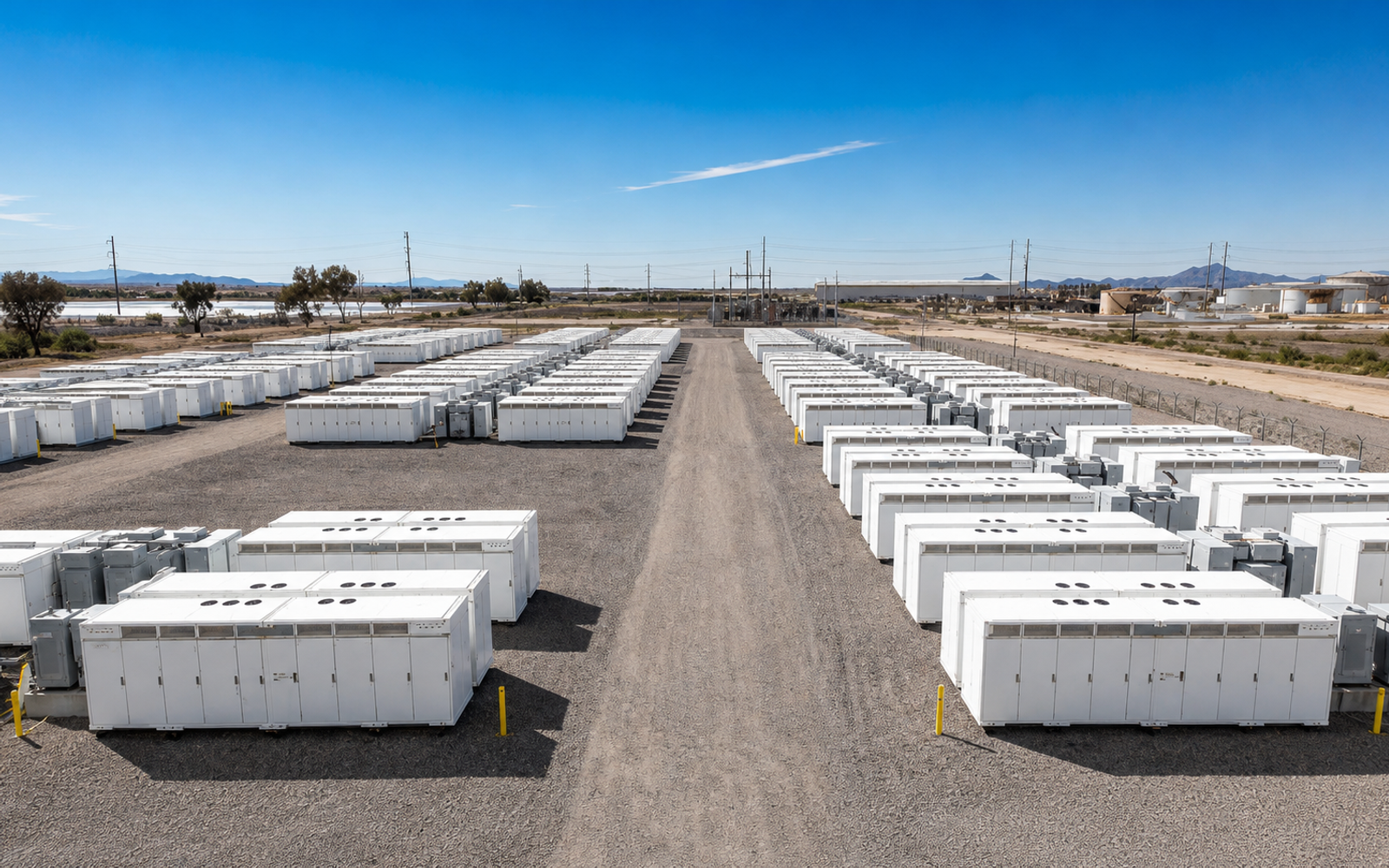
Twenty point two gigawatt-hours is an awkward thing to picture, so start with what it does. That's roughly enough electricity to carry about 700,000 American homes through a day, according to MIT Technology Review, and it all came online in the United States inside three months. The second quarter of 2026 was the largest single quarter of battery deployment in the country's history.
The figures come from the US Energy Storage Market Outlook published at the end of August by the Solar Energy Industries Association and Benchmark Mineral Intelligence. First-half installations reached 30.8 gigawatt-hours, up 23 percent year over year, and the full year is tracking toward roughly 71 gigawatt-hours, a 20 percent jump on 2025. Seven new systems larger than a gigawatt-hour each came online during the quarter, and the same report puts total utility-scale capacity in the country at 165 gigawatt-hours, up from 88 gigawatt-hours eighteen months ago. Shan Tomouk, energy storage and energy lead at Benchmark Mineral Intelligence, said: "It really came down to a handful of big projects."
That concentration is the part worth understanding, because it tells you what the storage market is paying for. The headline rewards a closer look, the same way an index can rally while most of its members fall. A battery doesn't generate electricity. It moves it through time, and the price of that service depends less on how much energy the box holds than on how fast it can shove it into a grid that's losing its footing.
What a Battery Actually Sells to the Grid
A shock absorber is the nearest everyday equivalent. It stores almost nothing in absolute terms, but its value lives entirely in how quickly it can swallow a jolt and how precisely it hands that jolt back. Grid batteries earn most of their money the same way: responding to frequency deviations in milliseconds, holding capacity in reserve for a system operator that needs a promise it can count on, and only then doing the obvious thing of buying cheap midday solar and selling it into the evening peak.
Duration is the dial that governs all of it. Most utility-scale systems in the US today are built for two to four hours, because the grid's daily problem is a four-hour problem. Solar floods the middle of the day and then disappears right as air conditioning load peaks, and rising data center demand has made that evening ramp steeper rather than gentler. A battery that absorbs the flood and releases it at six in the evening is solving the exact problem the system has.
Two forces are pushing the demand. One is the volume of solar and onshore wind being added to the grid, which produces power on a schedule nobody controls. The other is load that has stopped being predictable, including hyperscale AI buildouts that pull power around the clock. Storage is the cheapest tool that answers both ends at once, which is why procurement keeps accelerating quarter after quarter.
Everything downstream follows from scale economics. A one-gigawatt-hour site connects to the grid at a single point, signs one interconnection agreement, and buys one set of transformers, switchgear and breakers. String together three hundred home batteries and you need three hundred interconnections, three hundred permits, and a software layer that has to convince a utility the whole fleet will behave like one machine. On cost per installed kilowatt-hour, the big site wins by a wide margin, and that gap explains the shape of this record far better than any claim about chemistry.
Scale also changes how a project handles degradation. Lithium cells shed capacity over thousands of cycles, so a utility-scale site is designed with augmentation in mind: extra racks, scheduled top-ups, and warranty terms that keep the nameplate figure honest across twenty years. Doing that at one site with a maintenance crew is a line item. Doing it across ten thousand rooftops is a logistics business.
Why Home Batteries Are Still Playing Catch-Up
Behind-the-meter storage did grow in the quarter, but nothing like the utility side, and the reason sits in a tariff rather than in a datasheet. California's net billing tariff, the rule everyone calls NEM 3.0, cut the credit a homeowner earns for exporting solar from something close to the retail rate down to an avoided-cost figure that runs roughly five to eight cents per kilowatt-hour. That's a drop of about 75 percent, and it rewired the design logic of every rooftop system in the state. Installers no longer size panels to export. They size batteries to keep power behind the meter and push it into the evening peak.
The response is rational, but it makes a home battery's payback hostage to rate schedules that vary by utility, by season and by hour, and to whether a given household can shift enough load to matter. A utility-scale project signs contracts against published wholesale prices. A homeowner bets on a rate design that a public utilities commission can rewrite in an afternoon, and in California it has rewritten it more than once.
What separates these markets is whether the market pays for fast, dispatchable capacity, or only for kilowatt-hours delivered. Texas lets big batteries earn real money during scarcity events in ERCOT's energy-only market, which is why so much capacity has landed there, and Arizona utilities have procured gigascale projects faster than most of the country. Enthusiasm for batteries is roughly constant across all three. The payment structure isn't.
Behind-the-meter projects are also structurally harder to finance. A utility-scale battery has a rated capacity, a performance guarantee and a contract a bank can underwrite. A home system's value depends on a household's consumption pattern, its utility's rate schedule and the resident's willingness to let someone else dispatch the battery during peak hours. Virtual power plant programs in California and Texas have started paying for exactly that, aggregating home batteries into blocks of capacity utilities can call on, but the volumes remain small next to what a single gigascale site delivers.
Sodium-Ion Sells Longevity Instead of Energy Density
The chemistry shift underway makes the distinction concrete. Sodium-ion cells store less energy per kilogram than lithium-ion, which is close to fatal for a car that needs range and close to irrelevant for a container parked beside a substation. What sodium offers instead is cycle life and material abundance: sodium, iron and manganese are cheap and geographically spread out. CATL's Tener Sodium storage system, launched in Munich in June, is rated for 15,000 cycles and a 25 to 30 year service life, and in July the company signed a memorandum of understanding with the Dutch integrator Alfen to deploy 5 gigawatt-hours of it across Western Europe starting in 2027.
Run the cycle math and you get a machine that can charge and discharge every single day for more than forty years. That outlasts the site's inverters, and it outlasts most of the power purchase agreements the project will sign. CATL is making a specific argument about where scarcity lives in grid storage: not in stored energy, which is a commodity, but in a machine you don't have to rip out and replace. The company has framed its strategy as a "dual-star" approach with sodium and lithium developing in parallel, and said at its December supplier conference that sodium could reach cost parity with lithium by late 2026.
The trade is energy density, and the penalty is real. A sodium pack is heavier and bulkier per kilowatt-hour, which is why the first commercial deployments have gone to stationary storage and short-range vehicles rather than long-range cars. Land is cheap at a substation. Range is not cheap in a sedan.
The Constraint That Hasn't Moved
What governs how quickly any of this scales sits upstream and downstream of the cell: transformer lead times, high-voltage switchgear, the crews qualified to install them, and the interconnection queue where a project can wait years for a study that decides whether the grid will accept it at all. That queue is an engineering and paperwork problem, and no chemistry announcement shortens it by a single day.
Which reframes what a record quarter means. Twenty point two gigawatt-hours is a genuine achievement in manufacturing and in balance-sheet confidence, and it is also a count of how many large projects managed to clear a gate that has almost nothing to do with batteries.
The question engineers haven't answered is how to make the small stuff grid-visible. A thousand distributed batteries can, in aggregate, do work a single gigascale site can't, because they sit exactly where the load is, on the low side of transformers that would otherwise need replacing. Making that work requires settlement: a standard way to measure what a home battery delivered, a market that pays for it, and telemetry reliable enough that a system operator counts it as capacity rather than as a statistical guess. Until that layer exists, records will keep coming from a small number of very large sites, and the 700,000 homes in the headline figure will remain consumers of storage rather than owners of it.
Comments (0)
No comments yet. Be the first to share your thoughts.