Nolan's Epic That Broke Hollywood's Franchise Fever
Christopher Nolan's The Odyssey lands tomorrow. Its $250M budget, 172-minute runtime, and A-list cast argue for grown-up cinema.

A year ago, Universal Pictures did something strange. They put tickets on sale for a Christopher Nolan film twelve months before its release date. Not for a sequel. Not for a superhero movie. For a 2,700-year-old story about a Greek king trying to get home. That decision, which seemed like a stunt at the time, now reads as foresight. Tomorrow, The Odyssey opens in theaters worldwide, and the box office projections tell the story of a film that has already won the war before the first battle.
According to Deadline, the film is tracking for an $85 million to $100 million domestic opening with another $110 million overseas, putting its global debut around $200 million. For a three-hour, R-rated adaptation of Homer starring into the abyss of myth, those numbers are not just impressive. They are a rebuke to an industry that has spent the last decade pretending audiences will only show up for intellectual property they already know.
The Bet Against the Algorithm
The budget is $250 million. The runtime is 172 minutes. The film was shot entirely with IMAX film cameras. And the lead is Matt Damon playing Odysseus, a character defined not by super strength but by cunning and endurance. The supporting cast includes Tom Holland, Zendaya, Anne Hathaway, Robert Pattinson, Lupita Nyong'o, and Travis Scott in a role that People Magazine called "shocking." The trailer, released in December 2025, has amassed over 50 million views on YouTube.
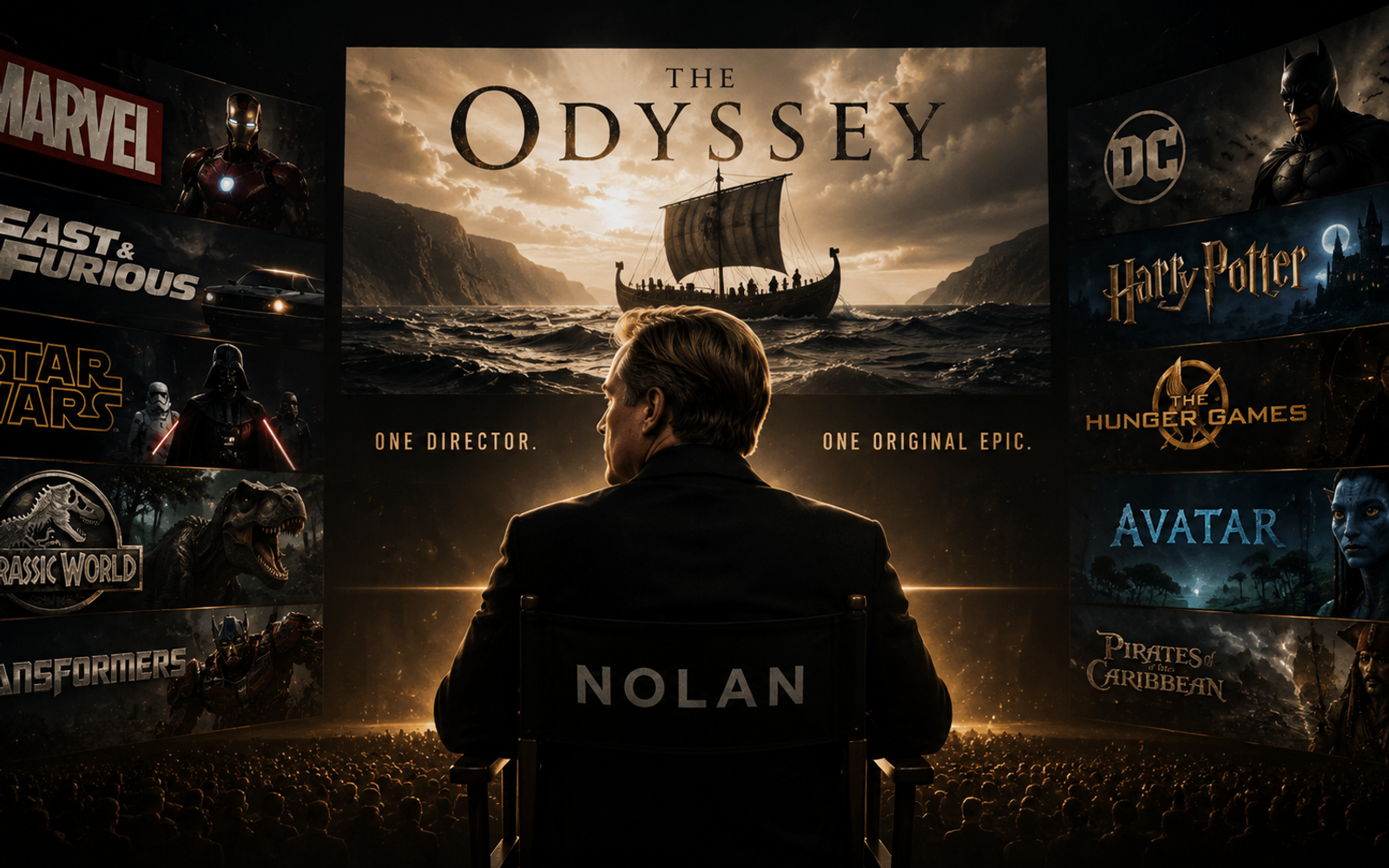
But the real story is not the trailer views. It is the fact that Nolan got this film financed at all. At a moment when every major studio is chasing franchise dollars, when the algorithm recommends sequels and streaming services bury original adult dramas in the middle of the menu, Nolan convinced Universal to spend a quarter of a billion dollars on a poem. That is the kind of leverage that only comes from delivering Oppenheimer, a three-hour biopic about a guilt-ridden physicist that grossed nearly $1 billion.
Nolan is now, by any measure, the most powerful director in the world. The question is what he does with that power. The answer, it turns out, is the oldest story in the Western canon.
The Practical Epic
One of the defining tensions of Nolan's career has been the relationship between technology and authenticity. He shoots on film. He builds practical sets. He avoids CGI whenever possible. And yet his films are about time, memory, and the unreliability of perception, abstract concepts that would seem to demand digital trickery.
The Odyssey resolves this tension by going fully material. Hoyte van Hoytema's cinematography, shot on large-format IMAX film, treats the Aegean Sea as a practical effect. The cyclops is reportedly a combination of puppetry and forced perspective. The sirens, according to early reviews, are staged with a physicality that recalls the pre-digital epics of the 1960s. Empire Magazine called the film "a monumental piece of work." The Telegraph's early look described it as "one battle after another."
What makes this interesting is not nostalgia for practical effects. It is the argument that Nolan is making about scale. In an era when Marvel films spend $200 million on green screens and the results look weightless, Nolan is insisting that weight matters. That the audience can feel the difference between a real ship on real water and a simulation. That the epic mode requires physical presence, not just digital abundance. The scale of the undertaking recalls other great monuments of patience and craft, like the long-awaited completion of Gaudí's Sagrada Familia tower, a project that took 144 years to reach its final form.
Ludwig Göransson's score, following his Oscar-winning work on Oppenheimer, reportedly leans into ancient instrumentation, percussive patterns and string drones that evoke the oral tradition from which the Odyssey emerged. The sound mix, in IMAX 6-Track and Dolby Atmos, is designed to push the audience into the hull of Odysseus's ship.
The Cast as Cultural Signal
The ensemble of The Odyssey is worth dwelling on because it represents a specific theory of casting. Damon as Odysseus is the obvious choice, a reliable leading man who can carry both the physical demands of the role and the psychological weight of a man who has been away from home for twenty years. But the supporting cast reads like a map of contemporary Hollywood's most interesting actors.
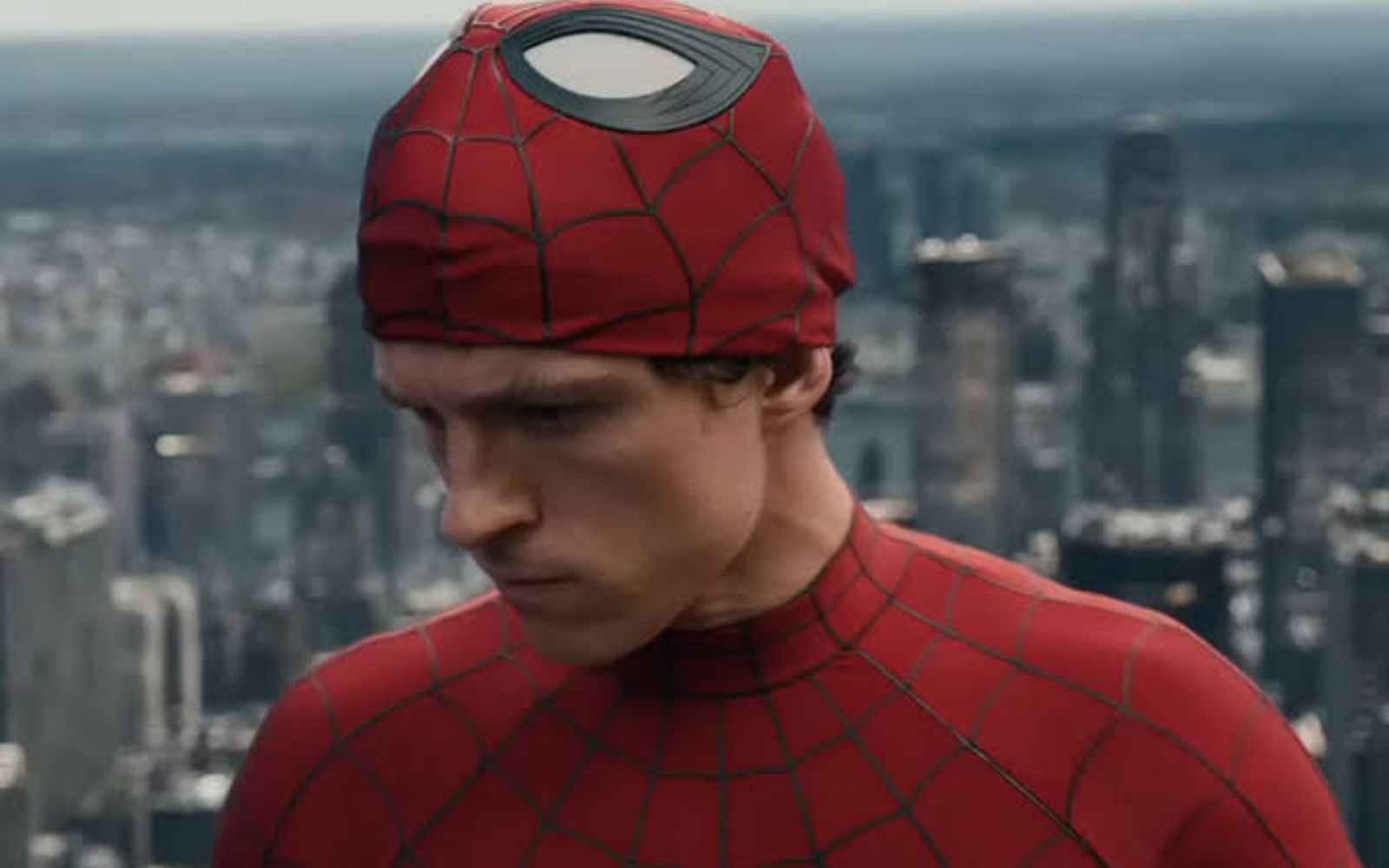
Tom Holland plays Telemachus, Odysseus's son, who has spent his adolescence waiting for a father he barely remembers. Zendaya plays Athena, the goddess who intervenes on Odysseus's behalf. These are not stunt castings. They are actors who bring their own cultural associations to ancient roles. Holland, who spent a decade carrying the Spider-Man franchise, now plays a son defined by absence. Zendaya, who has become one of the most watched performers on screen, plays a goddess whose power is intellectual rather than physical.
And then there is Travis Scott, whose role has been kept largely secret. The rapper's casting is the kind of move that could have been a gimmick, a pop star dropped into a prestige epic for the headlines. But Nolan has a track record of using non-traditional casting to expand the emotional register of his films. If Scott's presence signals anything, it is that The Odyssey is not aiming for museum-piece respectability. It wants to be alive, loud, and strange.
What the Opening Actually Means
The box office projections for The Odyssey arrive in the middle of a summer that has been unusually quiet for blockbusters. The film's $200 million global opening would place it among the top R-rated debuts of all time. But the more interesting number is the overseas projection: $110 million from 73 territories and 22,700 screens. That suggests that the appetite for Nolan's cinema is genuinely global, not just an American phenomenon. The film is opening in markets from Seoul to Lagos to London, and the pre-sales have been strong across all of them.
For the industry watching tomorrow's numbers, the stakes are straightforward. If The Odyssey opens at the high end of projections, it will confirm that there is still a market for ambitious, director-driven cinema that treats its audience as adults. If it underperforms, the studios will use it as evidence that only franchises work. That is an unfair burden to place on one film, but it is also the reality of Hollywood in 2026. The system has left no room for moderate success. A film either becomes a cultural event or it becomes a cautionary tale.
The Odyssey has already cleared one hurdle. It exists. It is a $250 million epic, shot on film, based on a Greek poem, starring actors who could be making superhero movies instead. That it made it to opening day is itself a victory for a certain idea of cinema. Tomorrow, audiences decide whether that victory was worth it.
But the real question is not whether the film makes money. It is whether the experience of watching it changes anything about how people think about scale and spectacle. Nolan has built a career on the idea that cinema can be intellectually serious and massively popular at the same time. The Odyssey is the purest test of that idea yet. Not because it is his best film, but because it is his most nakedly ambitious, a director who could make anything choosing to make the thing that could only exist at full size, on real film, with real water, in a room full of strangers who have paid for the privilege of sitting in the dark together.
And tomorrow, those strangers will walk into theaters around the world to find out if a story that has survived for three thousand years can still hold their attention for three hours. If the early reviews are any guide, it can.
Frequently Asked Questions
What is the runtime of Christopher Nolan's The Odyssey?
The Odyssey has a runtime of 2 hours and 52 minutes, or 172 minutes, making it one of Nolan's longest films.
Who composed the score for The Odyssey?
Ludwig Göransson composed the score, following his Oscar-winning work on Oppenheimer. The score uses ancient instrumentation and percussive patterns.
Is The Odyssey shot entirely on IMAX film?
Yes, the film was shot entirely with IMAX film cameras, making it the first film in history to be fully captured in that format.
What is Travis Scott's role in The Odyssey?
Travis Scott's role has been kept largely secret, though it is confirmed he appears in the film. His casting was described as "shocking" by early reports.
How much is The Odyssey expected to earn on opening weekend?
The film is tracking for an $85 million to $100 million domestic opening and $110 million overseas, for a global debut around $200 million.
Comments (0)
No comments yet. Be the first to share your thoughts.