When Your Text Editor Tries to Hack You: Supply Chain Attacks in 2026
The Notepad++ compromise and AI-driven phishing are defining a new era of cybersecurity threats. The defenses that work aren't the ones most companies buy.

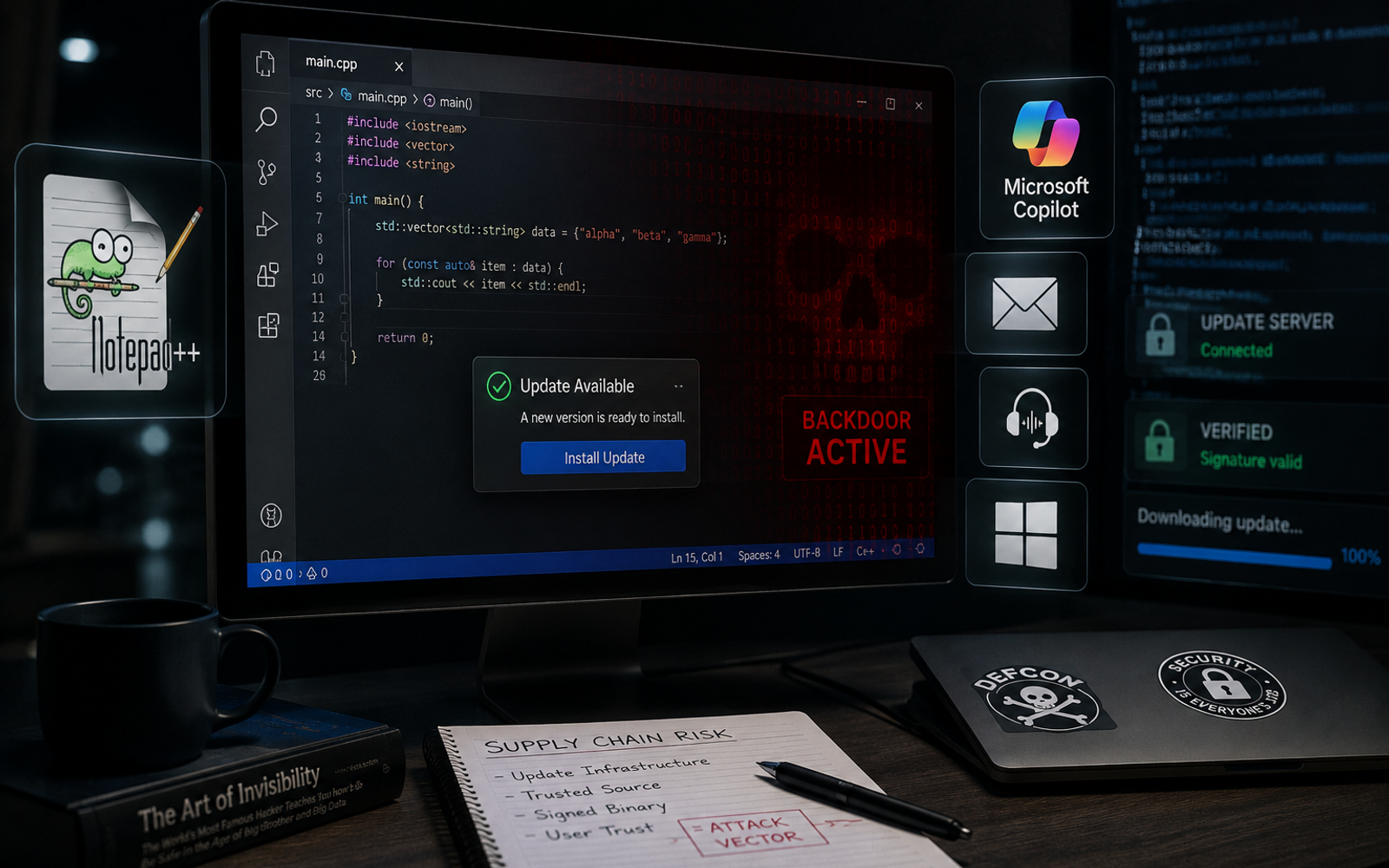
On February 2nd of this year, Don Ho, the developer behind Notepad++, published a disclosure that sent a specific kind of chill through the security community. For an undisclosed period, the update infrastructure behind one of the world's most widely installed open-source text editors had been compromised. Attackers, later attributed by multiple threat intelligence firms to a Chinese state-sponsored group, had replaced legitimate software updates with trojanized installers. Anyone who updated Notepad++ during the window of compromise received something they did not expect: a backdoor into their own machine.
The Notepad++ incident was not the first supply chain attack and will not be the last. But it arrived at a moment when the entire category of threat has mutated. The attackers in 2026 are no longer content to phish a single employee's credentials or exploit an unpatched server. They are now injecting malicious code into the software update pipelines that millions of people trust by default. And they are increasingly pairing those infrastructure-level attacks with a new generation of AI-driven social engineering that makes older phishing techniques look like clumsy ransom notes written in crayon.
The Software Supply Chain Has Become the Soft Underbelly
A supply chain attack works by finding the narrowest point of leverage in a distribution network. Rather than attack a thousand companies directly, an adversary compromises the single entity, a software vendor, a hosting provider, an update server, that feeds code to all of them. The Notepad++ compromise, detailed by SecurityWeek and others in June, was a textbook version of the technique. The attackers gained access to the hosting infrastructure that served updates, then swapped out the legitimate binaries for malicious ones.
What made the attack particularly insidious was the update mechanism itself. Notepad++ checks for updates automatically by default. Users who saw a prompt telling them a new version was available had no reason to suspect anything was wrong. The update came from the same place updates had always come from. The digital signature matched. The interface looked identical. Only the payload had changed.
According to Arctic Wolf's analysis of the incident, the compromise was discovered when a security researcher noticed anomalous outbound traffic from a machine that had recently updated Notepad++. That kind of detection depends on luck, vigilance, and the presence of endpoint monitoring tools, none of which are standard equipment on a typical office workstation or home computer.
Supply chain attacks are particularly difficult to defend against because they violate a foundational assumption of software security: that updates from trusted sources can be trusted. When the trust itself becomes the attack surface, every piece of software on every machine becomes a potential vector. The research firm Gartner has flagged that the growing adoption of generative AI across vendor and partner ecosystems is making the problem worse, since AI tools introduce additional dependencies and opaque code pathways that attackers can exploit.
AI-Generated Phishing Has Crossed a Threshold
While supply chain attacks target the infrastructure under software, another class of threat has been targeting the people who use it. AI-driven social engineering, sometimes called vishing, sometimes deepfake phishing, sometimes simply the new normal, has crossed from proof of concept into active, measurable harm.
The mechanism works like this. An attacker obtains a short sample of someone's voice, from a posted video, a conference recording, or a voicemail greeting, and feeds it into a voice cloning model that can generate new speech in that person's voice from just a few seconds of training audio. The cloned voice is then used in a phone call. The target hears what sounds like their CEO, their CFO, their head of IT, asking them to authorize a payment, share credentials, or approve a system change.
According to zeroThreat's 2026 statistics, financial services firms are the most targeted sector for these attacks, accounting for 28 percent of all deepfake fraud incidents. The same research found that AI-generated business email compromise scams, invoices that look legitimate, payment requests that appear to come from known vendors, have become the standard attack vector for organized cybercrime groups.
What makes these attacks so effective is personalization at scale. An older phishing campaign sent the same message to a million people. An AI-driven campaign can generate a million unique messages, each one referencing the recipient's actual job function, recent projects, and real professional relationships. The best defense against this kind of attack is not technical. It is procedural. Requiring out-of-band confirmation for any financial transaction, a second phone call to a known number, a message through a separate channel, stops the attack dead because the attacker cannot control both channels simultaneously.
The Copilot Problem: AI as an Attack Surface
The same large language models that companies are rushing to integrate into every product are themselves creating new categories of vulnerability. In May of this year, researchers disclosed critical vulnerabilities in Microsoft 365 Copilot, tracked as CVE-2026-33111 and others, that allowed attackers to extract sensitive information through command injection attacks on the AI assistant.
The vulnerability exploited the way Copilot processes user inputs in the context of enterprise data. Microsoft 365 Copilot has access to a user's emails, documents, calendar, and chat history. An attacker who could craft a prompt that bypassed the intended access controls could, in theory, ask the AI to retrieve and expose information it should not have shared. The severity rating of 9.3 out of 10 reflected the breadth of data at risk.
This is a structural problem that has no easy fix. Large language models are, by design, generalized text predictors. They respond to prompts by generating the most statistically plausible continuation. Separating what the model should be allowed to reveal from what it should keep private requires layering on external controls, permission boundaries, input sanitization, output filtering, that must be maintained independently of the model itself. A vulnerability in any one of those layers can compromise the whole chain.
As NovaRift covered earlier this year, one of the most effective ways to exploit an AI system is not to hack the model but to ask it nicely for what you want. The article "They Didn't Hack Instagram. They Just Asked Meta's AI" documented how attackers were able to extract information from Meta's AI assistant simply by crafting the right sequence of prompts, with no code exploits or malware required. The Copilot vulnerabilities follow the same logic: the weakest link is not the neural network but the permission model wrapped around it.
What Effective Protection Actually Looks Like
Given the landscape as it stands in mid-2026, the question is not whether an organization will be targeted. It is whether the defenses in place can absorb the first hit without collapsing. The evidence suggests that most organizations are still buying the wrong protections.
A layered security approach, one that does not rely on any single tool or practice, remains the consensus recommendation from every major threat intelligence firm. But layering needs to be understood in a specific way. It does not mean buying antivirus plus a firewall plus endpoint detection and pretending the problem is solved. It means building redundancy into the decision points where attacks actually happen.
For supply chain attacks, the critical layer is validation. Software updates should be verified not just by digital signature but by hash comparison against independently published values. Organizations should maintain a staging environment where updates are tested before deployment to production machines. The window between "update available" and "update installed" should be long enough to allow threat intelligence feeds to flag anomalies.
For AI-driven phishing and deepfake fraud, the critical layer is procedural, not technological. No matter how convincing a voice sounds or how authentic an email appears, a policy requiring secondary confirmation through an independent channel renders the attack useless. The attacker can clone a voice but cannot intercept a call placed to a number they do not control.
For AI-as-attack-surface vulnerabilities like the Copilot command injection flaws, the critical layer is data governance. Organizations need to know what their AI systems have access to, and they need to enforce boundaries at the data layer rather than relying on the model itself to behave correctly. This means maintaining strict role-based access controls on the backend systems that feed AI assistants, independent of whatever permission model the assistant implements on its own.
The Geography of Threat and Response
Cybersecurity is a genuinely global problem, but the shape of the threat varies by region. Europe's IT sector has ranked AI-driven cyber threats as the top concern for 2026, according to IT Brief UK, driven in part by the regulatory requirements of the EU AI Act and the General Data Protection Regulation. European organizations face the double burden of defending against attacks while meeting compliance obligations that can slow incident response.
In the Asia-Pacific region, the focus has been on supply chain attacks originating from state-aligned groups. The Notepad++ compromise, attributed to Chinese threat actors, is part of a broader pattern. Japanese semiconductor testing company Advantest Corporation was hit by a ransomware attack earlier this year that disrupted operations across multiple facilities, and researchers at Group-IB have tracked at least six distinct supply chain attack groups active in the region.
North American organizations, meanwhile, are grappling with the rapid integration of AI tools into enterprise software stacks, Microsoft Copilot, Google Gemini, and others, without corresponding investment in the security controls needed to govern them. The urgency to deploy AI has, in many cases, outpaced the caution required to deploy it safely.
The Asymmetry That Remains Unsolved
After studying the pattern of attacks across the first half of 2026, a clear asymmetry emerges between how defenders think about security and how attackers operate. Defenders optimize for prevention. They buy tools that promise to block attacks before they happen. Attackers, by contrast, plan for the inevitability of penetration. They assume they will get in. They design their operations around persistence, staying inside a network long enough to find the prize.
This asymmetry is baked into the economics of the situation. Defenders must protect every entry point, every day, perfectly. Attackers only need to exploit one entry point, once, well enough. The Notepad++ attackers did not break into every machine that ran the text editor. They compromised one update server and let the existing trust relationships do the rest. The deepfake voice scammers do not need to clone every executive's voice. They only need one successful call that results in a wire transfer.
The technical question that no one has fully answered, and the one that keeps security engineers awake, is whether defense can ever catch up structurally, rather than reactively. Current approaches rely heavily on detection: finding the attack after it has begun but before it has finished. That buys time but not safety. True prevention would require fundamentally redesigning the trust assumptions baked into software distribution, communication protocols, and AI permission models. It would require making the cost of an attack higher than the value of what the attacker hopes to gain.
That calculation has not shifted in the attacker's disfavor yet. And until it does, the most honest cybersecurity advice for 2026 is also the least satisfying: assume the update is compromised, assume the call is a deepfake, assume the AI has already seen too much, and build your procedures around the assumption that you are already inside a system that is trying to deceive you.
Frequently Asked Questions
What is a software supply chain attack?
A supply chain attack compromises a software vendor or update infrastructure to distribute malicious code through trusted channels. Instead of attacking individual users, the attacker injects malware into the updates or packages that those users install automatically.
How do AI voice cloning scams work?
Attackers capture a short voice sample from public sources like videos or voicemails, then feed it into a generative AI model that can produce new speech in that person's voice. The cloned voice is used in phone calls to impersonate executives or colleagues and authorize fraudulent transactions.
Why are AI assistants like Microsoft Copilot vulnerable to data exposure?
Large language models are designed to respond to prompts with contextually relevant information. If the permission controls governing what data the AI can access are flawed, an attacker can craft inputs that bypass those controls and extract sensitive internal documents or communications.
Does antivirus software protect against deepfake phishing?
Not reliably. Deepfake phishing targets human decision-making through phone calls and realistic audio or video, not through malicious files that antivirus can scan. The most effective defense is procedural: requiring confirmation through a separate, independent communication channel.
What is the single most effective step a small business can take against supply chain attacks?
Establish a staging environment where all software updates are tested before deployment to production machines, and verify update integrity using independently published hash values rather than relying solely on digital signatures from vendors.
Are open-source tools more dangerous than proprietary software for supply chain risk?
Neither category is inherently safer. Both are vulnerable to supply chain compromise. The risk depends on the security practices of the maintainers, the complexity of the dependency tree, and whether the software has an automatic update mechanism that trusts the update server without validation.
Comments (0)
No comments yet. Be the first to share your thoughts.