AI Agents Do the Work Now. Verification Can't Keep Up
AI agents now run for hours on delegated tasks. The unsolved engineering problem is checking they did it right.

By May 2026, more than four out of five sampled individual users of OpenAI's Codex had sent at least one request that the company's models estimated would take a human over thirty minutes to complete. Some of those requests carried estimates above eight hours of human work. OpenAI published those numbers on June 25 in an economic research paper, and they deserve to be read as a statement about what knowledge work is becoming, not as a footnote about a coding tool. The unit of exchange has moved from a question and an answer to a delegated task with a deadline.
The researchers compress the shift into one sentence: agentic AI changes the unit of knowledge work from single interactions to delegated, long-horizon tasks. A chatbot session is short and self-contained. An agent runs for minutes or hours, orchestrating tool calls, interacting with environments, and iterating toward a solution. That sounds incremental until you ask what has to be true under the hood for a machine to carry it off, and most of the answer has nothing to do with raw model intelligence.
The Loop Is the Difference
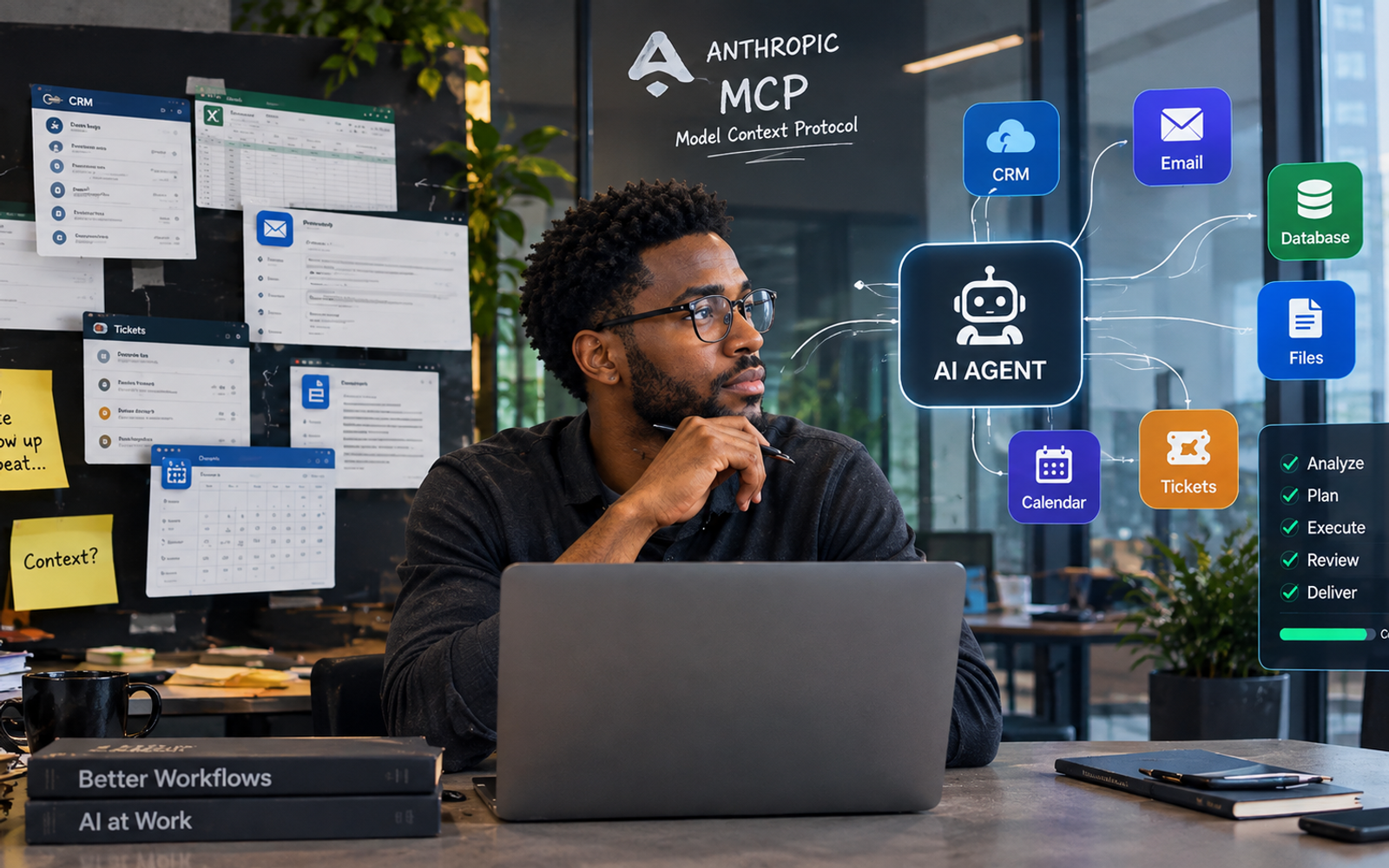
The architecture that turns a language model into an agent is not exotic. Take the model, give it tools such as a code interpreter, a browser, an API, or a database, and wrap both in a loop. The model proposes an action, the action executes against a real system, the result returns as fresh text, and the model decides what to do next. The cycle repeats until the task is finished, the agent exhausts its budget, or a human steps in.
Everything sold as an agent this year, from a support bot that refunds a delayed ticket to a coding assistant that opens a pull request, is that loop wearing different clothes. The part that matters is that the model's text is no longer the product. The product is the state of the world after the loop ends. A chatbot delivers words on a screen and the exchange closes when you stop typing. An agent delivers a changed codebase, a filed claim, or a reconciled ledger, which means the old failure modes stop mattering and a new set takes over.
A workplace analogy captures the difference. A chatbot is a colleague you shout a question at across the room, and the answer costs you nothing because you stay in control of what happens next. An agent is a colleague you hand your keys to at nine in the morning with a list of errands and a request for a report by five. The second arrangement is far more useful and far more dangerous, because you have delegated judgment, and delegated judgment fails in ways that a wrong answer to a question never can.
Planning, Memory, and the Long Horizon
Running for an hour or more changes what the model needs beyond the loop itself. A single chat reply draws on knowledge frozen at training time. A long task has to track a world that shifts while it works, fetching current data, remembering what it attempted ten steps ago, noticing that its approach is failing, and changing tactics without being told. That demands a planning layer that turns a vague instruction into concrete subtasks, plus memory that survives past the context window.
Most agent systems handle that memory the way a person handles a long project. The context window is the desk, useful while you are working on one thing but quick to fill up, so agents spill intermediate notes into files or databases, retrieve them on demand, and compress old reasoning into summaries. Long-running agents also checkpoint their state so a crash or a bad detour does not force a restart from zero.
Self-correction is the third requirement and the least solved. A model has to look at its own output, run a check, find the flaw, and retry. The reasoning models that arrived through 2025 made this practical by spending extra tokens on internal deliberation before committing to an action. That is real progress, but it only pushes the question one level down: the model is checking its own work, and a model that misunderstands the task will check confidently against the wrong standard.
Why Coding Became the Beachhead
Given all those requirements, it is not an accident that software became the first place agentic loops turned genuinely productive. Code has something most knowledge work lacks: an objective oracle. An agent can attempt a change, run the test suite, and know with certainty whether it succeeded. That binary signal is what makes autonomous iteration safe enough to trust, because every retry is checked against reality instead of against the agent's own opinion of itself.
OpenAI's June paper shows how quickly that changes work habits. OpenAI's economic research paper reports that active Codex users grew more than fivefold in the first half of 2026, with the fastest growth coming outside the original audience of professional developers, and that inside OpenAI, Codex usage is now nearly universal and has largely replaced business use of ChatGPT. One caveat belongs next to those figures: the task-length thresholds are model estimates drawn from a 0.1 percent sample of users who opted to let their queries be used for training. Read the precise numbers as directional rather than forensic.
The direction matches what the agentic coding reports published through early 2026 describe from a different vantage: single agents evolving into coordinated teams, long-running agents building complete systems rather than snippets, and human oversight scaling through structured checkpoints instead of line by line review. The pattern has also leaked past engineering. An agent called Astra recently solved ten math problems for $2,000, which NovaRift covered this year and which is a reminder that in narrow, checkable domains the economics of delegation have already shifted.
Orchestration and the Multi-Agent Handoff
The frontier in 2026 is what happens when one agent is not enough. A single loop hits limits quickly: one model, one context, one thread of reasoning, and a narrow set of tools. So the industry is moving toward orchestration, where a lead agent decomposes a mission and hands subtasks to specialist agents, one reading contracts, another querying the ERP, a third drafting the response, before the results are merged and checked.
Multi-agent setups need connective tissue. Through 2025 and into 2026, two protocols hardened into the de facto standard layer: the Model Context Protocol, which standardizes how agents reach tools and data, and the Agent to Agent protocol, which lets agents from different vendors hand work to each other. Enterprise stacks are increasingly built on those two rails the way the web was built on HTTP.
For most organizations the real workflow is not a single elegant loop, though. It is a chain: intake, interpretation, decision, execution, review, and follow-up. Regulated industries in Europe, pushed by the EU AI Act, have tended to treat agentic deployment as a governance problem first, logging every action, permissioning every tool, and keeping every step reversible. By mid-2026 that approach had carried orchestration out of isolated pilots and into production inside some of the largest compliance-heavy companies on the continent, which is exactly where the remaining weakness shows up.
The Verification Gap
The weakness sits one layer below the models, in verification. Every step in an agent's loop has a nonzero chance of being wrong, and a long task multiplies those chances across dozens of steps. A crashed server fails loudly, but a wrong agent step fails softly, producing a plausible intermediate result that every later step happily builds on. Over a long enough horizon the probability that an unaudited run came out clean collapses, and the agent cannot tell you which runs are the dirty ones.
This is the gap behind the industry's most repeated numbers. Gartner predicted that more than 40 percent of agentic AI projects would be canceled by the end of 2027, and enterprise surveys through 2026 keep showing the same shape: adoption is broad, while production deployments that touch real systems, real data, and real compliance risk remain the minority. Building an impressive demo is easy. Running a governed agent that earns back its cost is hard, and the difference between the two is almost always the verification layer.
Look at where agents already work and the pattern is consistent: every successful deployment sits on top of a cheap verifier. Code has tests, math has checkable proofs, and spreadsheet reconciliation has totals that must balance. The domains still stuck in pilot are the ones where the correct answer has no external referee, which is most of knowledge work. I'd argue the evidence points one way: the model race is effectively settled, and the binding constraint on agentic AI is the verifier race, the search for automatic checkers that can audit open-ended agent output as rigorously as a test suite audits code.
The unsolved engineering problem is not whether models can do the work, because they already can, for steadily longer stretches. It is verification for tasks that have no compiler and no unit test: how to build a cheap, reliable check on open-ended agent output, and what gets delegated before that check exists. Enterprises that park agents behind human review are betting that verifier is years away, while the labs spending heavily on evaluation are betting it arrives within months. The second bet is the one that decides whether agentic AI compounds or stalls, because generation without verification only produces confident mistakes faster.
Comments (0)
No comments yet. Be the first to share your thoughts.