How Shonen Anime Outgrew Its Own Rules
From dark trios to emotional epilogues, the genre is rewriting what it means to be shonen.

The moment that best captures where shonen anime stands right now happened without a single punch being thrown. Frieren: Beyond Journey's End returned for its second season in January 2026, and the conversation around it was less about action choreography and more about whether it even belonged in the shonen category at all. A series about an elf mage processing grief across decades, with pacing closer to a Studio Ghibli meditation than a tournament arc, was sitting comfortably on every "best shonen of 2026" list. According to ComicBook.com, the debate over Frieren's classification has become a talking point that reveals something deeper: the genre's boundaries are dissolving in real time.
The Dark Trio and What It Left Behind
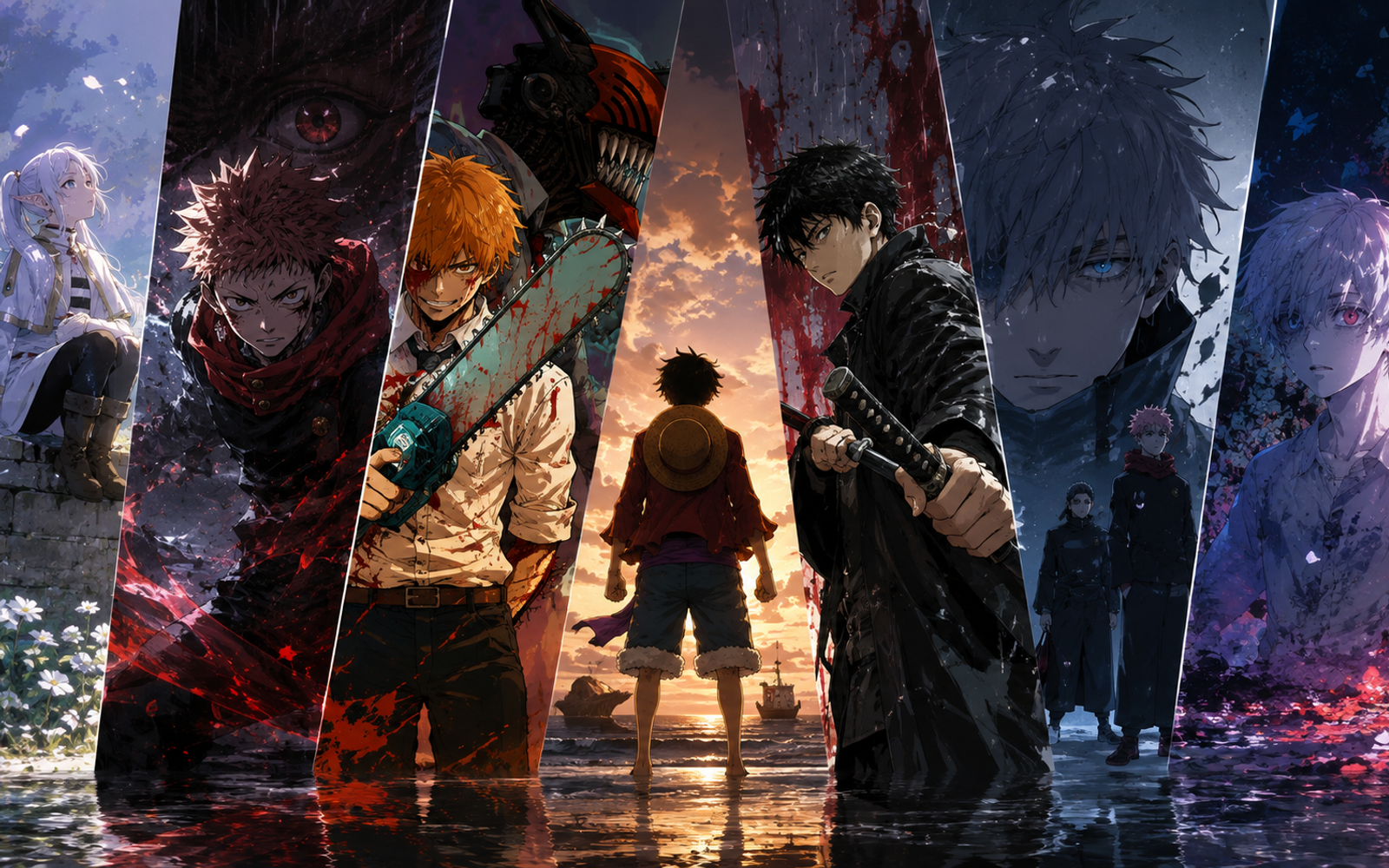
For the past few years, shonen's identity has been synonymous with the Dark Trio, Jujutsu Kaisen, Chainsaw Man, and Hell's Paradise. These series turned the genre toward moral ambiguity, graphic violence, and protagonists who operated more like survivors than heroes. It worked. Jujutsu Kaisen's Culling Game arc, which kicked off Season 3 in January 2026, turned the series into a high-stakes tournament narrative that kept audiences hooked through sheer brutality and narrative unpredictability. Chainsaw Man's Reze Arc movie and Hell's Paradise Season 2 followed suit, cementing a tonal shift that made the old "power of friendship" endings feel almost naive.
But dominance has a shelf life. By mid-2026, the Dark Trio's grip is loosening, not because audiences are tired of darkness, but because darkness itself has become the default rather than the subversion. When every shonen protagonist has a traumatic backstory and every victory costs something irreversible, the formula starts to feel as rigid as the one it replaced.
The Seasonal Revolution Came for One Piece
Read Also
Wearable Tech Walks the RunwayThe most significant structural change in shonen this year wasn't a new series, it was the oldest one finally breaking its own mold. One Piece, which had run continuously for 25 years, announced it would shift to a seasonal format starting April 2026, with a maximum of 26 episodes per year. Toei Animation's decision, reported by Polygon, followed a three-month production hiatus and effectively marked the end of the weekly long-running anime model. The last bastion of old-school production had finally embraced the seasonal approach that made series like Demon Slayer and Attack on Titan visually stunning and narratively tight.
This changes everything about how shonen is consumed. Weekly anime built their audience through ritual, the same time, same channel, every week for years. Seasonal releases demand appointment viewing. They reward density over duration. And they force storytelling that can sustain a 12-to-26-episode arc without filler. The One Piece shift isn't just a scheduling change; it's an admission that the industry's economic model has permanently tilted toward quality over quantity, a trend visible across every major studio's release slate for the rest of 2026.
What Counts as Shonen Now
The genre's expansion is most visible in the titles that don't fit the old template. Gachiakuta emerged as a strong shonen entry with a grimy, post-apocalyptic aesthetic that owes more to Dorohedoro than Dragon Ball. The Summer Hikaru Died brought horror-adjacent storytelling into the fold, proving that shonen could accommodate psychological dread alongside supernatural action. These aren't outliers anymore, they're signals that publishers at Weekly Shonen Jump and its rivals are willing to experiment with tone in ways that would have been unthinkable a decade ago.
And then there's Kagurabachi, the breakout manga that went from internet meme to legitimate phenomenon. Its anime adaptation was officially confirmed in April 2026 for an April 2027 premiere, with a world premiere screening of the first 20 minutes scheduled for July 3, 2026 at Anime Expo. Produced by Cypic studios, Kagurabachi represents the new shonen paradigm: a revenge story built around cursed blades and deliberate pacing, with an aesthetic that pulls from samurai cinema rather than battle manga tradition. Its rise mirrors the broader shift, audiences are rewarding specificity over formula.
The Emotional Turn
The most interesting development in 2026 shonen isn't about action at all. It's about what happens after the fighting stops. Series like Frieren and even arcs within Jujutsu Kaisen are spending more time on aftermath, the emotional cost of violence, the relationships that survive trauma, the question of what heroes do when there's no enemy left. This isn't a rejection of shonen's core appeal. It's an evolution of it. The genre that taught a generation that hard work and determination could overcome anything is now asking a more complicated question: at what cost?
This emotional turn mirrors what's happening in other corners of pop culture, where audiences are gravitating toward stories that earn their sentiment rather than manufacturing it. The same impulse that drives listeners toward music that captures the pain of early adulthood, as seen in recent album cycles from artists like Gracie Abrams, is driving anime fans toward series that treat their characters with psychological seriousness. Shonen is growing up alongside its audience, and the results are forcing a redefinition of what the genre can hold.
What the New Generation Actually Wants
The audience that made Jujutsu Kaisen a global phenomenon isn't the same audience that grew up on Naruto. They came of age in a streaming ecosystem where they could sample dozens of series in a month. They don't need the 200-episode training arcs because they don't have the patience for them. They want density. They want worlds that feel fully formed from the first episode. They want emotional complexity that doesn't undercut the spectacle.
Gachiakuta delivers on that front with a protagonist who isn't trying to become the best, he's trying to survive a world that has already discarded him. Hell's Paradise Season 2 pushes further into philosophical territory, questioning whether enlightenment is worth the bodies it leaves behind. Even Jujutsu Kaisen, the flagship of the Dark Trio, has shifted its emphasis from power scaling to character consequence, with the Culling Game arc functioning as much as a psychological thriller as a battle royale.
The Trajectory Forward
Shonen in 2026 is a genre without a single center of gravity. The Dark Trio still draws massive audiences, but the conversation has moved beyond them. Frieren's success proves that slow, meditative storytelling can thrive under the shonen label. One Piece's format shift proves that even the most sacred cows must adapt. And Kagurabachi's rise proves that the next generation of hits will come from places the old guard didn't expect.
The through line connecting all of these shifts is a genre finally comfortable enough with its own history to start breaking its own rules. Shonen no longer needs to prove that it can be dark or mature or emotionally complex, it has already done that. The challenge now is to keep evolving without losing the energy that made the genre a global force in the first place. That energy isn't going anywhere. It's just finding new shapes to fill, one season at a time.
Frequently Asked Questions
What is the Shonen Dark Trio?
The Shonen Dark Trio refers to Jujutsu Kaisen, Chainsaw Man, and Hell's Paradise — three series that defined modern shonen with darker themes, morally complex protagonists, and higher stakes than traditional battle anime.
Why is Frieren considered a shonen if it's slow-paced?
Frieren is published in Weekly Shonen Sunday, which technically makes it a shonen manga. But its meditative storytelling and focus on grief over action have sparked ongoing debates about whether the shonen label still fits.
How has One Piece changed its release format?
Starting in April 2026, One Piece moved to a seasonal format with a maximum of 26 episodes per year, ending its 25-year run as a weekly continuous anime to improve pacing and production quality.
What makes Kagurabachi different from other new shonen?
Kagurabachi blends samurai cinema aesthetics with a revenge narrative centered on cursed blades. It became a phenomenon through word-of-mouth and meme culture before its anime adaptation was announced for 2027.
Are traditional battle shonen becoming less popular?
Not less popular, but the definition is expanding. Audiences still love battle shonen, but they now expect stronger character development, emotional consequences, and unique visual identities alongside the action.
Comments (0)
No comments yet. Be the first to share your thoughts.