The Robot Workforce That Can't Stop Training
Tesla has 1,000 Optimus robots on factory floors. None do productive work. Physical AI's hardest problem isn't building the body, it's teaching the brain.

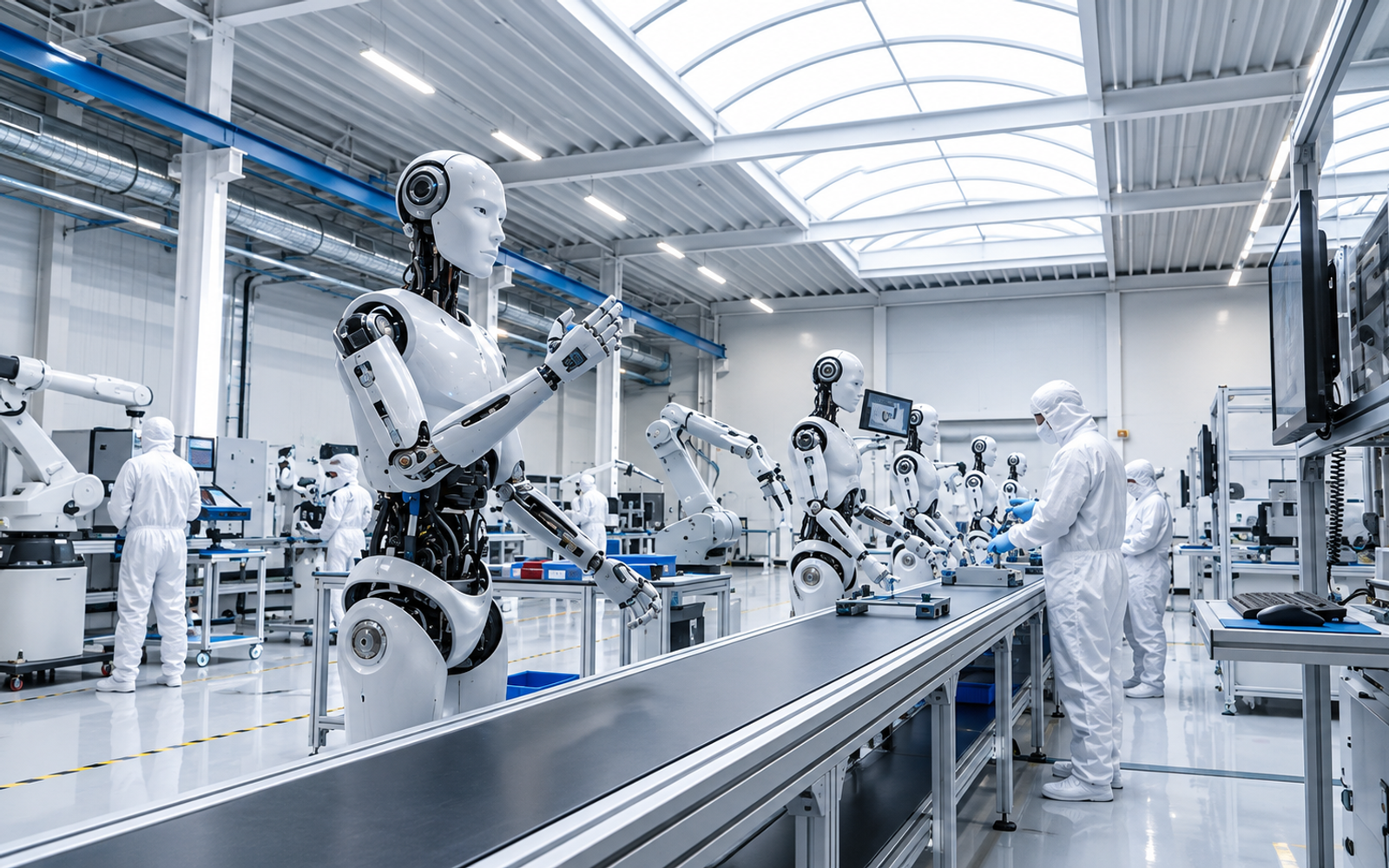
At Tesla's Fremont factory, 1,000 Optimus Gen 3 humanoid robots now walk the production floor. They move parts between stations, navigate aisles, and gesture with hands that underwent a complete redesign in mid-2025. Not one of them performs a task that generates revenue.
According to details from the Q4 2025 earnings call on January 28, 2026, confirmed by Technology Org, the robots are there to learn. Every movement, every grip, every step generates data that flows back into the models that control them. The robots are students, not workers, and that distinction captures the state of Physical AI in 2026 better than any press release.
It is not just Tesla. BMW deployed the Figure 03 humanoid at its Spartanburg plant in South Carolina in June 2026, taking over logistics tasks like part sequencing through what the company described as advanced Physical AI capabilities, per the BMW Group press release. Mercedes-Benz runs pilot programs with Apptronik's Apollo robot at its Berlin plant. Fanuc, the world's largest maker of industrial robots, announced a collaboration with Google on May 19 to bring Gemini AI to its 1.1 million installed robots, as reported by PRNewswire. The hardware is arriving. The question is whether the intelligence can keep pace.
The Sim-to-Real Gap: Why Simulation Betrays Robots
For decades, the problem has had a name that sounds deceptively simple: the sim-to-real gap. A robot trained in a simulation where gravity is perfect, friction is uniform, and every surface has a known coefficient behaves differently when placed in a physical world. The real world is messier. Lighting changes. Floors have unexpected textures. A bolt left on the ground by a human worker becomes an obstacle that no training scenario anticipated.
The sim-to-real gap is the central constraint of Physical AI, the branch of artificial intelligence that enables machines to perceive, reason, and act in physical space. A large language model can be trained on text scraped from the internet and deployed immediately because language is a closed system. A robot that must navigate a warehouse, pick up an object it has never seen, and place it on a moving conveyor belt faces an open system with infinite variables.
The gap matters because it determines whether a robot can be trusted in uncontrolled environments. A factory floor, even a highly organized one, is uncontrolled compared to a simulation. The NVIDIA press release from March 2026 announced Isaac Lab 3.0 and Cosmos 3, tools designed specifically to make simulations more realistic so that behaviors learned in software transfer reliably to hardware. But the transfer is never perfect.
What a Robot Actually Needs to Learn
Think about what a human worker does in the first hour of a new factory job. They watch another worker. They try the task slowly. They drop something, pick it up, adjust their grip. They learn that the box is heavier on one side because of how the contents settled. They learn that the conveyor belt has a slight lag when starting. They build a mental model of the environment through experience.
A robot has none of this context when it starts. It has a model trained on data that may or may not match its current environment. The FANUC-Google collaboration represents an attempt to bridge this gap: Google's Gemini AI, combined with its Intrinsic platform, provides a reasoning layer that can interpret what a robot's sensors are telling it and adjust behavior in real time. As The Next Web reported, the partnership brings this intelligence to over a million industrial robots that currently follow rigid, pre-programmed paths.
But reasoning in real time requires data, and data is the bottleneck. A Memeburn analysis of Physical AI's 2026 trajectory noted that even tens of millions of hours of robot data expected to be collected this year may represent only basis points of what is ultimately needed for high-level robotic performance. The comparison to large language models is instructive: GPT-4 trained on roughly 13 trillion tokens of text. There is no equivalent corpus for physical interaction.
The Data Choke Point
The shortage of physical data creates a paradox. To collect the data needed to train capable robots, robots must be deployed in real environments. But to be worth deploying in real environments, robots must already be capable. The way companies are solving this in 2026 is by deploying robots that do not need to be productive, like Tesla's Optimus units, purely to generate training data.
This is why the distinction between deployed and working matters. When Tesla says it has 1,000 robots on its factory floor, it sounds like production has begun. But as the RoboZaps blog confirmed in its July 2026 update, Tesla's Fremont Model S and X lines are being shut down and converted to Optimus manufacturing. The factory is making robots so that the robots can learn to do the work the factory used to do.
The economics are not yet viable at scale. A Marketscale report on AI partnerships in factory automation noted that the value of industrial robots reached $16.7 billion, but the return on investment for humanoid robots remains unproven. The hardware costs are high, the software is incomplete, and the training data is insufficient. As we previously explored, the broader AI industry is facing a similar reckoning with ROI, and Physical AI has not yet made its case.
How Companies Are Closing the Gap
NVIDIA's approach is the most systematic. Isaac Sim, its robotics simulation platform, now includes physics models accurate enough that behaviors trained in simulation transfer to hardware at higher rates than ever before. The March 2026 announcement of Isaac Lab 3.0 added foundation models that can generalize across tasks, so a robot trained to pick up a specific part can adapt to picking up a different part without retraining.
The FANUC-Google deal takes a different tack. Rather than building better simulations, Google is providing an AI agent that can operate the robot using natural language commands and visual understanding. An operator can tell the system what needs to be done, and the AI translates that into robot movements. This reduces the need for extensive pre-programming and allows the robot to adapt to new tasks on the fly.
BMW's deployment of Figure 03 represents a third path: partner with a robotics company that has already solved some of the sim-to-real challenges and deploy the robot in a controlled subset of tasks. The Figure 03 handles part sequencing, which is repetitive but requires precise spatial reasoning. The robot runs on a proprietary AI model called Helix that handles perception and motion planning together rather than as separate systems.
Each approach shares a common limitation: none of them generalize well. A robot trained in NVIDIA's Isaac Sim still needs fine-tuning when placed in a specific factory. Google's AI agent can interpret commands but struggles with tasks it has never seen described. Figure 03 works reliably at Spartanburg but would need weeks of retraining at a different plant.
What Still Does Not Transfer
The deeper problem is that robots lack what cognitive scientists call common sense. A human worker knows that a cardboard box can be crushed but a metal box cannot. They know that if they cannot reach an object, they can step closer or ask for help. They know that a loud noise might mean something broke. These inferences are trivially obvious to humans and almost impossible for current Physical AI systems.
This is where the NVIDIA announcement of Cosmos 3 matters most. The platform is designed to give robots a kind of world model, an understanding of how physical objects behave rather than just how to recognize them. A robot with a world model can predict what happens when it pushes a box, instead of having to learn that specific scenario from data. But world models for physical interaction are still in their early stages and remain largely theoretical for complex environments.
The research community has begun to frame this as the difference between perception and understanding. A robot can perceive a shelf full of parts. It can recognize each part by shape and color. But understanding that the heavy parts should go on the bottom shelf because the top shelf might collapse requires reasoning about physics, materials, and intent that no current Physical AI system can reliably perform.
This gap between recognizing and understanding also surfaces in how robots handle failure. A human who drops a bolt learns something about grip strength, surface friction, and their own coordination. A robot that drops a bolt records a data point. It does not infer why it dropped the bolt unless that inference was explicitly programmed. The difference between learning from an experience and logging an event is the difference between a workforce that improves over time and one that repeats the same mistakes until a human updates the code.
The question that lingers is not whether Physical AI will eventually work. The hardware is improving rapidly, the investment is substantial, and the market incentive is enormous. The question is whether data collection alone can close the gap, or whether the missing ingredient is something more fundamental: a different architecture for learning physical interaction that has not yet been discovered. The robots on factory floors around the world are watching, learning, and failing quietly, and what they lack is not strength or dexterity but the ability to learn from one mistake and apply that lesson to a situation they have never seen. That is the problem no simulation, no partnership, and no amount of data has solved.
Frequently Asked Questions
What is Physical AI?
Physical AI is the branch of artificial intelligence that enables machines to perceive, reason, and act in the physical world. It combines computer vision, natural language processing, and robotics to allow machines to navigate and manipulate real environments rather than just processing digital information.
Why can't humanoid robots work in factories yet?
The main obstacle is the sim-to-real gap: robots trained in simulations behave differently in the messy, unpredictable conditions of a real factory. They also lack common sense reasoning and the ability to generalize learning from one task to another without extensive retraining.
What is the sim-to-real gap in robotics?
The sim-to-real gap refers to the difference between how a robot performs in a simulated training environment with perfect conditions and how it performs in the real world where lighting, friction, object shapes, and obstacles vary in ways that simulations cannot fully capture.
How are companies training Physical AI robots in 2026?
Companies use three main approaches: deploying robots purely for data collection rather than productive work, partnering with AI firms to add reasoning layers to existing industrial robots, and running controlled pilot programs that limit the range of tasks a robot must handle.
Which companies are leading humanoid robot development?
Tesla with its Optimus line, Figure AI with the Figure 03 deployed at BMW, Apptronik with the Apollo robot at Mercedes-Benz, and FANUC partnering with Google are the most active players. NVIDIA provides the simulation infrastructure that many of these companies rely on for training.
When will humanoid robots replace human workers?
There is no clear timeline. Current humanoid robots cannot perform productive work at scale and are primarily used for data collection and narrow, controlled tasks. Most industry observers expect that widespread deployment in manufacturing is still years away and will begin with specific, repetitive roles rather than broad replacements.
Comments (0)
No comments yet. Be the first to share your thoughts.