The Two Homecomings That Defined July
Nolan's The Odyssey and Dubai's reopened churches both answered the same quiet question.

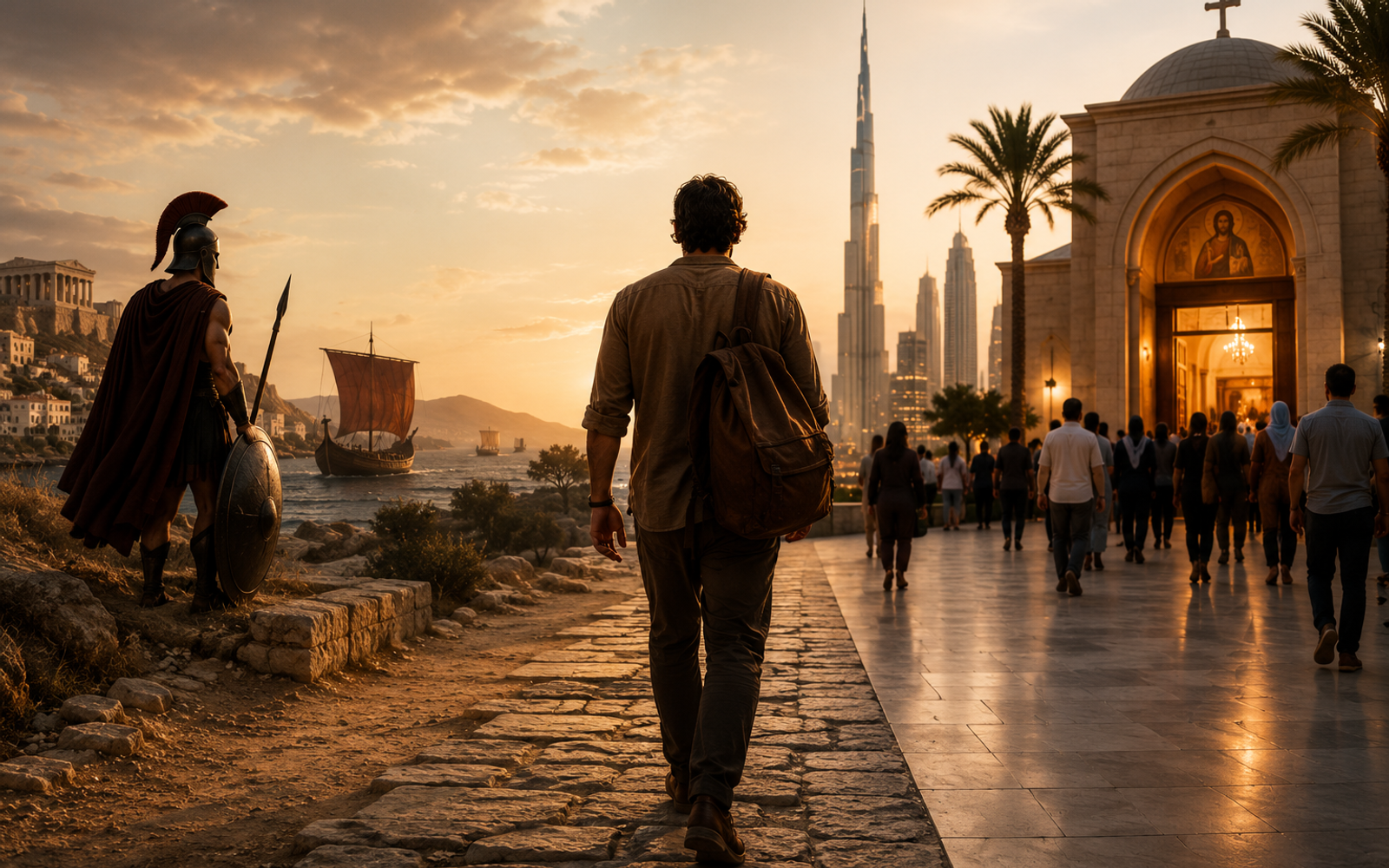
Two things happened in the same July that, on paper, share almost nothing. One was a movie. One was a mass, in the literal sense. But they arrived in the same window of days, they both cost something to pull off, and they both answered the same question that this year has been asking more directly than most: what does it mean to come home?
On July 17, Christopher Nolan released The Odyssey, his adaptation of Homer's ancient poem, starring Matt Damon as Odysseus, the man who spent a decade trying to return to Ithaca. On July 2, Dubai's Catholic churches opened their doors fully for the first time in three months, after restrictions tied to the U.S.-Iran war forced them to suspend in-person services during Holy Week of all weeks. St. Mary's in Oud Metha and St. Francis of Assisi in Jebel Ali resumed 100 percent operations following directives from Dubai's Community Development Authority, as reported by Gulf News. These are very different kinds of homecoming. But they are both homecomings. July, it turns out, was the month the world remembered what it means to gather again.
The Audacity of Telling an Old Story Big
The Odyssey opened to $124.5 million in North America and $264.1 million globally, according to The Hollywood Reporter, making it Nolan's biggest domestic debut. Those numbers matter less for the record they set than for the signal they sent. This is a three-hour adaptation of a 2,700-year-old poem about a man who gets lost at sea, starring a 55-year-old Matt Damon in a beard, with no superheroes, no franchise sequel number, and no pre-existing IP beyond the kind you studied in high school. And it demolished expectations.
Nolan has always been a director who trusts audiences to keep up. But this was something else. This was betting that the collective desire for a story about return, about endurance, about the moment a wanderer finally steps back into his own doorway, was stronger than any comic book mythology. The bet paid off. IMAX screenings sold out weeks in advance. The film set records in 48 countries. People showed up, not because they needed to know what happened next in a cinematic universe, but because they needed to watch someone, anyone, make it home.
And they needed to do it together. The box office numbers are not just about ticket sales. They are about the decision to leave the house, sit in the dark with strangers, and share an experience that no streaming queue can replicate. That decision, that collective choice, is part of what this July was really about.
The Other Sanctuary That Came Back
The Catholic churches of Dubai were forced to suspend in-person services on April 3, 2026, according to Arabian Business. That date matters. It was the Friday of Holy Week, the most sacred stretch of the Christian calendar, when worshippers typically gather for the Easter Triduum. Instead, they stayed home. Easter Sunday passed without congregations. The churches went dark for three months.
The restrictions were part of broader security measures in the region, after the U.S.-Iran conflict escalated in ways that made public gatherings a complex calculation. For Dubai's Catholic community, a population made up largely of expatriate workers from the Philippines, India, Lebanon, and across Africa and Europe, the closure meant more than a missed holiday. It meant the loss of a weekly ritual that anchors life far from home. Many of these worshippers are already in a kind of exile, working in a country where they are guests. The church is not just a building. It is the place where foreignness recedes.
When the reopening came in early July, Bishop Paolo Martinelli thanked the authorities and the faithful for their patience, according to the Khaleej Times. The phrasing was gracious. But the relief was obvious. After three months, the congregation could once again do what congregations are supposed to do: gather.
This is not a small story. It is not a footnote to the war coverage. It is the texture of how ordinary people experienced an extraordinary geopolitical crisis. The headlines about the Iran conflict focused on missiles, negotiations, and diplomatic talks in Doha. But the lived reality for thousands of people in Dubai was that they could not go to church for three months. They could not light a candle. They could not sit in a pew and feel, for an hour, that they belonged somewhere.
What These Two Events Share
So the connection between a $264 million Hollywood epic and the reopening of two Catholic churches in the UAE is not about content. It is not about theology or narrative. It is about the same fundamental hunger.
Both stories are about the return of ritual. Nolan's film is a ritual in itself, the ritual of the theatrical experience, the shared attention, the collective intake of breath when something on screen surprises everyone at once. The churches reopening is a more ancient ritual, but the shape is the same. People showed up. They sat together. They participated in something older than themselves.
The timing is not accidental. July 2026 comes after a period when many kinds of gathering felt precarious. The pandemic reshaped how people thought about proximity. The war in the Middle East reinforced that fragility. And then, in the same month, two very different institutions, one a movie theater, one a church, demonstrated that the instinct to assemble has not been crushed.
Nolan, who has long been a champion of the theatrical experience, has made a career out of betting on audiences who want to feel something together. The Odyssey is maybe his most explicit statement yet of that belief. And the churches in Dubai, without any cinematic ambition, proved the same point: people need places to go. They need rituals that require their physical presence. Streaming and Zoom and online services carried the load for a while. But they could not carry it forever.
The Quiet Truth of the Moment
Dubai's Catholic community has been a revealing lens throughout this war. When the Easter services were suspended, the faithful did not disappear. They adapted. Some churches livestreamed masses. Others held small prayer groups in private homes. But everyone understood that these were substitutes, not solutions. The thing itself, the gathering, was what mattered. And losing it for three months in a city where so many residents are already displaced from their countries of origin was a specific kind of grief.
The reopening in July was not a grand political event. It was not covered by cable news with breaking news banners. It was a quiet administrative notice, sent to parishioners, posted on church websites. But the quietness of it is precisely the point. The most important cultural stories are not always the loudest. Sometimes they are the ones that let a thousand people walk through a familiar door on a Sunday morning and feel, for the first time in a long time, that the world has settled back into something recognizable.
The Odyssey will leave theaters in a few months. The churches will keep holding services. But for one July, both were speaking the same language. The language of return.
Frequently Asked Questions
Why was Christopher Nolan's The Odyssey such a big box office success?
The film benefited from Nolan's track record, the appeal of IMAX-only filming, a star-studded cast including Matt Damon and Zendaya, and a cultural appetite for epic storytelling that is not tied to existing franchise IP.
What caused Dubai's Catholic churches to close for three months?
The closure was a precautionary measure tied to the U.S.-Iran war and regional security concerns, with authorities suspending in-person services starting on April 3, 2026, during Holy Week.
When did Dubai's Catholic churches fully reopen?
The churches resumed 100 percent operations in early July 2026, after receiving clearance from Dubai's Community Development Authority.
How does The Odyssey the film differ from the ancient poem?
While Nolan's adaptation remains faithful to Homer's core narrative of Odysseus's journey home, it expands the visual scale using IMAX technology and condenses the epic's timeline for cinematic pacing.
Who are the main characters in Nolan's The Odyssey?
Matt Damon plays Odysseus, with Zendaya as Athena, Tom Holland as Telemachus, and Anne Hathaway in a key supporting role, among a large ensemble cast.
What was the impact of the war on religious life in the UAE?
The conflict forced temporary restrictions on public gatherings, including church services, but religious communities adapted through online streaming and small private groups until authorities lifted the measures.
Comments (0)
No comments yet. Be the first to share your thoughts.