
Advertising a SaaS on a Tiny Budget
What $50 to $500 a month actually buys when you advertise a SaaS, and the cost per signup comparison that decides what to keep.

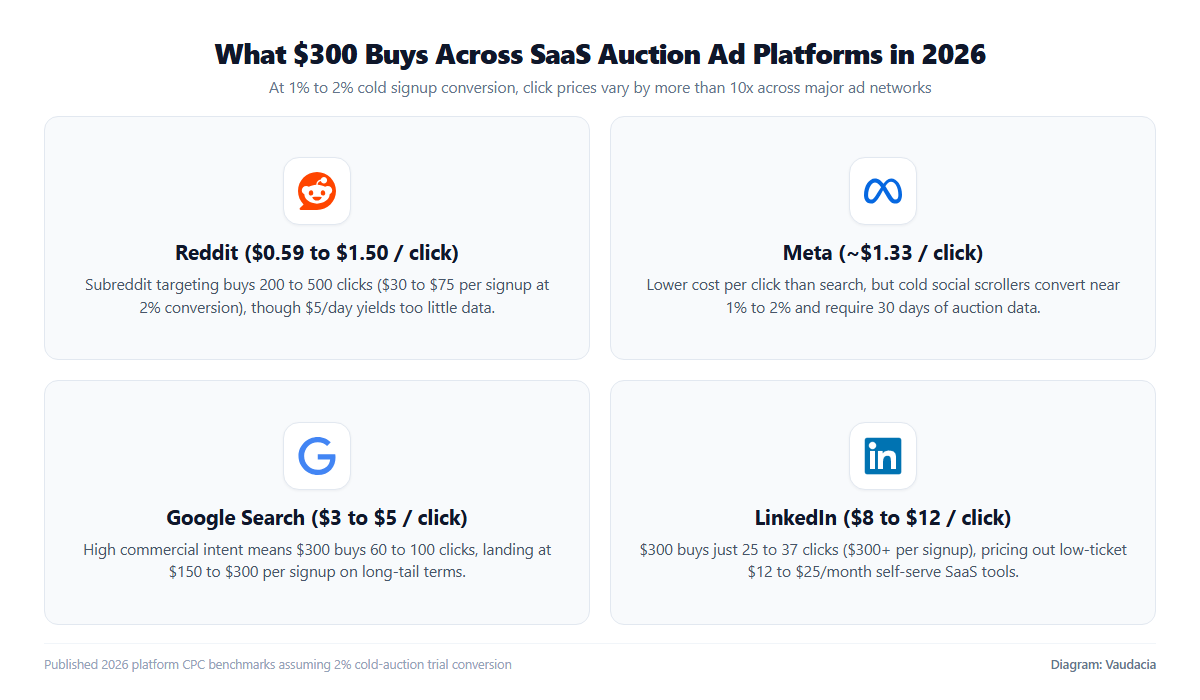
Reddit will happily take $5 a day from a founder with a working product and no marketing team. At the platform's typical cost per click in 2026, that buys three to eight visitors a day, which isn't a test of anything. It's a coin toss with an invoice attached, and the invoice is the only part that arrives on schedule. The mistake isn't picking the wrong channel. It's buying in the wrong format: single clicks sold at auction when what you needed was a fixed number of interested readers for a fixed fee.
- 1Platform floors are not test budgets: Reddit's $5 daily minimum buys three to eight clicks at 2026 rates. That's too few to learn from, which is why a real read on a cold auction channel needs four figures.
- 2Set a cost per signup ceiling first: Work back from the first three months of gross profit a customer is worth, then refuse to pay more than that per signup.
- 3Flat fees before auctions: A $29 monthly directory spotlight or a single newsletter send has a denominator you can count before you pay. A $5 daily ad set doesn't.
What a Small Budget Can Actually Buy
Advertising rates in 2026 vary by a factor of ten depending on the format. Reddit clicks average around $0.59 against $1.33 on Meta, while Google Search clicks on commercial keywords run $4 to $5 because the buyer's intent is already formed. Paid newsletter slots sit on a separate scale: general-interest lists trade at $15 to $30 per thousand opens, and B2B SaaS lists quote $90 to $180 for the same thousand. The same $300 lands in completely different places depending on which of those you buy.
One assumption decides which format suits you, and it's the share of clicks that become signups. Cold auction traffic on a self-serve SaaS converts at roughly 1 to 2 percent, while a reader arriving from a newsletter or a founder directory is already halfway sold and converts nearer 4 to 6 percent. A channel that looks three times more expensive per click can therefore be the cheaper one per signup. Cost per click is a price. Cost per signup is a result.
Same $300, five formats, using published 2026 rates rather than optimistic ones. The signup columns assume 2 percent for cold auction traffic and 5 percent for newsletter and directory traffic, so read them as planning figures.
The pattern holds across every combination: at this budget, flat fees beat auctions. A flat fee has a denominator you can count before you pay. An auction charges you for the privilege of guessing.
Buy the Audience Instead of the Impression
A single send to a 10,000-subscriber founder list costs about $300 at a $30 CPM, roughly the same as a month of Reddit at $10 a day. What it buys is an audience that opted in to the subject your product solves, and that difference shows up in the signup rate rather than the click price. B2B SaaS lists charge more, $90 to $180 per thousand opens, so a 10,000-subscriber SaaS newsletter is $900 to $1,800 a send and out of reach. The reachable version is smaller: a 2,000 to 5,000 subscriber list selling a flat $100 to $300 placement.
That's why a 3,000-subscriber list can charge what a 30,000-subscriber general list charges. The inventory is scarce in the only sense that matters, which is how many of the right readers are in the room, and scarcity rather than packaging is what sets that premium. Vetting takes four questions: the open rate, the last three sponsors, the clicks those sponsors got, and whether the publisher will take a CPA deal. Anyone who won't share click numbers is selling you an impression and keeping the result.
Paying per conversion removes most of the guesswork, which is the same logic behind affiliate and CPA deals, where the traffic buyer pays only for the action. Most small newsletters won't offer it. Ask anyway, because the ones that say yes have told you something useful about their confidence in the list.
The Cheapest Real Estate in the Category
Founder directories have become the cheapest real estate in the category. A sitewide spotlight on Best Million Startups runs $29 a month, which is six days of a $5 daily Reddit budget, except it keeps running on every page of the site for the whole month instead of stopping when the budget runs out. The traffic is smaller and the intent is narrower. For a product sold to founders, indie hackers, or freelancers, that trade usually goes the right way.
Launch sites are free but time-boxed: a spike, a badge, and a permanent page nobody revisits. A paid directory listing holds a position month after month, which matters more when your product needs three touches before anyone buys. The two work as a pair rather than as a choice.
The Dollar Inventory Problem
Ad inventory is priced in dollars and the price doesn't adjust for what your customers pay. A founder charging the equivalent of $12 a month in naira, shillings, or rupees meets a $4 Google Search click, and one click costs a third of a month's subscription before a trial even starts. The ceiling gets hit long before the budget does, so the channel looks broken when the pricing is the actual problem.
The workaround isn't a cleverer campaign. It's buying inventory where rates are set locally: regional tech newsletters, WhatsApp and Telegram groups where your buyers already argue about tools, and the events and hubs that invoice in local currency. These placements are harder to buy, which is much of why they stay cheap relative to their relevance.
Underneath all of it sits a pricing decision. If your product earns $12 per customer per month, no auction in a high-cost market will ever pay back, so you either raise the price for a narrower, better-funded segment or stay on free channels until contract value justifies the click.
Thirty Days, One Number
Tag every link with UTM parameters before the first dollar moves, and give each channel its own landing page so the signup in your dashboard traces back to the placement that produced it. Then set the ceiling: what the first three months of gross profit from one customer is worth. A $25 a month product at 80 percent gross margin earns about $20 a month before overhead, so three months is $60, and that's the most you can pay per signup while still funding growth from cash flow.
$300 a month against a $60 ceiling means five signups is break-even on the payback test. Not the point where you get rich, the point where the channel is allowed to continue. Auction channels need data volume before their numbers mean anything, so give them the full thirty days. A single newsletter send or directory placement can be judged after one month because there's no algorithm warming up.
Write the kill rules down before you spend: three sends with zero signups closes a newsletter, and one month at twice the ceiling closes an auction channel. A channel inside the ceiling gets its budget doubled once, to see whether the result holds at higher volume. It frequently doesn't, which is better to learn at $300 than at $3,000.
Where Free Still Does the Work
Paid buys an answer. Free builds the asset. Launch platforms, founder communities, one SEO page per problem your product solves, and twenty cold emails a day cost time instead of money, and they compound in a way a $29 spotlight doesn't. The only discipline required is measuring them the same way you measure paid, with a tagged link and a signup count, so the comparison means something.

There's a rule that saves money more reliably than any channel choice: only pay to send traffic to a page you already know converts, proven by free traffic. Advertising to an unproven landing page is paying $4 a click to test your own copy. For most solo founders that means one paid placement a month as a control while free channels carry the load, because paid works as a measurement instrument and an amplifier of what already works, in that order.
The founder who gets a return from $300 spends it in one place and moves the whole amount rather than a quarter of it. Splitting it across four channels produces four inconclusive experiments and one conclusion you can't act on. Ad platforms will keep selling daily minimums that feel like permission, because that's the product. What decides whether any of it worked is the number you wrote down before you spent: cost per signup, measured against a ceiling built from gross profit rather than optimism.
Comments (0)
No comments yet. Be the first to share your thoughts.