
Technical Case Studies Drive Consultant Inbound Pipeline
Why consultants with full pipelines write case studies for strangers and AI search rather than for the clients who already bought.

The case study page on most technical consultancies holds three entries, eight hundred words each, and every one ends with a client who was delighted with the results. They don't get forwarded. Meanwhile the buying committee that would have taken a discovery call in 2019 now builds its own shortlist before anyone picks up the phone, and what it reads first is whatever surfaces when an operations director asks an AI tool which firms have cut order-to-cash time at a mid-market manufacturer. The consultants filling their calendars without cold email made one switch. They started writing proof for the stranger who hasn't bought yet.
- 1Publication rights: Negotiate the right to publish anonymized metrics when the contract is signed, not when the engagement ends, because your leverage has evaporated by then.
- 2Buyer-specific proof: One engagement can produce three shorter studies aimed at the operations lead, the CFO, and the sales leader, each built around the number that person is judged on.
- 3Retrieval-ready structure: Figures written as plain text under plain headings, gathered on one results page, are what AI tools quote when buyers ask which firms have done this work before.
Why the Case Study Became the First Sales Call
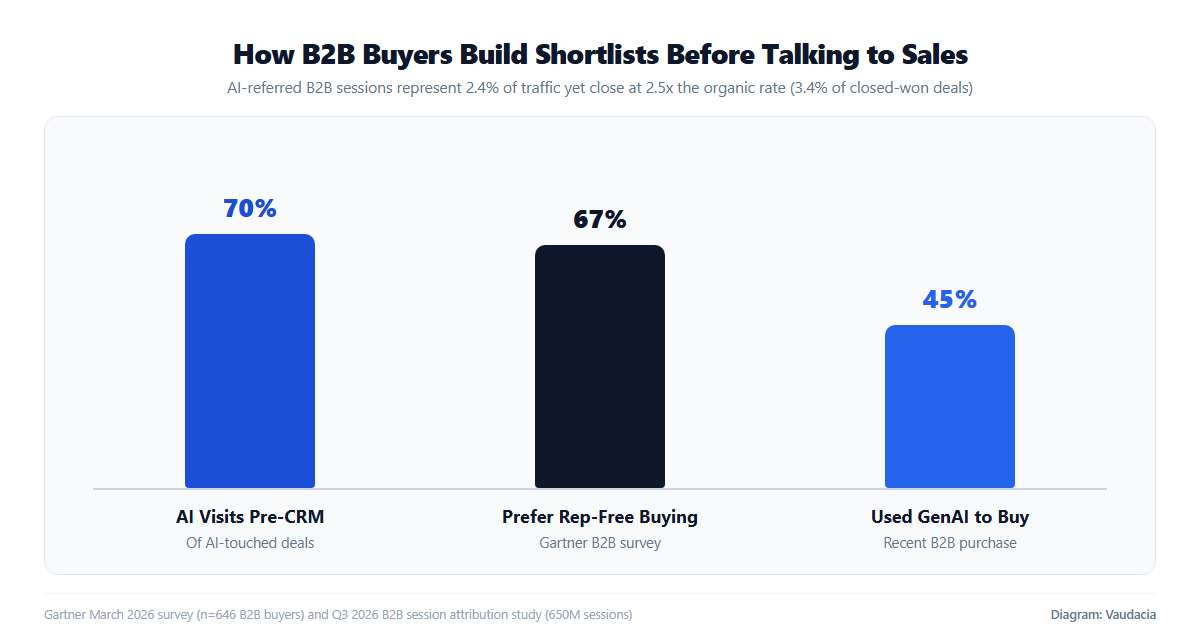
The scale of the shift is easy to misread. Research published in the third quarter of 2026 tracked 650 million B2B sessions from click through to closed-won revenue and found that AI search accounted for 2.4% of traffic but 3.4% of deals. Accounts arriving that way closed at 2.5 times the rate of organic ones, and seven in ten AI-touched deals had their first AI visit before the opportunity existed in the CRM at all.
Human behaviour points the same direction. Gartner's March 2026 survey of 646 B2B buyers found 67% prefer a rep-free buying experience and 45% had used generative AI during a recent purchase. The polite description is buyer self-education. The practical consequence is that the shortlist forms while you're still waiting for a form fill.
That leaves one asset doing the heavy lifting before a consultant ever speaks. A technical case study answers the only question a stranger actually has, which is whether you've solved this specific problem in a company that looks like theirs, and what moved afterwards.
Sign the Publication Clause Before the Work Starts
Most technical consultants say they can't publish numbers because clients won't allow it. In practice the ask usually arrives at the end of a project, in the wrap-up call, when the client has received everything they paid for and you have nothing left to trade.
A publication clause belongs in the proposal, next to the payment schedule, and it should hand the client three things: final approval on wording, the option to stay unnamed, and a veto on any figure that touches their own customers or suppliers. What you keep is the right to publish an anonymized version within 90 days of sign-off.
I'd argue that clause is the highest-return paragraph in a consulting contract, and that discounting your fee to win it is a mistake. A discount tells the client the proof was worth less than the invoice.
Write the Constraint, Not the Compliment
A case study that opens with the client's excellence carries no information. The structure that works is baseline, intervention, delta. What was the number before you arrived, what did you change, what did the number become, and over how many months.
The credibility sits in the constraint. A study that says a warehouse migration stalled for fourteen months because two teams owned the same table tells a buyer you've been inside a real mess. Naming what you refused to do, or what failed on the first attempt, does more work than three paragraphs of adjectives.
Insist on three figures at minimum: the operational metric the client tracks weekly, elapsed time to change, and the spend or headcount avoided. Round them, keep them in plain text, and date the study. Undated proof reads as though it was written once and abandoned.
One Engagement, Three Readers
The same project gets read by three people who don't care about the same thing. An operations lead wants cycle time and exception rate. A CFO wants fully loaded cost per transaction and headcount avoided. A sales leader wants ramp time and quota coverage. Give all three the same eight hundred words and none of them finds their number.
Run one long interview with the client sponsor, forty-five minutes, then cut it into three 250-word variants. Each variant leads with the metric that reader is measured on, and the long version stays on the site.
The one-pager earns its hours because it travels upward inside a client organisation without you in the room.

Give the Reader Something That Scores Them
A contact form asks someone who has just learned you might help them to perform interest. The moment after a case study is the one moment they're willing to check their own situation against yours.
A twelve-question self-assessment built from your last five engagements outperforms a generic PDF, because the output is a score and a score invites an argument. Build it from the questions you'd ask in the first discovery call anyway, then hand it over without a gate or with an email field and nothing more.
The completed answers also arrive as a discovery brief. You walk into the call already knowing which of the twelve things is broken, which is a better use of the first ten minutes than asking about their goals for the quarter.
Six Studies on One Page, Built for Retrieval
Scattered case studies on a blog do less than a single Results page, because buyers and language models both read collections. Six to eight studies with identical structure, the same headings, the same number of sections, and figures in the same place.
Retrieval has rules. Numbers need to be text in the HTML, never baked into a chart image, and never only inside a PDF, which is a dead end for most retrieval systems. Each study should name the industry and a size band, carry a date, and live on one canonical URL.
Question-shaped headings help more than clever ones. "How a logistics operator cut invoice exceptions by 40% in five months" is parseable. "Turning friction into flow" is not. A model quotes what it can compare, and it compares what you made comparable.
What the Asset Costs Against What It Returns
A long study runs ten to fourteen hours of senior time: the interview, a draft, two rounds of client review, the one-pager, and the cut-downs. At a blended $180 an hour that's roughly $2,000 to $2,500 of billing you didn't do, which is the honest price of the thing.
The return is lopsided in a way that rarely gets spelled out. If AI-referred sessions are 2.4% of traffic but 3.4% of closed-won, and they close at 2.5 times the organic rate, then per session they're worth about 3.5 times an organic visitor. Four hundred AI-referred sessions a year do the work of roughly 1,400 organic ones.
Even at an unglamorous close rate the breakeven is thin. A $45,000 engagement won at one in eight on inbound means each qualified inbound lead carries about $5,600 of expected value, which is exactly the kind of outcome-based anchor that makes value-based pricing hold up better than hourly billing. Two of those leads cover the production cost twice over, and the study keeps working for eighteen months while a paid campaign stops the day the budget does. The failure mode isn't a badly written case study. It's one case study, a fortnight of silence, and a retreat back to cold email.
That firm with eleven years of warehouse migrations and three studies ending in delight isn't short of expertise or even of happy clients. It is short of a document that a stranger, and the tool the stranger is asking, can compare against every other option on the table. That gap closes with a clause, an interview, and a number somebody agreed in writing to let you publish. It is the least creative work in the business, and it decides which consultants get introduced before the first call.
Comments (0)
No comments yet. Be the first to share your thoughts.