Whop Clipping Pays for Views; Affiliates Pay for Conversions
Short-form editors chasing $1 to $5 per thousand views on Whop learn quickly that view counts mean nothing if a clip fails brief rules, watermark bans, or empty escrow budgets.

Every month, a fresh wave of young editors boots up CapCut or Premiere, slices forty vertical highlights from a trending podcast stream, pulls 180,000 cumulative views across TikTok and YouTube Shorts, and refreshes their dashboard expecting $400 to hit bank payouts. Half of them wake up staring at $0.00 approved because two clips omitted required brand placement, a submission link arrived 45 minutes late, or the campaign escrow wallet ran dry while their reel was still accelerating overnight.
Understanding the split between Whop Content Rewards ("clipping") and recurring software affiliate marketing explains why raw views rarely convert smoothly into bank deposits. Both models monetize online attention without holding inventory or shipping physical boxes, yet their rejection triggers, verification bottlenecks, and cash-flow durability follow opposite rules. Reading Whop's clipping workflow mechanics alongside formal payout terms from Whop Earnings Terms and Opus Clip's Affiliate FAQ shows exactly why skilled editors get tripped up before clearing their first withdrawal.
How Whop Content Rewards Campaigns Work
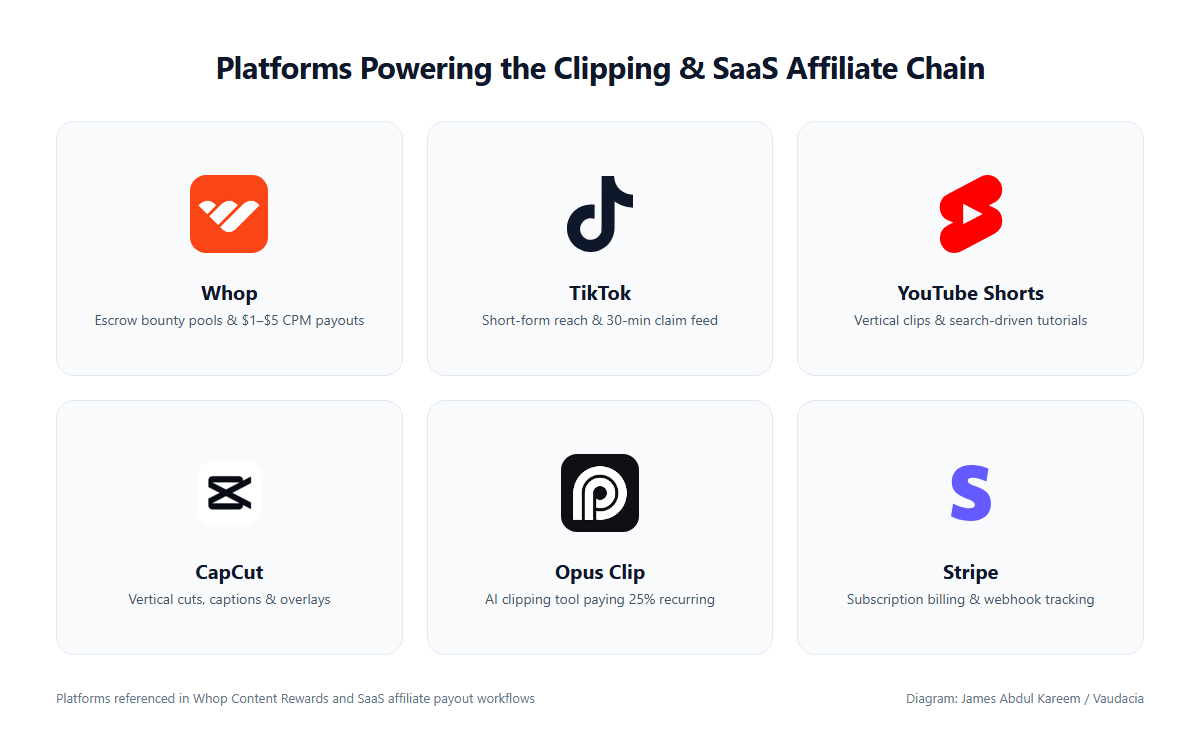
Inside Whop Content Rewards campaigns, podcasters, livestreamers, musicians, and mobile app founders preload an escrow pool paying editors on a flat CPM (cost per 1,000 qualified views). Rates commonly sit between $1 and $5 per thousand views depending on campaign budget and niche demand.
Rather than pitching sponsorship desks one by one through cold emails, editors grab raw source clips, tighten the pacing, add bold subtitles, and post them from niche theme pages. Once a clip goes live on TikTok, Instagram Reels, or YouTube Shorts, the editor pastes the published URL into the Whop campaign dashboard for automated tracking and review.
That low barrier to entry explains why clipping exploded among solo editors. You do not need an established personal brand, a sales call, or a media kit to start earning. If a 22-second podcast cut hooks viewers in the first two seconds, the platform algorithm supplies the reach on day one.
Why High-View Clips Still Get Rejected
Because campaign pools drain rapidly when one reel breaks out organically, campaign managers and automated moderation systems enforce strict rules. Almost every zero-dollar payout traces back to a handful of recurring misses.
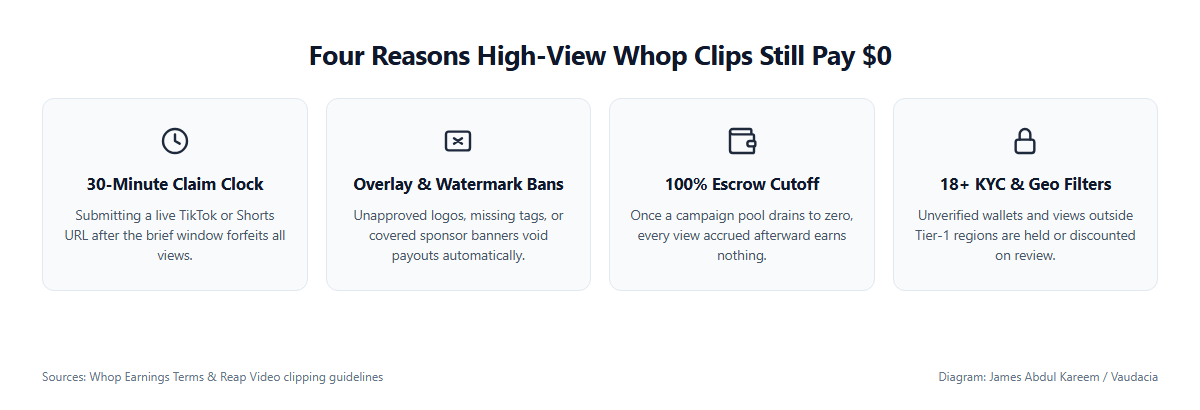
Many active campaigns enforce tight publish-to-claim clocks, frequently requiring creators to drop the live TikTok, Reels, or Shorts URL inside 30 minutes of hitting publish. That rule stops clippers from recycling month-old organic hits against newly funded escrow budgets.
Prompt and overlay noncompliance disqualifies clips just as fast. Dropping unapproved watermarks, placing subtitles directly over sponsor overlays, forgetting mandatory pinned tags, or failing exact audio-clip pairing invalidates a reel automatically even when watch-time metrics look solid. Unnatural view spikes from engagement pods, bought views, or unedited re-uploads trigger fraud flags across both platform filters and manual creator audits before payout clearance.
Escrow Exhaustion and the Weekend Cutoff Trap
Even clean edits run into three structural walls outside an editor's timeline. Once an active campaign's funded escrow balance hits 100%, new views accrued afterward earn zero regardless of algorithmic momentum unless the campaign owner deposits fresh capital.
Strong editors often underestimate how brutal a depleted escrow pool feels mid-surge. Spending three evening hours trimming four vertical cuts for a pool already sitting at 93% spent means three competing clippers can hit a weekend spike first and drain the remaining $300 before your videos finish indexing on Shorts. By the time your clip clears 80,000 organic views on Sunday morning, the campaign banner flips to "Completed" and every view past the cutoff pays nothing.
Whop also enforces 18+ eligibility and identity verification (KYC) checks before releasing accumulated wallet balances to bank rails, trapping underage editors who skip guardian legal compliance behind locked withdrawals. On geo-restricted consumer app briefs, views outside Tier-1 markets (US, UK, Canada, Australia) are frequently discounted on review as well.
How SaaS Affiliate Programs Grade the Same Traffic
SaaS affiliate programs like Opus Clip ignore view counts altogether. Nobody cares if your YouTube tutorial pulls 900 views or 900,000 views; payouts attach solely to verified paying conversions tracked through attribution cookies and Stripe billing webhooks.
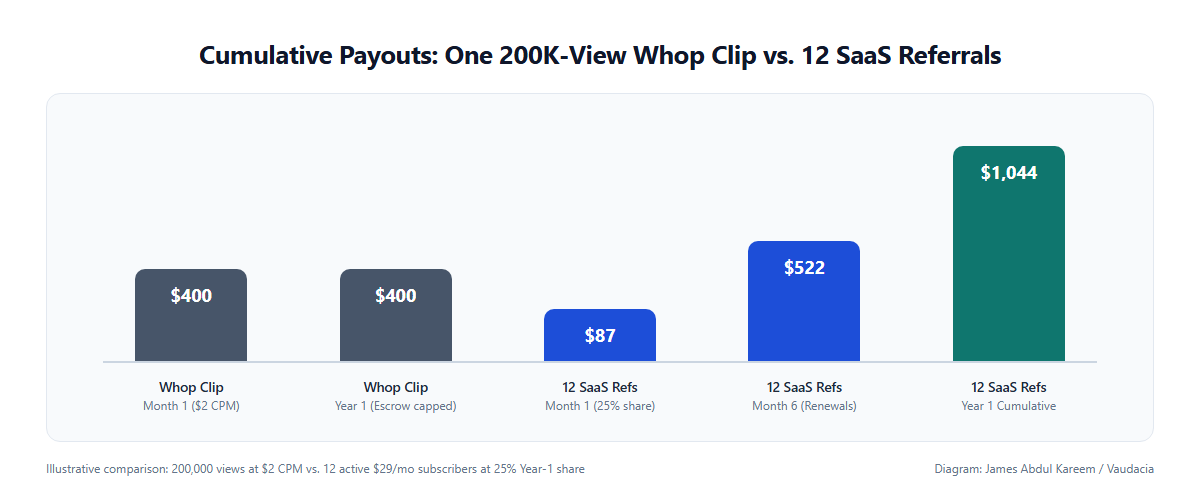
On Opus Clip's standard program tier, partners earn a 25% commission across Year-1 recurring payments from referred paid customers once cleared balances cross a modest $20 monthly payout minimum, paid on a fixed schedule around the 15th. A small search-ranking review tutorial pulling only 1,400 monthly views from working social media managers can comfortably outperform a viral 400,000-view meme page if twelve managers sign up for annual editing plans and keep renewing.
Affiliate programs carry their own attrition rules, though. Terms typically allow programs to deactivate dormant partner accounts that go extended periods with zero conversions, and free-trial signups that never convert to a paid invoice pay nothing.
Auditing, Attribution Windows, and Account Bans
Automated auditing polices affiliate dashboards just as aggressively as Whop moderates view spikes. Buying your own Pro plan through a secondary Gmail alias and virtual debit card flags billing fingerprints and cancels account payouts permanently.
Running Google Search ads bidding on branded keywords like "Opus Clip promo code" breaches partner terms and forfeits earned commissions retroactively. If a referred customer demands a refund inside the trial window or pushes a dispute through their card issuer, pending commissions drop right back off the partner ledger prior to the 15th monthly payout run.
Cookie durability introduces another gap newcomers miss. Most Whop campaigns judge clips across strict seven-day bursts tied to single social URLs, whereas SaaS affiliate dashboards attach 30-day or 60-day first-party referral cookies inside a prospect's browser. When an agency founder clicks your comparison link on Monday, runs internal budget checks for three weeks, and checks out on Friday of week three, a clean affiliate cookie catches that conversion without forcing you to publish fresh videos daily.
Clean device separation protects both income streams. Running multiple creator accounts behind shared consumer VPN exits or rotating residential proxies regularly triggers fraud-scoring blocks across both Whop KYC portals and SaaS partner networks before earnings leave pending status.
Side-by-Side Economics: Views vs. Conversions
Comparing the two models side by side clarifies why editors who treat them as interchangeable get burned on cash planning. Whop rewards immediate editing speed and hook intuition, while SaaS affiliates reward buyer intent and search trust.
That structural gap shows up most clearly after week one. A viral clip earns almost all of its payout inside a brief burst and drops to zero once the campaign budget closes, whereas a single evergreen workflow guide keeps collecting renewals across multiple billing cycles.
Turning Short-Form Speed Into Recurring Assets
Young solo operators rarely stick to Whop clipping forever, just as impatient beginners struggle waiting six cold months for SEO product reviews to rank while hosting bills arrive now. Treating clipping as paid technical sparring while routing audience trust toward recurring tools solves both cash gaps at once.
Inspect remaining escrow headroom before cutting a single minute of podcast footage, and pass on campaigns nearing depletion unless the sponsor has a multi-month reload streak. Run focused channel themes rather than mixing AI SaaS walkthroughs, gaming clips, and fitness highlights on one incoherent TikTok profile, and demonstrate software utilities inside workflow tutorials where a pinned bio link converts naturally.
Above all, stay clear of bought followers or Telegram engagement swaps: one noisy spam injection contaminates account trust scores across both TikTok's algorithm and affiliate attribution models. Over two or three quarters, the editing instincts forged inside high-pressure clipping briefs transfer straight into tutorial series, email lists, or recurring member communities that outlast fickle sponsorship payouts, giving you durable leverage long after any single podcast campaign cuts its CPM rate.
Comments (0)
No comments yet. Be the first to share your thoughts.