
The First $10,000 in Revenue Is a Buffer, Not a Budget
The first $10,000 rarely funds growth. Here is the operational allocation framework for reserves, debt elimination, and one critical constraint, plus what to leave alone.

The balance hits five figures on an ordinary weekday. For a solo operator the moment arrives without ceremony: a retainer clears, two invoices land, a project deposit posts. Within a week the browser holds eleven tabs of things the business supposedly needs, and the founder is pricing ad campaigns with money that hasn't been earned twice yet.
- 1Buffer before spend: At $10,000 in revenue, three months of fixed costs plus a real owner draw absorbs the whole sum, so there's no growth budget yet.
- 2Measure the payback loop: Reinvest only where you can name the customer count, the margin, and the month the money returns.
- 3Ignore the upgrade list: Ads, rebrands, second product lines and conference booths turn cash into hope until retention has 90 days of evidence behind it.
That first cushion tends to vanish through a hundred plausible small calls rather than one reckless one, and every call arrives with a reasonable story attached. The new machine is genuinely slow. The website genuinely looks dated. The ads course genuinely worked for somebody. None of it answers the question that matters in month two, which is whether the business survives a client who pays late.
A business at $10,000 has proven something real: somebody will pay for the offer. It hasn't proven the machine repeats, and the allocation choices made right here decide how much cash is left to find out.
Why the First $10,000 Buys Fragility Before Growth
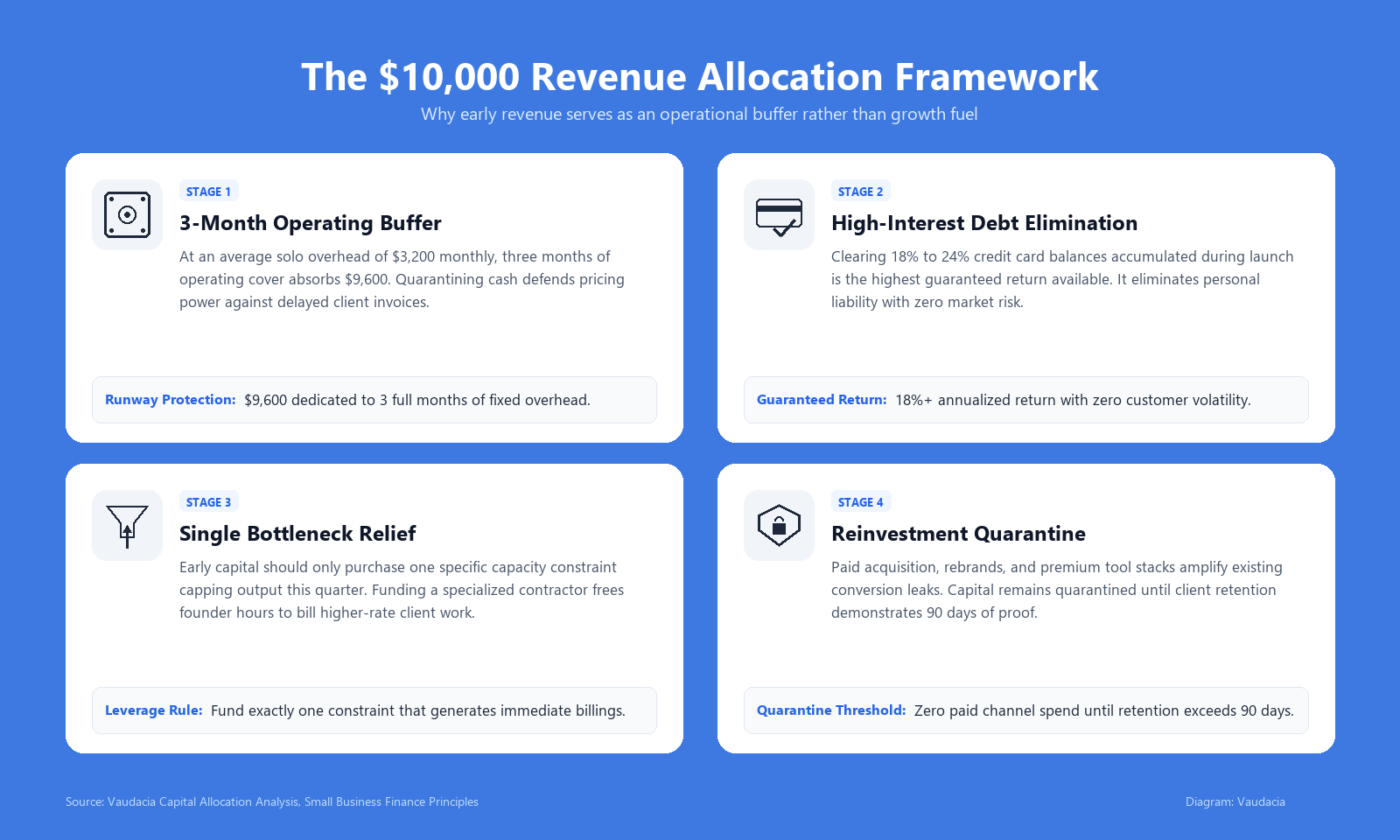
Write down the monthly cost of running the thing: software, insurance, accounting, hosting, phone, workspace, the subscriptions nobody cancels. A solo consultant who does that honestly usually lands between $2,500 and $4,000. At $3,200, three months of cover costs $9,600, which is effectively the whole $10,000 before you pay yourself anything.
That's why this is often the most expensive money the business will ever hold. It's the only cash that has to do the work of a lender, an insurance policy and a salary at the same time, and money that arrives later shows up when a buffer already sits behind it.
I'd argue the useful question here isn't the return on a spend but how many months of client disagreement you can absorb without cutting your price. That number protects a pricing position far better than a growth rate does, which is the same logic behind value-based pricing in year one.
The September issue of Harvard Business Review carries Paul Blase and Paul Leinwand's piece on how much a firm should invest in growth, and it opens on this failure at corporate scale: most companies get capital allocation wrong. The mistake looks familiar from the bottom up. A number gets pulled from convention, some fixed slice of revenue, instead of set against what a specific opportunity can absorb and return.
Geography changes the size of the buffer and the instrument, not the logic. In Lagos or Nairobi, three months of cover held in local currency is a buffer that shrinks while it sits, so part of it belongs in a stable unit you can access without fees eating the difference. In Lisbon, it can sit in a savings account.
The psychological pressure at this threshold is disproportionate. When a personal bank balance has hovered at low figures for months, seeing ten thousand dollars sitting in a commercial account triggers a spending reflex disguised as investment. The founder categorizes hardware upgrades, specialized software suites, and automated schedulers as operational necessities rather than elective expenditures. Each individually costs seventy or eighty dollars a month, but collectively they anchor an unproven business to high structural overhead before customer retention has been measured.
A disciplined operator counters this by establishing physical account segregation immediately. Splitting gross receipts across three separate accounts, an operating expense reserve, a tax escrow buffer, and a founder drawing account, prevents the illusion of unencumbered liquidity. If twelve hundred dollars of that initial ten thousand represents accrued state and federal tax liabilities, that capital was never yours to allocate. Leaving it mixed in a single operating balance guarantees an emergency borrowing cycle six months down the line.
The Three Lines That Earn a Share of the Money
The first line is your own pay, lifted to a floor you set in advance. A floor, not a market rate, is the right target at this size, because the point is to stop funding the business with personal credit while calling it reinvestment. A founder who draws nothing looks more profitable than the business is in reality, and that distortion gets priced into every later decision.
The second line is debt priced above what the business earns on cash. Clearing an 18% or 24% balance is the best guaranteed return available to a small operator, and it carries no customer risk at all. Nothing in the growth column beats that risk-adjusted, so the balance clears before the tools and before the ads.
The third line is the single constraint capping output this quarter. For most solo operators that's one hire: a bookkeeper so Saturdays stop disappearing, a contract developer for the integration that keeps stalling, a part time editor for the content nobody finishes. Buy the constraint rather than the category. One editor for three months beats six content subscriptions opened twice. Everything else waits. The rest of the spending may well be sensible, and it just doesn't touch the number that caps revenue this quarter.
This drawing floor serves an operational purpose beyond personal survival: it defends pricing composure. An operator with two weeks of personal runway left in their checking account will accept unfavorable contract terms, negotiate their day rates downward, or take on demanding scope creep simply to secure immediate cash inflows. Conversely, an operator who knows their baseline living expenses and fixed business overhead are insulated for ninety days approaches client negotiations from an uncompromised position. Cash in the bank functions as pricing power.
Calculate the Payback Window Before Spending a Dollar
Ten thousand dollars buys one meaningful swing, not three, so the choice has to be made against a return threshold instead of a wish list.
The right hand column is where founders fool themselves. The buffer figure is settled division: $10,000 split by $3,200 is 3.1 months, and nothing in it changes if the market does. The customer figure is a projection resting on a churn rate measured across maybe forty people. Treat the first as certain and the second as a hypothesis you're paying to test.
Payback is the only metric worth memorising at this size. A customer paying $50 a month at 80% gross margin returns $40, so a $250 acquisition cost comes back in a little over six months. Lose that customer in month four and the spend never returned at all, and buying a hundred more only scales the loss. The margin argument in this micro-SaaS breakdown applies to a consultancy too: a business running on small fixed costs needs a payback period it can survive, not capital.
The contractor test works the same way. Pay $2,500 a month and the spend only returns if the freed hours get billed at more than $2,500. That sounds obvious until you notice most founders free the hours and spend them on admin, which is the same work at the same rate with a second invoice attached.

What to Ignore Until the Loop Is Proven
Paid acquisition is the first thing to defer and usually the first thing purchased. Ads amplify whatever the funnel already does, leaks included. Until retention has 90 days behind it, a paid channel is a machine for buying customers you'll lose before you've recovered the cost of finding them.
A rebrand comes second. It's the most satisfying way to spend money without moving a single number. New typography doesn't shift conversion unless the old site was actively broken, and most founders can't tell you which version they own.
The list runs longer than people expect: a conference booth, a second product line, a generalist hire, a software stack promising to replace process, an agency retainer. Each one bolts a fixed monthly cost onto revenue that's still uneven, and fixed costs are what turn a slow month into a crisis.
A recurring cost should be payable from three months of gross profit, not three months of optimism. If one slow quarter would force you to cancel it, the timing is wrong.
One filter handles all of them. Ask what number you'll be able to read in 60 days that you can't read today. If the answer is a feeling about the brand, a follower count, or a vague sense that things look more professional, the money isn't being allocated. It's being spent.
What the Milestone Proves
The founder with eleven tabs open isn't careless. The signals feel urgent and real, and the pressure to look like a bigger company is genuine. The allocation that answers those signals buys three months of nothing going badly wrong, then stops.
The first $10,000 in revenue won't compound. It sits there, largely unspent, doing the least glamorous work in the business, which is buying time for the offer to prove it repeats. The operators who last past that number mostly keep it, then let month four tell them what they built.
Surviving the first $10,000 has less to do with how well it was deployed than with whether any of it is still there in month four, when a retainer pauses and an invoice doesn't land.
Comments (0)
No comments yet. Be the first to share your thoughts.