
A $30K Micro-SaaS Runs on $135 a Month. Margins Still Decide.
The real math behind a $30K micro-SaaS with a $135 hosting bill, and why the margin depends on hours nobody invoices.

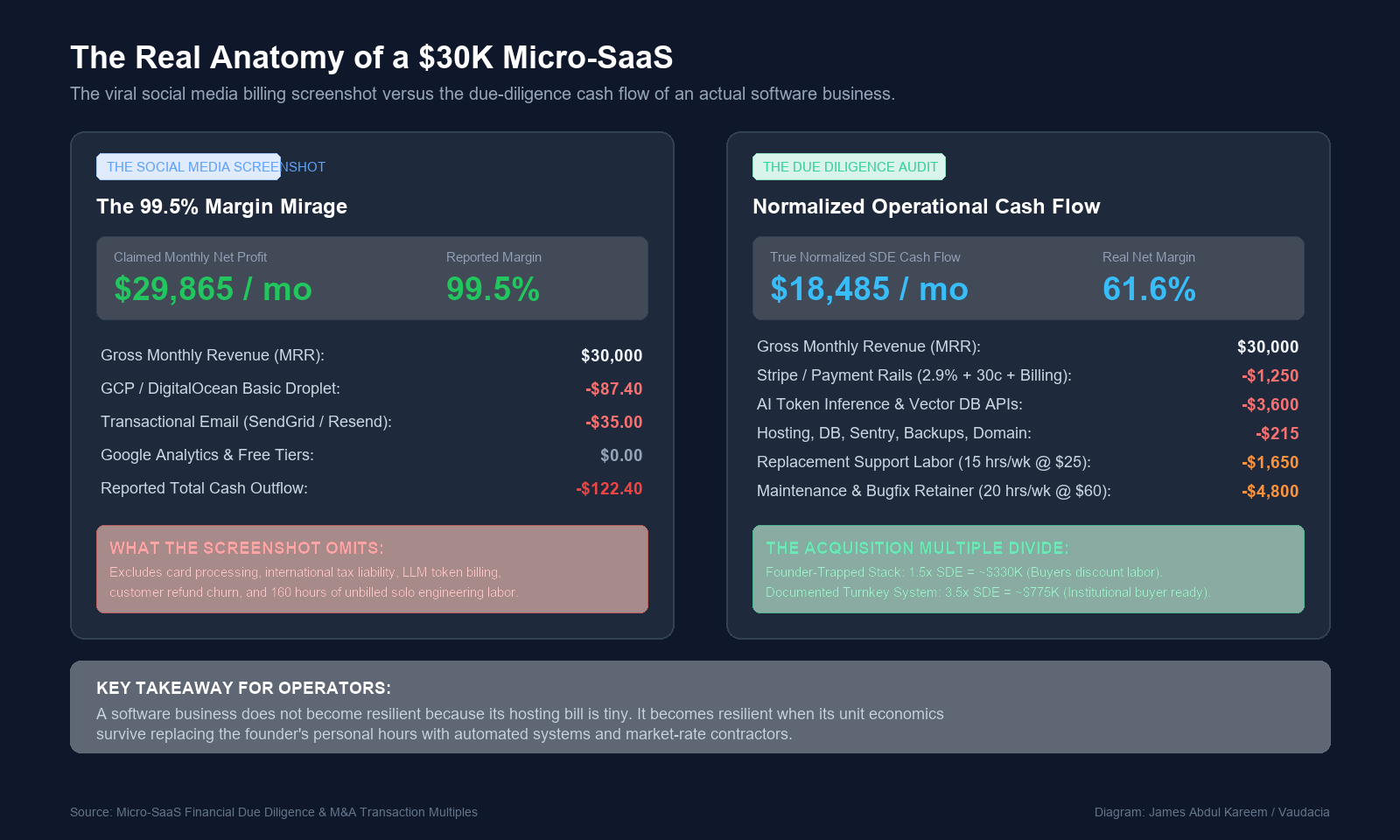
Every few weeks, a familiar screenshot makes the rounds on developer forums and bootstrap communities. A solo founder shares their monthly Google Cloud or DigitalOcean dashboard showing a compute charge of $87.40, a transactional email invoice for $35, and a free-tier analytics dashboard. Directly beside it sits a Stripe dashboard displaying $30,000 in monthly recurring revenue. The caption is almost always the same: software is the greatest business on earth because running the entire company costs less than a decent dinner for two, a culture of viral vanity metrics analyzed in The 50 Most-Shared SaaS Tweets Reward the Wrong Thing.
- 1Hosting is a rounding error, payment processing is not: A $30,000 MRR software product can easily run on $135 a month for cloud compute, database hosting, and transactional email, but credit card processing, billing fees, and currency conversions quietly eat eight to ten times that amount.
- 2Founder hours are an unrecorded subsidy: Claiming a 99% profit margin is only possible when the person writing the code, answering customer support tickets, and running database hotfixes bills their own labor at zero dollars.
- 3Acquirers price operational durability, not server bills: Small software businesses sell on Seller's Discretionary Earnings (SDE), not raw top-line revenue. When a buyer deducts the cost of hiring contractors to replace the founder's weekly workload, paper margins drop from 99% to roughly 55% to 65%.
- 4The wrapper margin trap: If a micro-SaaS relies on third-party AI models or external data scrapers, unmetered usage can turn a healthy gross margin into a negative balance sheet overnight unless hard token budgets and usage tiers are enforced.
The screenshot is technically accurate on an accrual accounting basis, but financially deceptive as an operating philosophy. The $135 hosting bill is real, yet it creates a dangerous illusion for early-stage builders. It treats the physical server as the sole cost of delivering software, while completely ignoring the payment friction, compliance overhead, third-party API token consumption, and hundreds of unbilled human hours required to keep 600 paying customers from churning.
Understanding what that $135 figure truly represents, and where the remaining money actually flows, is the difference between running a fragile lifestyle app and building a defensible software asset that can survive an audit, hire help, or sell for a life-changing multiple.
What the $135 Hosting Bill Actually Buys
The server stack behind an ultra-lean micro-SaaS is intentionally simple. In an era where venture-backed enterprise companies spend hundreds of thousands of dollars on Kubernetes clusters, microservices, and dedicated DevOps engineering teams, bootstrappers have rediscovered the raw efficiency of boring technology.
A single virtual machine on Hetzner, DigitalOcean, or Google Cloud Platform running for $60 to $90 a month can comfortably serve tens of thousands of daily requests when configured properly. Pair that with a localized SQLite database or a managed PostgreSQL instance, route transactional emails through Resend or SendGrid for $35, and point DNS records through Cloudflare's free proxy tier. For lightweight CRUD (Create, Read, Update, Delete) applications, this architecture is not just cheap; it is blazingly fast and remarkably stable.

Many solo founders take this minimalism even further by adopting what the industry now calls "vibe-coding": writing vanilla HTML, lightweight CSS, and modular backend JavaScript with the assistance of modern language models, skipping complex build pipelines, Docker orchestration, and heavyweight frontend frameworks altogether.
That technical decision saves significant cash during the first year of operation. Framework upgrades and dependency rot consume weeks of unbilled development time, and avoiding build tools eliminates random Sunday morning deployment failures. If a solo founder can prompt an AI assistant to generate a functional webhook handler in twenty minutes, they avoid paying thousands of dollars in monthly developer retainers.
The hidden risk is that simplicity on an invoice often masks architectural fragility. When an entire codebase is stitched together through prompt iterations without formal documentation, automated integration tests, or consistent database migrations, comprehension exists only inside the founder's head. If that founder gets sick, burns out, or attempts to onboard a junior contractor, the technical debt immediately surfaces. A stack that costs $135 to host can easily cost $10,000 in emergency refactoring the moment an upstream API updates its authentication protocol.
Payment Rails Cost Eight Times More Than Hosting
The moment you look beyond the hosting invoice, the math behind a $30,000 software business shifts dramatically. While infrastructure scales sub-linearly, payment collection scales directly with revenue.
Assume a business brings in $30,000 monthly with an average subscription price of $49 per user. That represents approximately 612 individual credit card transactions every thirty days. Stripe's baseline domestic processing fee is 2.9% plus 30 cents per transaction. On 612 successful charges, the percentage cut consumes $870, and the per-transaction fee takes another $184, totaling $1,054 per month.
That alone is nearly eight times the entire server bill. But real-world payment collection rarely stops at domestic baseline fees:
- International Card Surcharges: Cross-border transactions incur an additional 1.5% fee on Stripe, plus an extra 1% to 2% if currency conversion is involved. If 30% of your customer base resides in Europe, Canada, or Australia, payment processing quietly climbs past $1,250 a month.
- Stripe Billing and Invoicing: Automated recurring subscription management, customer portal hosting, and failed payment dunning sequences carry an additional 0.5% to 0.8% fee on gross volume.
- Disputes and Fraud: Every disputed charge carries a non-refundable $15 fee from the card networks. More dangerously, if your dispute rate crosses 0.75%, payment processors will place your account under review or enforce a rolling reserve, freezing 10% to 20% of your cash flow for ninety days.
- Emerging Market Rails: For founders operating outside the primary dollar ecosystem, payment friction is even higher. Payment gateways like Paystack charge 1.5% plus local fees on domestic Nigerian transactions and 3.9% on international cards. An entrepreneur in Lagos or Nairobi pays a significantly higher proportion of their gross revenue to payment rails than a founder in Austin or London.
Payment processors take their slice off the top of every successful dollar before your bank account ever sees it. When low-tier subscriptions sit at or , fixed transaction fees devour an outsized percentage of your margins, which is why Your Micro-SaaS Niche Is Too Cheap, Not Too Small emphasizes that lifting contract values is the most reliable way to insulate small software tools against processing drag. Hosting providers bill a predictable flat fee; payment rails take an equity-like tax on your commercial growth.
The Global Tax Compliance Minefield
Beyond transaction percentages sits the single biggest blind spot in the bootstrap community: indirect tax compliance.
If you sell digital software subscriptions to customers in the European Union, the United Kingdom, Canada, or specific American states that enforce economic nexus thresholds, you are legally required to calculate, collect, and remit value-added tax (VAT) or sales tax.
Many solo developers ignore this entirely in the early days, assuming that a small digital product is beneath regulatory notice. That assumption works until you attempt to sell the company or your payment volume crosses statutory thresholds. During acquisition due diligence, buyers will scrutinize your historical tax filings. If you have collected $360,000 in annual software revenue across forty countries without remitting EU VAT, the unpaid liability along with associated interest and penalties is deducted straight out of the purchase price or held in an escrow account for eighteen months.
To avoid this trap, founders increasingly choose between two paths:
- Stripe Tax: Adds roughly 0.5% per transaction to calculate tax rates automatically, but leaves the actual filing and foreign registrations on the founder's plate.
- Merchant of Record (MoR) Providers: Platforms like Paddle or Lemon Squeezy act as the legal reseller of your software. They charge a higher fee (typically 5% plus 50 cents per transaction), but they assume complete liability for global tax registration, remittance, and audit compliance.
On $30,000 of monthly volume, opting for a Merchant of Record pushes your payment processing and compliance bill from $1,050 to nearly $1,800 a month. That is thirteen times the hosting cost, yet it buys absolute peace of mind and preserves enterprise value for an eventual exit.
The Variable API Dependency Trap
For traditional software tools that manipulate static databases, gross margins routinely sit between 75% and 85%. But in the current wave of micro-SaaS applications, a substantial portion of new products are thin wrappers built around third-party artificial intelligence models, web scrapers, or proprietary data feeds.
In an AI-enabled software product, every customer interaction carries a variable marginal cost. A single user who runs fifty document summaries, generates thirty marketing graphics, or queries an automated research agent consumes external tokens from providers like OpenAI, Anthropic, or specialized vector databases.
Consider the unit economics of a product handling 200,000 monthly API calls:
A flat-rate subscription model without strict usage metering is a recipe for silent margin destruction. If you charge $49 a month for "unlimited" access, an aggressive user or an automated bot network can easily consume $150 worth of raw token calls in three weeks. The founder only discovers the deficit when their credit card is charged on the first of the following month.
Protecting your margins requires implementing strict per-seat token allocations, caching frequent prompt completions, and establishing automated rate limits. Variable costs scale with customer enthusiasm, which makes unmonitored usage far more dangerous than an undersized server.
The Hours That Never Appear on an Invoice
The most significant subsidy inside any solo software business is the founder's personal time. In economic terms, this is known as unrecorded sweat equity.
At $30,000 monthly revenue with an average customer value of $49, an operator manages roughly 612 accounts. Even in a well-designed self-serve application, an active subscriber base of that size generates between twenty and thirty customer inquiries every single week:
- Billing disputes, invoice updates, and credit card failure inquiries.
- Account permission modifications and seat reassignment requests.
- Edge-case bug reports across outdated browser engines and mobile viewports.
- Feature requests, integration troubleshooting, and onboarding guidance.
Handling those communications takes twelve to fifteen hours a week. Writing feature updates, monitoring server telemetry, and fixing bugs takes another twenty hours. That represents roughly 140 to 160 hours of monthly labor.
Because the founder takes a dividend rather than drawing a formal W-2 salary, that labor is treated as free on social media dashboards. But if that founder decided to step away, a replacement support representative would cost at least $1,500 to $2,000 a month, and a competent part-time software engineer would command $4,500 to $6,000 a month just to keep the application operational.
The business is undeniably profitable, generating over $18,000 in real economic cash flow. But it is not a 99% margin software miracle. It is a 60% margin enterprise where one person works two full-time jobs: one as an executive taking profit, and one as an underpaid systems administrator absorbing operational friction.
How Acquirers Actually Value a Micro-SaaS
When small software businesses change hands on marketplaces like Acquire.com, Quiet Light, or Flippa, buyers do not value the business based on the hosting invoice or raw monthly revenue. They evaluate Seller's Discretionary Earnings (SDE).
SDE is calculated by taking net profit, adding back discretionary owner expenses, and then deducting the necessary cost of replacing the founder's daily labor.
If an acquirer discovers that a $30,000 MRR tool only runs because the founder spends forty hours a week answering customer emails and writing uncommitted hotfixes in production, they apply a severe risk discount:
- The Founder-Trapped Asset: A business with zero documentation, spaghetti code generated through chat prompts, and high customer support dependency typically trades at 1.5x to 2.2x SDE. On an adjusted $220,000 annual SDE, that translates to a sale price of $330,000 to $480,000.
- The Turnkey Automated System: A business with a modular codebase, automated unit tests, self-serve billing, documented standard operating procedures (SOPs), and an outsourced support contractor trades at 3.0x to 4.0x SDE. That same revenue stream yields an exit valuation of $660,000 to $880,000.
Buyers purchase cash flow, but they pay premiums for autonomy. The gap between a mediocre exit and a life-changing payout is not another hundred subscribers; it is whether the software can run smoothly while the owner is on vacation for two weeks.
The Resilient Micro-SaaS Blueprint
Transitioning from a fragile, screenshot-driven project to a resilient, high-margin software business does not require turning into an enterprise bureaucracy. It requires implementing four pragmatic guardrails:
1. Build Self-Serve Infrastructure for the Top Five Inquiries
Analyze your support inbox. Over 70% of customer tickets typically fall into five basic categories: receipt downloads, subscription cancellations, email changes, API key regeneration, and plan upgrades. Building self-serve buttons for those five actions takes two days of development, but permanently reclaims ten hours of your weekly schedule.
2. Offload International Tax to a Merchant of Record
Unless you have the capital and accounting infrastructure to register for tax nexus in dozens of jurisdictions, use a Merchant of Record like Paddle or Lemon Squeezy from your first paying user. Paying an extra two percentage points on payment fees is the cheapest insurance policy in software.
3. Implement Hard Usage Caps on Third-Party Tokens
Never offer true "unlimited" plans on features powered by external APIs. Provide generous tiers, but implement hard monthly consumption caps with clear dashboard progress bars. If a power user exhausts their allocation, require them to upgrade to a higher tier or provide their own API key.
4. Create Documentation as You Code
Maintain a clean repository wiki containing three essential files: a local development setup guide, an environmental secrets manifest, and a deployment runbook that explains how to restore the database from an off-site backup. If another developer can clone your repository and deploy a bugfix in under two hours without calling you, your business is instantly worth twice as much.
The solo founder celebrating an $87.40 cloud invoice on a Tuesday morning has achieved something genuinely impressive: finding product-market fit and building a cash-generative digital business. The goal is not to bloat that bill with unnecessary enterprise tools, but to see the numbers clearly. When you account for payment rails, tax compliance, API token costs, and your own valuable time, you stop chasing social media vanity metrics and start building an enduring software company.
Comments (0)
No comments yet. Be the first to share your thoughts.