Yuan Settlement in Africa Grows. Yuan Reserves Won't.
Beijing is building yuan settlement scale across Africa through debt swaps and CIPS access, but the currency still can't be earned.

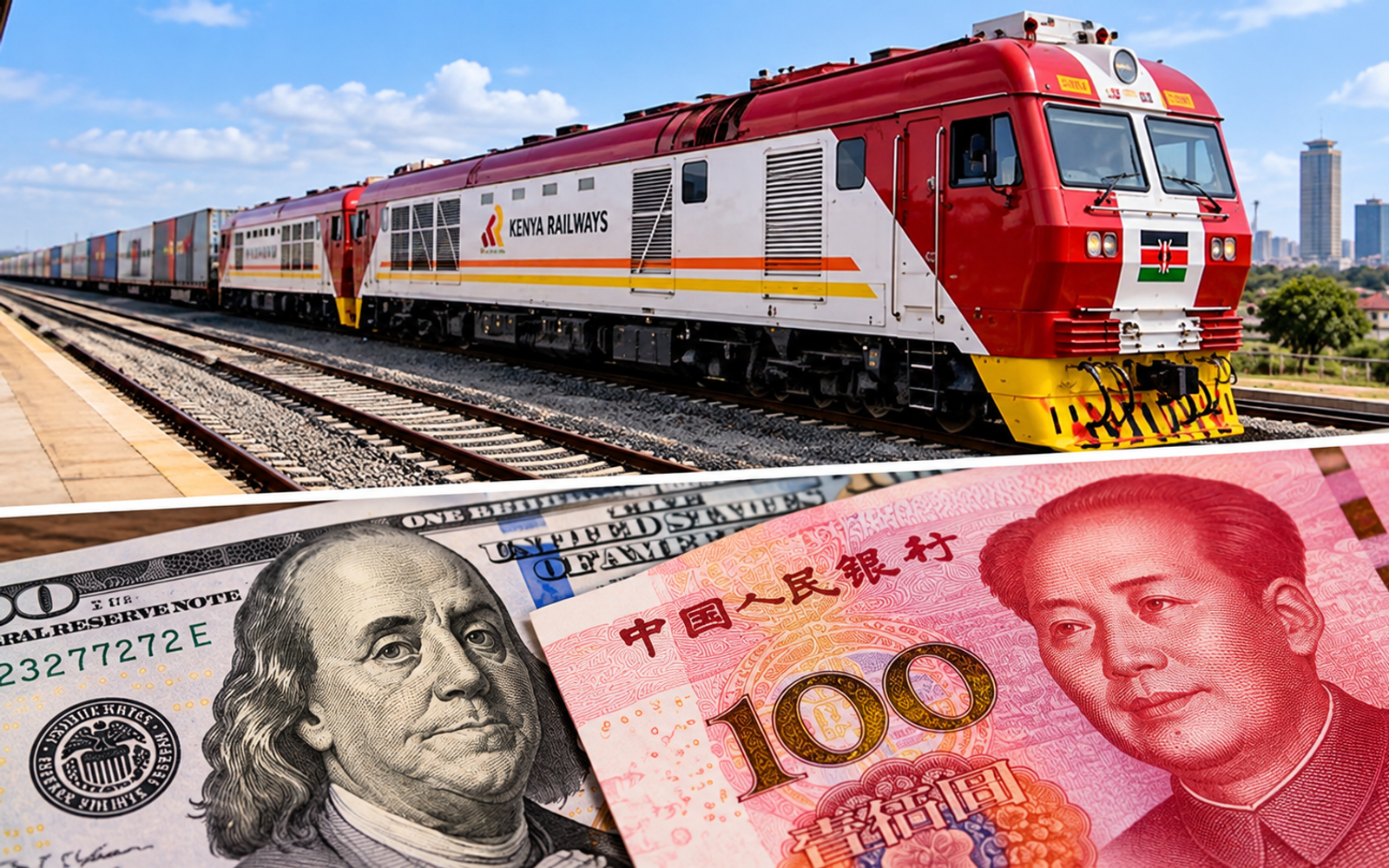
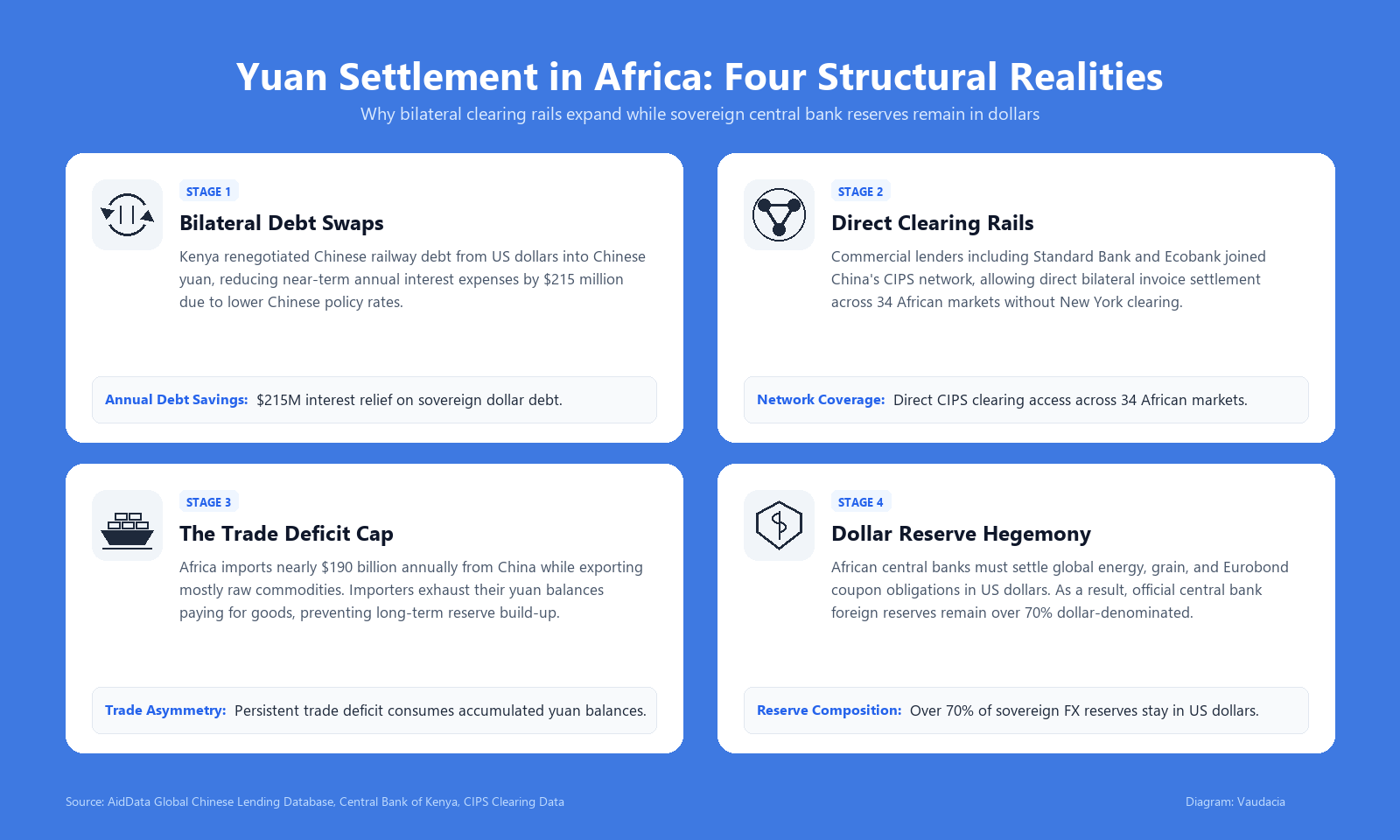
Kenya's Treasury converted the dollar balance of its Standard Gauge Railway loans into yuan in October 2025, and the figure that circulated through African finance ministries was $215 million. That was the annual debt service saving Nairobi booked on roughly $3.5 billion of Chinese Export-Import Bank debt, measured against the $1 billion a year it had been paying China. Bloomberg reported the saving as the centrepiece of the deal, and the framing stuck. A debt-stressed frontier borrower cut its annual bill by a fifth and, in the process, handed Beijing a small victory in its long campaign to internationalise the renminbi.
- 1Debt math, not de-dollarization: Kenya cut $215 million a year from its China loan bill by converting dollar debt into yuan, a saving worth about 6% of the principal and easily erased by currency moves.
- 2Payment rails came first: Standard Bank, Afreximbank, Bank of Kigali and now Ecobank have connected to China's CIPS network, giving African corporates a direct route for yuan settlement across 34 markets.
- 3The trade deficit caps the currency: Africa buys close to twice what it sells to China, so yuan has to be borrowed rather than earned, which limits it to a financing currency on the continent.
Both readings are accurate and both miss the mechanism. What Kenya signed was a currency conversion, which means it also signed up to a set of exposures no African treasury has much experience pricing. In the same period, the plumbing that makes such deals usable was being laid elsewhere on the continent, bank by bank, quietly.
The Numbers Kenya Signed Up For
Start with the ratio nobody quoted. A $215 million annual saving on $3.5 billion outstanding works out to about 6.1% of principal per year, and that percentage is the whole story. Every 1% move in the shilling-yuan rate shifts the value of that $3.5 billion by $35 million. A six percent appreciation of the yuan against the shilling, spread across the remaining life of the loan, absorbs an entire year of the savings. That is the size of the position Kenya took, whether or not anyone in the Treasury modelled it that way.
The conversion also bundled three concessions into a single document: a lower coupon, longer maturities and a change of currency. Research group AidData, in analysis reported by Reuters, concluded that the transaction was a restructuring wearing a currency label, and the same report noted that at least five other African governments have asked about similar conversions. Read the structure closely and the interpretation is hard to dispute.
Kenya's deeper problem is that it doesn't earn much yuan. Its sales to China are modest next to what it buys, so servicing a yuan loan requires either export receipts in yuan or repeated conversion out of shillings and dollars. A country that ships tea, coffee and horticulture to buyers who pay in dollars still carries dollar risk on the revenue line, and now carries yuan risk on the liability side. The mismatch didn't vanish, it moved.
Where the Payment Rails Now Sit
The more consequential story lives in the interbank layer, where the numbers are duller and the direction clearer. China's Cross-border Interbank Payment System processed 175 trillion yuan, about $24.4 trillion, in 2024, up 43% on the prior year. Standard Bank became the first African lender to join as a direct participant in November 2025, with Afreximbank alongside it and Rwanda's Bank of Kigali joining in the same window.
Ecobank signed on in October 2026. Its chief executive, Jeremy Awori, told Reuters: "CIPS is an important part of the infrastructure supporting international RMB payments." The pan-African group operates across 34 African markets, which turns a bilateral clearing arrangement into something closer to a continental rail.
Bank participation is a commercial decision rather than a diplomatic one. African lenders with Chinese trading clients lose the business to Chinese banks when every invoice has to route through a dollar correspondent in New York or Hong Kong. Direct CIPS access removes a conversion step and a settlement delay, and it lets the local bank keep the client relationship, which is the part that earns fees rather than spreads.
The volume trend argues against overreading any of this. CIPS growth flattened sharply in 2025 after the 2024 surge, which means the network is not compounding at the rate the headline figure implies. Payment infrastructure usually exists ahead of demand, and CIPS in Africa fits that pattern.

The Surplus That Caps the Currency
Two-way goods trade between Africa and China hit a record $275 billion in 2024, with Chinese goods sent into the continent accounting for about $182 billion of it. Africa buys close to twice what it sells. That gap is the binding constraint on the yuan's prospects, because it determines which direction the currency has to travel.
A currency internationalises through two channels. Foreigners hold it as a store of value, which requires current account surpluses or deep, liquid financial markets under the issuing government's control. Or foreign borrowers take it on as debt, which requires a willing lender. Africa's position with China points firmly at the second channel. Standard Chartered notes that China accounts for over 15% of global trade while less than 5% of that trade is settled in renminbi, a gap that reads less like unexploited opportunity and more like a feature of a surplus economy that doesn't push its currency abroad through its trade account.
Global payment data fits. In June 2026 the renminbi held 3.10% of SWIFT payments by value against the dollar's 50.10%, and 8.00% of trade finance against 81.16%. Trade finance is where the yuan is strongest, because that's the corner of banking where the exporter chooses the invoice currency.
Two conclusions follow. The yuan has real traction as an invoicing and financing currency in the parts of the world that buy from China, and almost none among anyone who sells to someone other than China.
Who Ends Up Holding the Risk
The currency risk Kenya took on moves slowly, and the market for hedging shilling-yuan exposure over three to five years is thin to nonexistent. A Nairobi importer can hedge a dollar payable with a forward at a quoted price from three or four banks. The same importer asking for a twelve-month yuan forward will get a wide spread, if it gets a quote at all. That absence of a hedge market is what turns a modest currency exposure into a balance-sheet problem for the borrower and a margin problem for the bank.
Go Deeper
Why Rest No Longer Recovers YouYen-denominated lending across Asia in the 1980s looked cheap for exactly the reason yuan lending looks cheap in Africa now: a low coupon in a currency the borrower doesn't earn. When the yen roughly doubled against the dollar after the 1985 Plaza Accord, the low coupon turned into a far larger principal burden measured in local currency.
What a finance ministry buys at signature is breathing room, and the room is genuine. Kenya's saving is cash in the year it's booked, which counts for a lot when domestic borrowing is expensive and dollar bond yields are unforgiving. If dollar funding stays costly at the long end, a five percent Treasury yield that repriced global risk assets keeps pushing finance ministries toward alternatives, and the yuan is the only alternative with a lender attached.
For a corporate treasurer the calculation is narrower and more honest. Dollar invoicing on a Chinese import involves two conversions, and the friction sits in the spread between them. At 25 basis points of round-trip cost, shifting even half of Africa's $182 billion of Chinese imports into direct yuan settlement puts roughly $228 million a year back on the table across the continent, before anyone thinks about hedging. That's the real size of the efficiency gain, and it's a smaller prize than the political headlines suggest.
The Variable That Decides This
The unresolved question isn't whether more African central banks sign swap lines or more lenders join CIPS. That's already under way and will continue, because the commercial logic is sound and the political cover is free.
The question is whether yuan liquidity inside Africa becomes deep enough that a local bank can fund a three-year yuan liability and hedge the local currency leg at a price a mid-sized importer will accept. That requires a clearing bank, a working money market and a swap line that gets drawn rather than merely renewed. Until those three exist together, the yuan can be the currency an invoice is written in without becoming the currency a balance sheet is anchored to, and that is exactly the arrangement China has built across the continent so far. The yuan is becoming the currency African trade settles in without becoming the currency African reserves are held in.
Disclaimer: This article is for informational purposes only and does not constitute financial advice. Past performance is not indicative of future results. Consult a qualified financial advisor before making investment decisions.
Comments (0)
No comments yet. Be the first to share your thoughts.