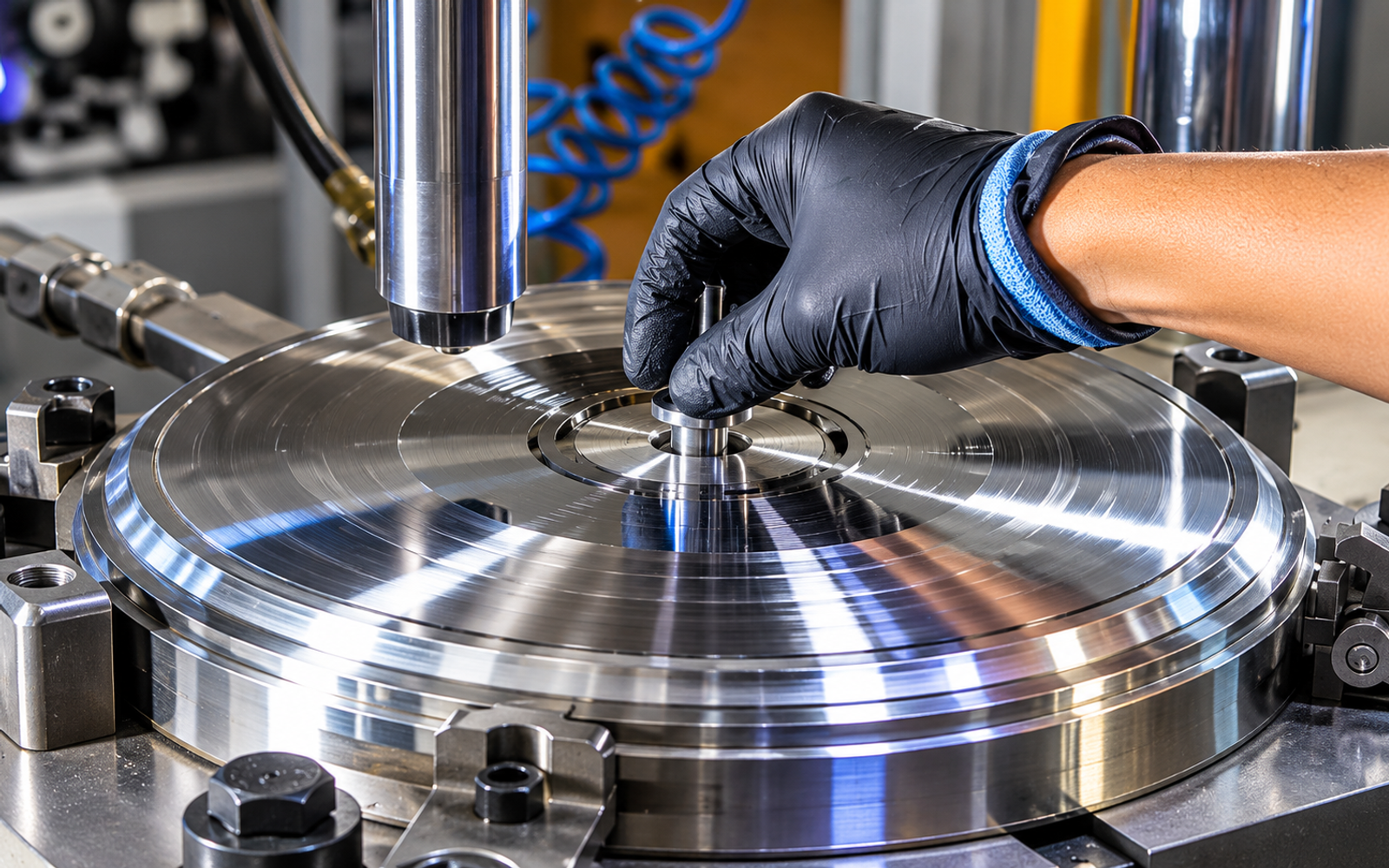
Vinyl Pressing's Real Bottleneck: One Lacquer Factory
Vinyl keeps selling, but a single Japanese factory supplies the world's lacquer discs. That's why a record still takes a year.

Vinyl records cleared 1.4 billion dollars in United States retail revenue over the past year, moving nearly 48 million new physical albums and outselling compact discs for the fourth consecutive year. As digital streaming feeds became saturated with disposable content, listeners gravitated toward tangible physical ownership rather than ephemeral playlists. Yet if an independent record label books a five-hundred-copy run of a debut album today, the plant manager will quote an estimated delivery window of nine to twelve months.
- 1The Single-Factory Monopoly: A chemical fire in 2020 destroyed Apollo Masters in California, leaving MDC in Yokohama, Japan as the sole global supplier of analog lacquer mastering discs.
- 2The Chemical Barrier: Lacquer discs require nitrocellulose resin, a volatile compound chemically related to guncotton. Extreme environmental regulations make permitting new western chemical plants nearly impossible.
- 3The Pop Star Squeeze: Modern pressing delays are exacerbated when major record labels monopolize electroplating baths and hydraulic lines to press hundreds of thousands of multi-color vinyl variants for arena artists.
Musicians assume the delay is caused by a shortage of hydraulic presses. That assumption is wrong. Over the past five years, venture-backed pressing plants from Toronto to Prague spent tens of millions of dollars installing modern automated presses from manufacturers like Viryl Technologies and Newbilt. The machines are sitting on factory floors, fully operational, waiting for metal stampers that never arrive.
The true choke point of the entire global vinyl format is an unglamorous, highly volatile twelve-inch plate: the analog lacquer disc. And in 2026, the entire music business depends on a single chemical workshop in Japan to manufacture them.
The Night the Global Supply Chain Burned
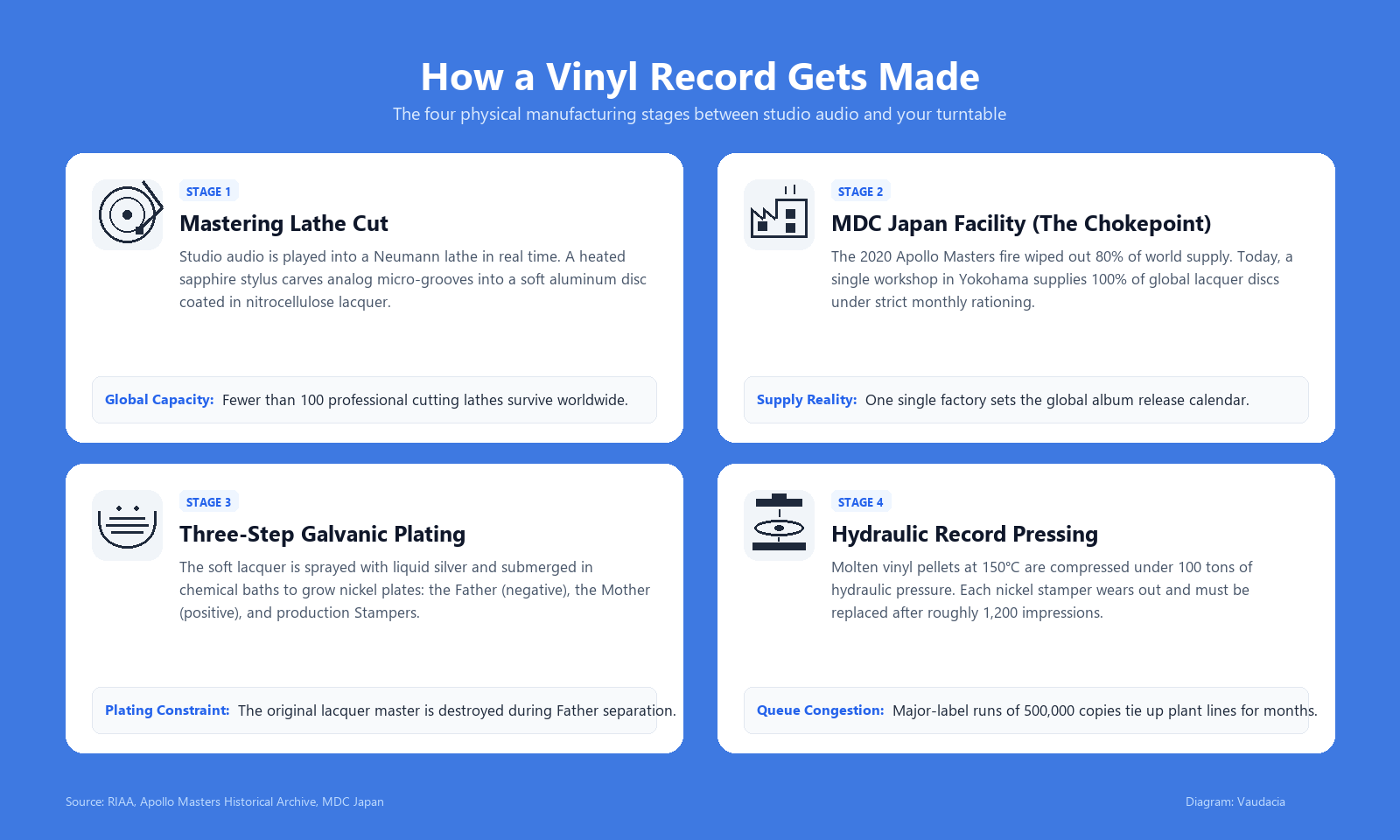
On the night of February 6, 2020, a three-alarm fire ripped through the Apollo Masters manufacturing facility in Banning, California. The seventy-year-old plant was reduced to twisted corrugated steel and ash within three hours. Nobody was injured, but the fire erased eighty percent of the global supply of master lacquer discs in a single evening.
Worse still, Apollo was the primary global manufacturer of the microscopic sapphire and ruby cutting styli used by mastering engineers to carve sound waves into discs. Overnight, the worldwide pipeline for physical records collapsed to a single surviving supplier: MDC (Mastercraft Disc), operating out of an aging industrial district in Yokohama, Japan.
Before the Banning fire, Apollo and MDC split the global market. Apollo supplied North America and much of Western Europe, while MDC served Japanese mastering houses and specialized European audiophile facilities. When Apollo burned, MDC inherited one hundred percent of global demand with zero excess factory capacity.
MDC is not a mega-corporation. It is a family-owned chemical enterprise staffed by senior technicians who mix coatings by hand. Rather than attempting a reckless expansion that could ruin quality control, MDC placed every mastering studio on strict monthly rations. If an American mastering engineer requests two hundred blank discs to cut new albums this month, MDC might allocate forty. If a blank disc arrives warped or scratched in transit, that album side cannot be cut until the next allocation cycle rolls around.
What an Analog Lacquer Disc Actually Is
To understand why tech startups cannot simply spin up a replacement factory, you have to understand the extreme physical chemistry of the lacquer blank.
A lacquer master begins as an aircraft-grade aluminum disc, precisely machined and mirror-polished until its surface has zero microscopic pitting. The disc is then coated with an ultra-thin layer of nitrocellulose lacquer combined with synthetic plasticizers, solvents, and refined castor oil.
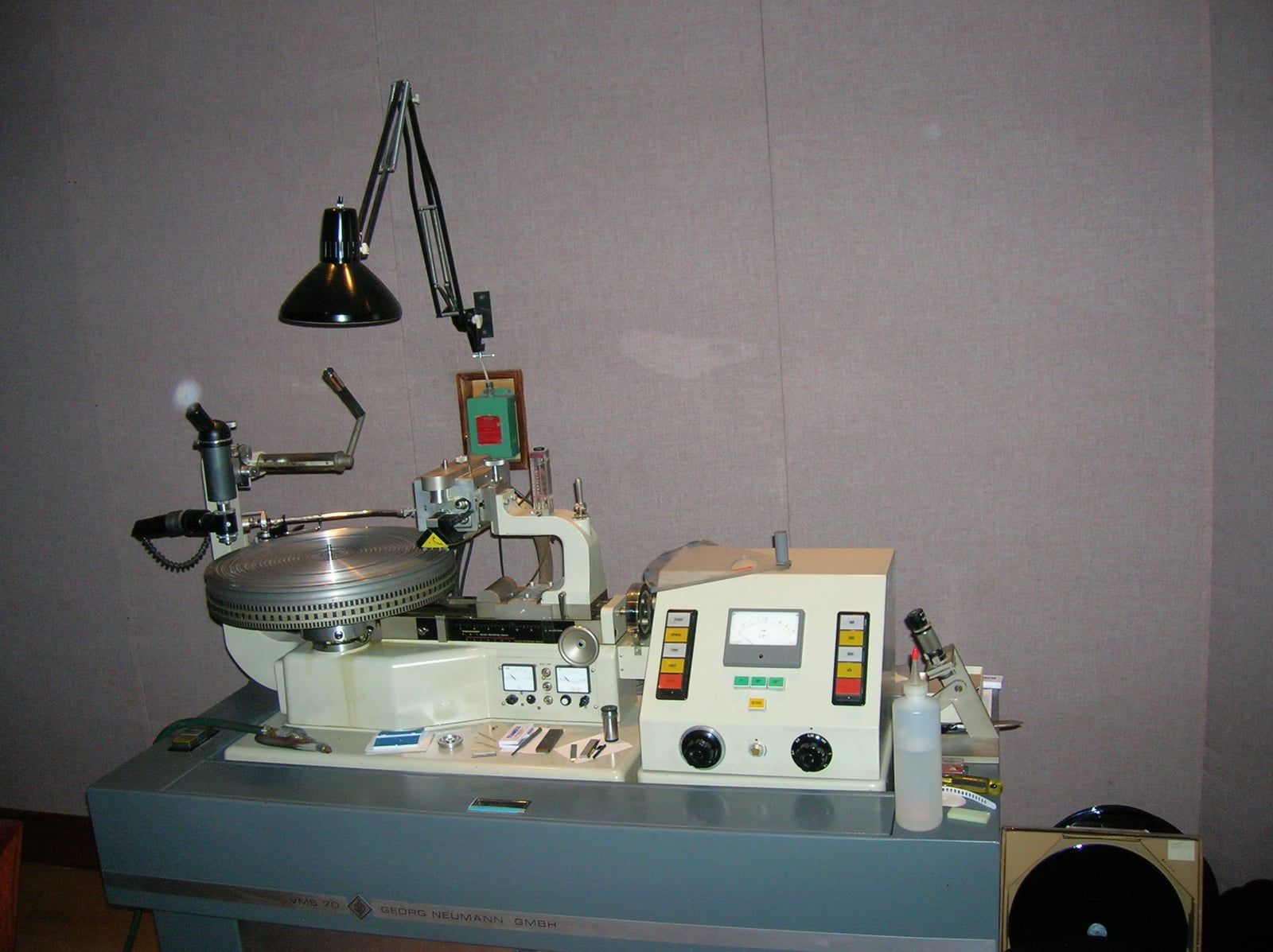
Nitrocellulose is the critical ingredient because of its contradictory physical properties. It must remain soft enough for a heated sapphire stylus mounted to a cast-iron lathe, like the iconic Neumann VMS-70, to glide smoothly through the surface at twenty-two minutes per side without chatter, tearing, or microscopic friction noise. Simultaneously, the lacquer must be rigid enough to hold the microscopic physical contours of a 15,000 Hz violin harmonic without collapsing under its own structural weight.
The environmental catch is that nitrocellulose is chemically identical to guncotton, a historically potent military explosive. Mixing, spraying, and baking nitrocellulose lacquer releases massive quantities of volatile organic compounds (VOCs). The chemical mixture is violently flammable and susceptible to static ignition.
In 1950, a company could operate a nitrocellulose coating facility on an open commercial lot in California. In 2026, obtaining an environmental permit, toxic emissions clearance, and municipal fire marshal approval to build a new nitrocellulose spraying plant in North America or Western Europe is a regulatory nightmare. The insurance premiums alone kill private investment before ground is broken.
The Three-Step Galvanic Gauntlet
Even when a mastering engineer successfully cuts an immaculate lacquer master, the physical journey has only just begun. A lacquer disc is soft; playing it on a consumer turntable with a diamond stylus would destroy the delicate grooves in two passes. It must be converted into solid nickel metal through a complex electroplating sequence:
First, the freshly cut lacquer is sprayed with a microscopic layer of liquid silver to make its non-conductive surface electrically active.
Second, the silvered disc is submerged into an electroforming bath of nickel sulfamate. Over several hours of continuous electrical current, nickel atoms deposit onto the silver, growing a metallic negative plate known as the Father.
Third, peeling the Father off the lacquer destroys the original lacquer master forever. If the plating bath had a single dust particle or an improper electrical gradient, the master is ruined and the band must cut a new lacquer from scratch.
To produce commercial volumes, the metal Father is submerged again to grow a metal positive called the Mother. The Mother is checked by audio technicians with headphones for clicks and pops. Once verified, the Mother is electroplated repeatedly to yield working nickel Stampers.
A single nickel stamper degrades after pressing roughly 1,200 records before groove deformation causes audible surface distortion. If an artist sells 50,000 albums, the plant requires more than forty distinct stamper plates. Every single plate trace leads straight back to that solitary chemical plant in Yokohama.
Why Direct Metal Mastering Does Not Solve It
Whenever vinyl production hits a wall, audio engineers bring up Direct Metal Mastering (DMM). Developed in the 1980s by German audio pioneer Georg Neumann GmbH in collaboration with Teldec, DMM skips the lacquer blank entirely.
Instead of cutting into soft nitrocellulose, a specialized DMM lathe uses a solid diamond stylus vibrating with high-frequency ultrasonic energy to cut grooves straight into a plate of high-purity copper. Because copper is already conductive, the copper master bypasses the silvering bath and the Father plating stage, allowing technicians to grow stampers immediately.
DMM saves weeks of processing time and eliminates groove pre-echo, but it introduces two severe hurdles:
First, sound aesthetics. Cutting into rigid copper requires extreme high-frequency carrier modulation. Audio purists, classic rock producers, and hip-hop mastering engineers frequently complain that DMM cuts sound clinical, harsh, and brittle in the treble register, lacking the warm, elastic bass bloom that defines traditional lacquer cuts.
Second, vintage machinery scarcity. Neumann ceased production of DMM cutting lathes decades ago. There are fewer than twenty functioning DMM lathes surviving on the entire planet, mostly clustered in large European facilities like GZ Media in the Czech Republic. Sourcing replacement parts, diamond styli, and precision mechanical drive motors requires cannibalizing vintage studio hardware.
The Pop Star Variant Squeeze
The final constraint is not technical; it is economic. Over the past four years, major record labels transformed the vinyl album from an audiophile music format into a luxury merchandise collectible.
When an arena pop star releases an album, the corporate label does not order twenty thousand copies. It orders five hundred thousand copies spread across eight or ten colored vinyl collector variants: lavender marble, translucent seafoam, target-exclusive ruby, and indie-record-store silver.
Because major labels write multi-million-dollar checks, commercial pressing plants prioritize their orders above all else. A single blockbuster pop campaign will book every electroplating bath and hydraulic press in a facility for three solid months. Independent punk, jazz, and electronic labels, operating on five-hundred-copy budgets, are pushed to the back of the queue.
This dynamic reveals the unforgiving math of physical manufacturing. Unlike digital products where software infrastructure scales on low monthly overhead, doubling physical vinyl volume requires real raw materials, hazardous chemical baths, and non-negotiable machine hours on vintage lathes.
What the Future Actually Looks Like
Relief will not arrive from Silicon Valley venture capital or three-dimensional printing. High-resolution audio grooves require sub-micron tolerances that additive plastic printing cannot replicate.
A handful of boutique startups in Europe and North America have spent four years attempting to formulate reliable, non-hazardous lacquer alternatives or launch localized electroplating cooperatives. Progress is slow, measured in millimeter tolerances and chemical batch tests.
Until a modern chemical manufacturer successfully masters the nitrocellulose formula and satisfies environmental safety boards, the global vinyl boom remains tethered to a single factory floor in Japan. The next time you hold a new twelve-inch record in your hands, remember that it is not merely a piece of retro plastic. It is an industrial miracle that survived a four-stage galvanic gauntlet, carved on an antique lathe using a fragile disc from the only chemical shop left standing.
Comments (0)
No comments yet. Be the first to share your thoughts.