Gut-Brain Axis Supplements: Where the Clinical Evidence Stops
The gut-brain axis is real biology. The supplement aisle selling it is mostly packaging.

In early 2026, the supplement industry's favorite clinical trial on the gut-brain axis ran into a stubborn wall of data: after eight weeks of daily dosing, the mood and sleep benefits had completely evaporated. The study evaluated Bifidobacterium longum 1714, a strain patented specifically for stress resilience and cognitive performance. It was funded by the commercial enterprise that sells the organism. Even under favorable corporate sponsorship, the clinical signal could not survive a single calendar quarter.
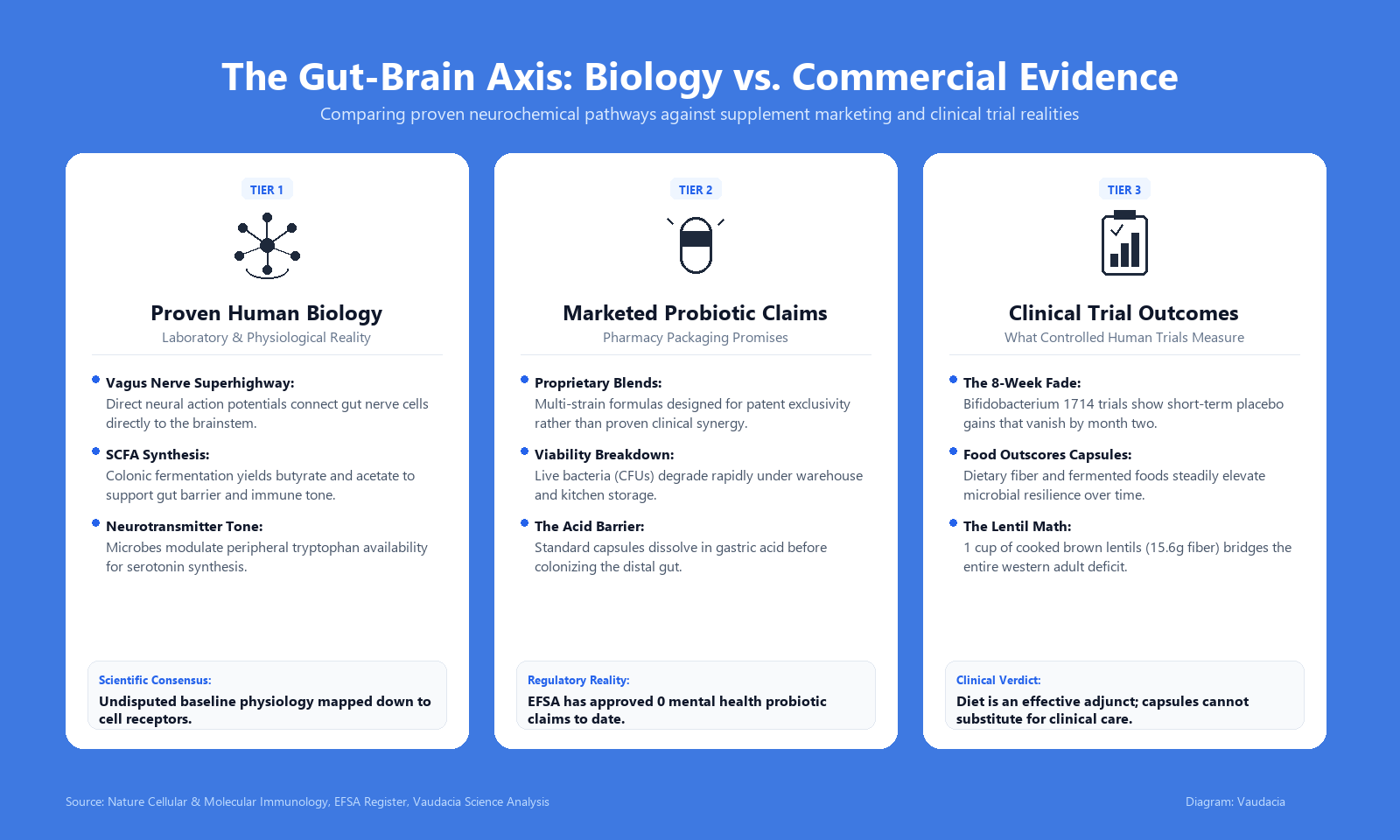
- 1The 8-Week Trial Fade: The clinical trial most often cited to sell mood probiotics tested Bifidobacterium longum 1714. Early sleep and mood improvements vanished completely by the end of the eighth week.
- 2The Delivery Mismatch: The distal colon is where beneficial bacteria ferment dietary substrate into short-chain fatty acids. Most commercial capsules dissolve in gastric acid long before reaching that site.
- 3The 40-Cent Fix: Closing the western adult dietary fiber gap takes about 15 grams. A single cup of cooked brown lentils provides 15.6 grams for less than fifty cents.
The disconnect between laboratory mechanism and pharmacy packaging is where billions of dollars currently change hands. The gut-brain axis is not marketing fiction. It is a dense, bidirectional signaling network that connects the enteric nervous system of your digestive tract to the central nervous system in your cranium. Yet the commercial wellness industry has pulled off a familiar sleight of hand: it borrows the undisputed credibility of human biology while quietly ignoring its biological constraints.
What the Biological Mechanisms Actually Describe
The baseline physiology is settled science. Trillions of microbes residing in the distal colon break down non-digestible plant carbohydrates through anaerobic fermentation. This process yields short-chain fatty acids, primarily acetate, propionate, and butyrate. Butyrate serves as the primary fuel source for colonocytes, tightening epithelial junctions and preventing systemic endotoxemia.
Signals move upward to the brain across three distinct pathways:
First, neural wiring. The vagus nerve acts as a physical superhighway. Enteroendocrine cells in the gut lining detect microbial metabolites and fire electrical action potentials directly into the solitary tract of the brainstem, modulating anxiety circuits and autonomic response within milliseconds.
Second, endocrine and metabolic pathways. Gut bacteria influence peripheral availability of tryptophan, the essential amino acid precursor for serotonin synthesis. Microbes also synthesize gamma-aminobutyric acid (GABA), dopamine, and acetylcholine locally within the gut lumen.
Third, neuroimmune regulation. As highlighted in a comprehensive 2025 review in Cellular & Molecular Immunology, microbial metabolites directly train microglial cells in the central nervous system, setting systemic baseline neuroinflammatory tone and moderating hypothalamic-pituitary-adrenal (HPA) axis reactivity.
None of this is fringe science. But biological plausibility is the cheapest currency in preventative medicine. A physiological pathway can be real, thoroughly mapped, and entirely unresponsive to an over-the-counter pill. Knowing that an electrical wire exists between two rooms tells you nothing about whether a capsule dropped in the doorway can flip the light switch.
The Human Trials: Where the Effect Sizes Vanish
When researchers move from mouse cages and petri dishes into human clinical trials, the dramatic headlines dissolve into modest, formulation-dependent ripples.
The Bifidobacterium longum 1714 human trial illustrates the core problem: transient early placebo response followed by a statistical return to baseline. In mild-to-moderate mood studies, subjective self-reporting scales are inherently volatile. Furthermore, live fermented cultures change stool consistency and digestive transit within forty-eight hours. Participants quickly deduce whether they received active bacteria or an inert starch placebo, breaking blinding and inflating short-term self-evaluations.
Read pooled meta-analyses carefully and a consistent pattern emerges. Yes, some microbial interventions show a statistically detectable nudge in subjective depression scores. But that effect is tightly restricted to specific, proprietary strains taken at exact colony densities. Switch from Strain 1714 to a generic shelf-stable organism, and the measured benefit disappears entirely.
If low mood, chronic brain fog, or persistent fatigue has altered your daily functioning for more than four weeks, buying a thirty-dollar bottle of probiotics is an expensive distraction. The evidence points to consulting a medical clinician, not testing random bacterial strains against your gut lining.

Why Food Consistently Beats the Capsule
The strongest clinical data in gastrointestinal neurology does not come from blister packs. It comes from dietary intervention studies.
Controlled human feeding trials run at Stanford and across European research hospitals compared high-fiber diets against high-fermented-food diets over ten-week windows. The findings were stark:
The fermented food group, consuming three to six servings daily of live-culture kefir, plain yogurt, kimchi, and fermented vegetables, demonstrated steady, sustained increases in overall microbial diversity alongside reductions in nineteen distinct inflammatory markers.
The high-fiber group increased the metabolic output of their existing microbiome, ramping up short-chain fatty acid enzyme production without needing any introduced organisms.
The math behind dietary fiber explains why commercial supplements look unnecessary:
National dietary surveys in the United Kingdom and North America reveal that average adult fiber intake sits between 15 and 18 grams daily, far below the recommended baseline of 30 to 38 grams. That shortfall of roughly 15 grams can be closed entirely with a single cup of cooked brown lentils. Buying an expensive probiotic capsule while starving your resident bacteria of dietary fiber is like buying expensive aquarium fish and refusing to feed them.
Clinical Note: If you suspect an underlying digestive pathology such as coeliac disease, do not initiate an elimination diet before completing standard medical testing. Both serology blood panels and duodenal biopsies require continuous gluten consumption to yield accurate results, as detailed in our guide on The 2026 Coeliac Guideline and when a biopsy is not needed.
The Structural Regulatory Trap
The legal architecture governing the supplement industry reveals why store shelves look so disconnect from peer-reviewed literature.
In the European Union, the European Food Safety Authority (EFSA) enforces an exceptionally rigorous evidentiary bar. To date, EFSA has evaluated hundreds of health claim dossiers submitted by probiotic manufacturers. It has approved exactly one: live yogurt cultures improving lactose digestion in individuals who struggle to digest lactose. Every single application claiming mood improvement, cognitive focus, stress mitigation, or immune optimization has been rejected for insufficient clinical substantiation.
In the United States, dietary supplements are regulated under the Dietary Supplement Health and Education Act of 1994 (DSHEA) as food rather than pharmaceutical drugs. Manufacturers do not submit pre-market proof of efficacy to the FDA. They are legally permitted to stamp structural claims like "promotes emotional well-being" or "supports healthy neurotransmitter synthesis" on a box, provided they attach the obligatory small-print disclaimer that the FDA has not evaluated the statement.
This creates a perverse commercial incentive:
- Formulating a clinical product around an exact, single strain tested in a university trial is expensive and impossible to patent.
- Blending ten generic organisms into an undisclosed "proprietary complex" creates a trademarked asset that competitors cannot easily duplicate, even though no human trial has ever studied that specific cocktail.
- Stated Colony Forming Units (CFUs) represent viable cell counts at the moment of manufacturing. Heat exposure in shipping containers and room-temperature storage steadily kill live bacteria before the consumer opens the bottle.
An Eight-Week Whole-Food Testing Protocol
If you want to test whether shifting your gut-brain axis produces tangible benefits in your daily energy and mental clarity, you do not need proprietary powders or subscription cleanses. You need two observable variables tracked consistently for eight weeks:
- Target 30 Grams of Daily Plant Fiber: Add legumes, oats, flaxseed, chia, and cruciferous vegetables into meals you already prepare. Increase intake gradually over fourteen days to avoid transient bloating.
- Incorporate Fermented Whole Foods: Introduce two small servings weekly of live unpasteurized kefir, kimchi, sauerkraut, or miso. If well tolerated, build to four servings weekly by month two.
Keep an unglamorous two-line log on your phone each morning: rate subjective sleep quality on a scale of 1 to 10, and rate baseline morning low mood or tension on a scale of 1 to 10. Memory is notoriously subjective; a written log protects you from mistaking a stressful Tuesday for dietary failure.
At the same time, keep psychological perspective. The wellness industry frequently co-opts medical terminology to market lifestyle products, a pattern explored in our analysis of why nervous system regulation will not fix the daily news cycle. Regulating physiological stress requires consistent sleep schedules, physical movement, and clinical mental healthcare when warranted.
Red-flag symptoms demand immediate medical evaluation rather than dietary experimentation. Unexplained weight loss, nocturnal abdominal pain, persistent blood in stool, or depressive episodes lasting longer than a month require comprehensive gastroenterological or psychiatric care.
The human body is an intricate biological system. When an industry insists that an interconnected biological network can be mastered by swallowing a shelf-stable capsule, it has revealed what it values. Real physiological changes arrive slowly through whole foods, and real health decisions are built on clinical evidence rather than packaging claims.
Comments (0)
No comments yet. Be the first to share your thoughts.