What Are LEO Satellite Economics When Launch Is Cheap
Reusable boosters cut launch to about $3,000 per kilogram. The harder number is replacing every satellite, again and again.

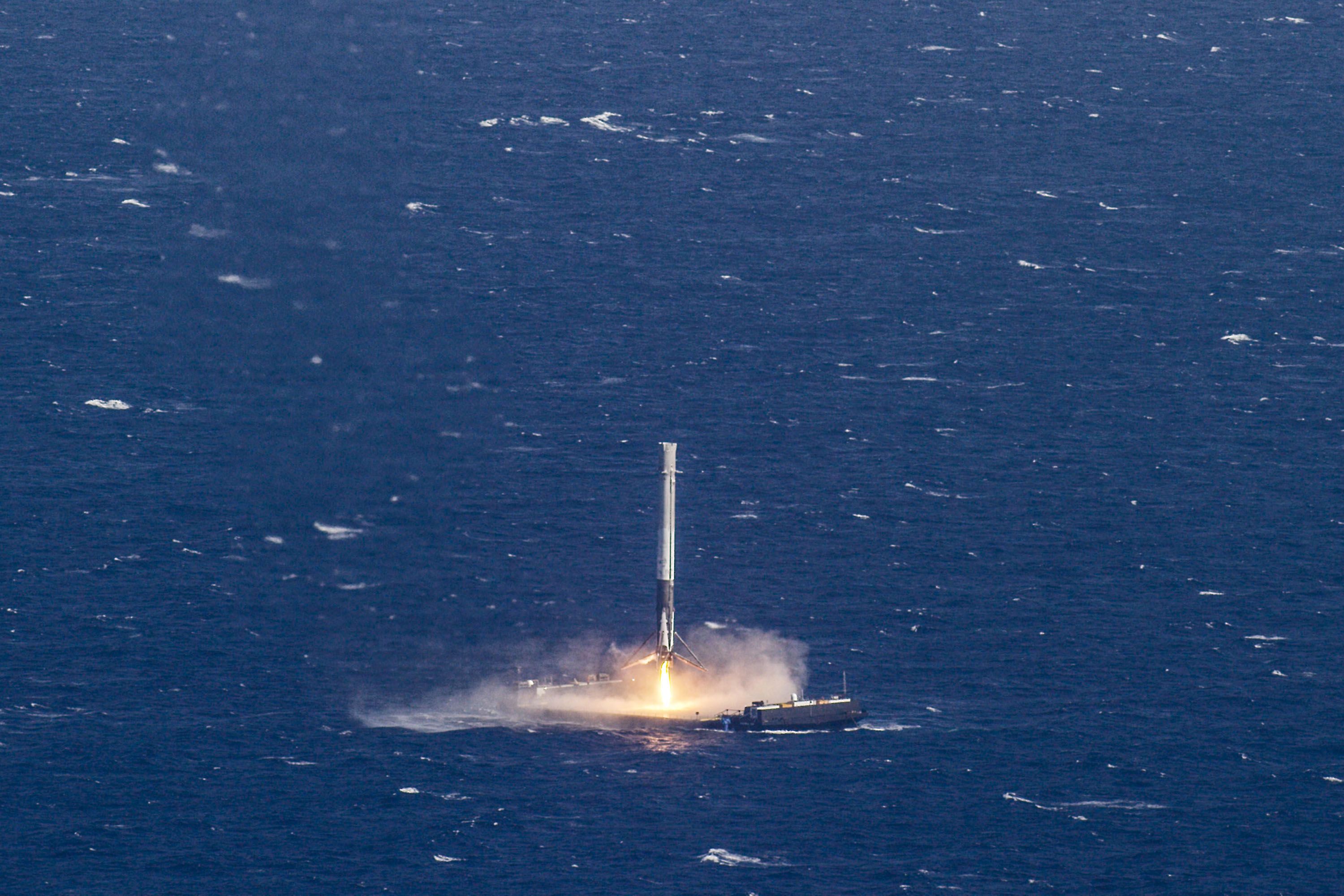
A Falcon 9 first stage is a cylinder of aluminium-lithium tankage, nine engines, four grid fins and a set of landing legs, and it is the most expensive single object in the commercial launch business. One of them recently came back down onto a floating platform in the Atlantic for the 35th time. Whatever that booster cost to build, the company that built it has now spread the cost across three dozen flights, and the next one is already on the manifest. That single fact, more than any satellite design or spectrum filing, is what turned low Earth orbit from a graveyard of bankruptcies into an address where businesses operate.
- 1Launch price: Reusable Falcon 9 boosters took the cost of reaching low Earth orbit from about $54,000 per kilogram on the Space Shuttle to roughly $3,000 today, which is what made mega-constellations bankable.
- 2Design life: Cheap, frequent launch pushed satellites onto five to seven year design lives built from commercial silicon, moving the engineering target from survival to replacement cost.
- 3The recurring bill: In steady state most flights carry replacements rather than new capacity, so a constellation's long run cost is set by its replacement rate, not its launch price.
For five decades the price of orbit behaved like a utility bill nobody could negotiate down. The Space Shuttle flew at roughly $54,000 per kilogram in inflation-adjusted terms. A reused Falcon 9 now prices out near $3,000, and a dedicated mission lists at $74 million for up to 22.8 tonnes to low Earth orbit, which is about $3,250 a kilogram if you fill the fairing. Everyone in the industry quotes that curve. Fewer people stop to ask which constraint it actually removed, and which cost it quietly promoted in its place.
What the Cost Curve Actually Broke
Under the expendable model, the booster, the upper stage and the payload fairing all ended up in the ocean or burned up on reentry, so every mission carried the full manufacturing cost of the vehicle plus the full cost of the ground campaign to assemble, test and certify it. That put a floor under the price of orbit which no amount of factory efficiency could break, because the factory had to build a brand new rocket for every flight. Reuse didn't make the factory better. It changed the accounting, converting a per flight manufacturing expense into a capital cost amortized over dozens of missions.
The mechanical consequence is easy to miss. When launch dominates your budget, you obsess over mass, because every kilogram is a bill. That produced the exquisite small satellite era: ultra-light structures, exotic materials, agonizing over grammes. When launch is a minority of your cost, mass stops being the design driver and unit economics takes over. You build satellites a little heavier and a lot cheaper, because the rocket has room and the invoice is dominated by the thing you're putting inside the fairing.
A three hundred kilogram satellite used to cost more to launch than to build. At $54,000 a kilogram the ride came to roughly $16 million, which dwarfed the price of a modest smallsat bus. At $3,000 a kilogram the same ride costs about $900,000, a rounding error next to the payload. That inversion is the real story of reusability. Launch stopped being the gate and became a line item.
Designing a Satellite to Die on Schedule
The old specification for a commercial satellite was written around scarcity. Fifteen year design life, radiation hardened processors, triple redundancy on anything that mattered, and a qualification campaign that could run for years because there was no way to fix a mistake in orbit. At those tolerances a satellite cost hundreds of millions and was built essentially by hand, one at a time, for a single mission.
The new specification is written around replacement. Five to seven years of design life, commercial silicon wherever it survives, software updates instead of hardened logic, and an accepted failure rate across the fleet. A satellite that will be deliberately deorbited in year six does not need to withstand fifteen years of cumulative radiation damage. The engineering target moved from survival to the cost of the next unit.
A modern constellation is closer to a stadium lighting rig than to a fleet of aircraft. You do not send a technician up the gantry to repair a floodlight. You design the fixture to be swapped, you buy them by the pallet, and you budget for the ones that fail. Treating satellites as consumables feels wrong to anyone raised on the idea that space hardware must be perfect. It is also the only way the numbers work at scale.
The volume behind that shift is now visible in filings. SpaceX's registration statement, filed in May, disclosed a Redmond facility producing roughly 70 Starlink satellites a week, which annualizes to more than 3,600 spacecraft. Of the 4,522 satellites launched globally in 2025, SpaceX accounted for about 70 percent. The value of spacecraft entering service reached $65.39 billion in 2025, up 21.9 percent, even as per unit manufacturing costs fell. That pattern, where total spend rises while unit cost drops, is the signature of a component becoming a commodity, and it is the same curve that pulled flagship phone capability down into mid range hardware in the $400 handset market.
Most Launches Are Becoming Replacements
The unit economics of a constellation make more sense once you divide revenue by spacecraft instead of by subscriber. Starlink's subscriber base has been reported at roughly 12 million paying accounts, with quarterly revenue around $4.3 billion. Spread over a working fleet that has passed 9,000 satellites, that works out to about 1,300 subscribers per satellite.
Run that forward with a blended average revenue near $119 per account per month, and one satellite is generating something close to $155,000 a month, or roughly $1.9 million a year. Over a five year design life that is on the order of $9.5 million in lifetime revenue per spacecraft. At 24 satellites per dedicated Falcon 9 flight and $74 million on the list price, the launch bill per satellite is about $3.1 million, or roughly a third of the lifetime revenue it enables. The spacecraft itself, the ground segment and the terminal subsidy have to fit inside the rest.
Now the part that changes the shape of the business. If a fleet of 9,000 satellites has a five year life, steady state replacement requires 1,800 new spacecraft a year just to hold position. At 24 per flight, that is 75 dedicated launches annually before a single new market is opened. The table below shows how sensitive that bill is to design life, which is the single most consequential number in constellation planning.
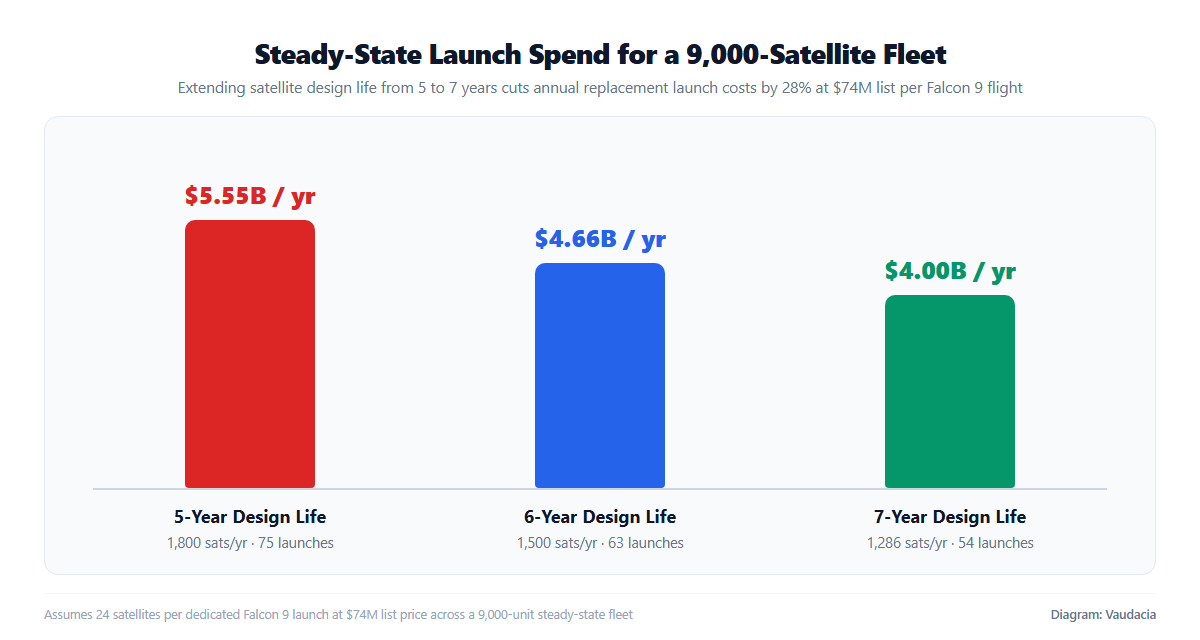
Extend the design life by two years and the recurring transport bill drops by roughly 28 percent. That is a bigger lever than any plausible further reduction in price per kilogram, and it explains why operators keep chasing incremental gains in radiation tolerance and thermal design rather than waiting for cheaper rockets.
Extending satellite design life by two years cuts annual replacement launch spend by roughly 28%, delivering a larger recurring savings than plausible further reductions in $/kg rocket pricing.
Starship's stated target of $100 to $200 per kilogram changes the transport line and almost nothing else. At those prices, launch cost falls below the manufacturing cost of the satellite it carries, so the constraint relocates to factory throughput and to whatever the real service life of the fleet turns out to be. Cheaper transport doesn't reduce the number of satellites you need to replace every year. It only makes moving them uninteresting.
A Second Rocket Is a Cost Center
The clearest test of these economics is a competitor that has to buy its launches on the open market. Amazon's Leo constellation holds a licence for 3,236 satellites and has contracted more than 80 launches across five vehicle families, a procurement widely reported at over $10 billion. Its first Vulcan Centaur mission carried 40 satellites, the largest single batch the program has flown. Spreading the manifest across Vulcan, Ariane 64, New Glenn, Atlas V and even Falcon 9 buys schedule resilience, since no single rocket failure can stall deployment.
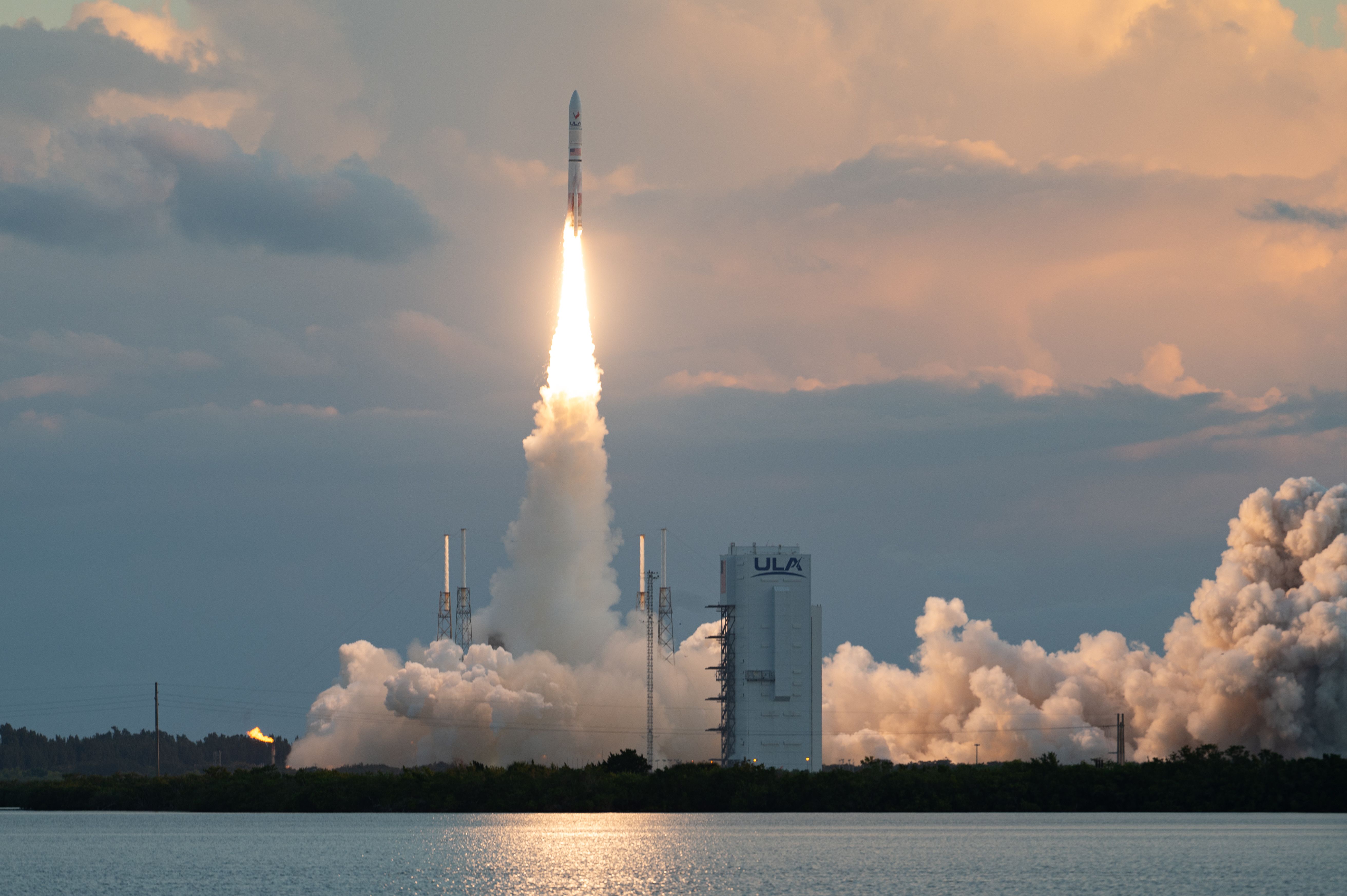
That resilience has a price, and the price is the market rate plus a competitor's margin. SpaceX flying its own satellites is effectively paying an internal transfer price that covers propellant, refurbishment and range costs. Amazon pays list. In a business where the satellite and the launch together define the unit cost, a structural gap of that kind doesn't close through better satellite engineering, however good the satellite is.
China's two mega-constellations show the same constraint from a different angle. Guowang and Qianfan have together placed a bit over 300 satellites into orbit across roughly 30 launches since August 2024, a serious program running at a cadence limited by expendable Long March flights, with LandSpace's Zhuque-3 debut marking the first domestic attempt at a reusable medium lift vehicle. The gap to close is measured in flights per year, not in satellite capability, and flights per year is downstream of whether the booster comes home.
The Clock That Ignores Your Unit Economics
None of this plays out on the operator's preferred timetable. Spectrum filings carry deployment milestones with hard dates attached, which means a constellation has to put up a large fraction of its licensed satellites on a regulatory schedule, whether or not each of those launches is the cheapest thing to do that quarter. Debris mitigation rules add a second obligation, since every spacecraft now carries an end of life disposal plan and the fuel reserve to execute it. That reserve is mass that earns no revenue, sitting inside the same unit cost as the antennas and the phased array.
The unresolved technical question is how a fleet actually wears out. Operators are budgeting replacement cycles against modelled degradation, and the models are built from component testing and a handful of years of on orbit telemetry rather than from the failure distribution of thousands of identical units observed through a full life cycle. Nobody has yet published a credible fleet level survivorship curve for commercial silicon in low Earth orbit at this scale. Until those curves exist, the largest recurring cost in the industry is projected from an engineering estimate.
The $3,000 per kilogram headline is a milestone, not a moat. It removed the barrier that kept orbit expensive and handed the industry a new set of numbers to manage: replacement rate, factory throughput, disposal reserve and the cost of the unit that goes up in year six with no new subscriber attached to it. Every constellation now flying is amortizing a liability whose size nobody has yet measured.
Comments (0)
No comments yet. Be the first to share your thoughts.