
Administrative Burden of Adult Life: A 2026 Audit
Adult admin isn't a personality problem. Count the hours it takes, and why most fixes leave the total untouched.

The form asks for your address. You typed that address into the same portal eleven months ago, in the same box, and the field is empty again. So you retype it, then upload a proof of address that the portal itself generated. Somewhere around the fourth screen you stop being a customer and become unpaid clerical staff for an organisation that has already been paid.
- 1The scale: Federal paperwork alone came to 10,503 million hours in fiscal 2023, roughly a working week per adult per year, before banks, insurers, employers, or schools send anything.
- 2The wrong fix: Batching and automation shave minutes off tasks you never chose. They leave untouched the number of institutions entitled to demand your time.
- 3The audit: Log admin by counterparty for two weeks, not by task type. The count of parties, not the speed of your workflow, sets the total.
Policy researchers call this administrative burden, and they split it into learning costs, compliance costs, and psychological costs. What the literature rarely does is total the hours. What the productivity industry rarely admits is that most of those hours were never yours to schedule.
The Hours Are Documented, the Fragments Are Not
The Office of Management and Budget has to report the paperwork burden the federal government imposes on the public. Its Information Collection Budget for fiscal 2023 put the total at 10,503 million hours. Divide that across roughly 262 million American adults and you get about 40 hours each, a full working week, spent on federal forms alone.
That figure is a floor, and a low one. It excludes banks, insurers, employers, schools, landlords, utilities, payroll software, visa appointments and the annual scramble through tax preparation. It also excludes the informal version of the same work: chasing a refund, correcting a billing error, proving to a third party that you are who the first party already knows you are.
Nobody has a feel for the total because admin arrives in fragments. A 4-minute call, a 12-minute portal, a 25-minute hold, a form filled twice because the session timed out. Recall-based time diaries delete fragments, and calendars never held them. You can finish an entire day of admin and find your schedule was empty.
Why Better Systems Don't Move the Number
The standard advice is batching: a Friday admin block, inbox rules, autopay on every recurring bill. This is genuinely useful at the margins, and it addresses the wrong term. Total admin time is the number of demands multiplied by the minutes each one takes. Tools shrink the minutes. Institutions set the demands.
Automation also has a habit of adding counterparties rather than removing them. Every tool you adopt brings an account, a renewal date, a password to rotate, a data export to request, and a failure mode that returns to you the moment a card expires. Anyone who has quietly abandoned a productivity stack knows how fast that maintenance accumulates.
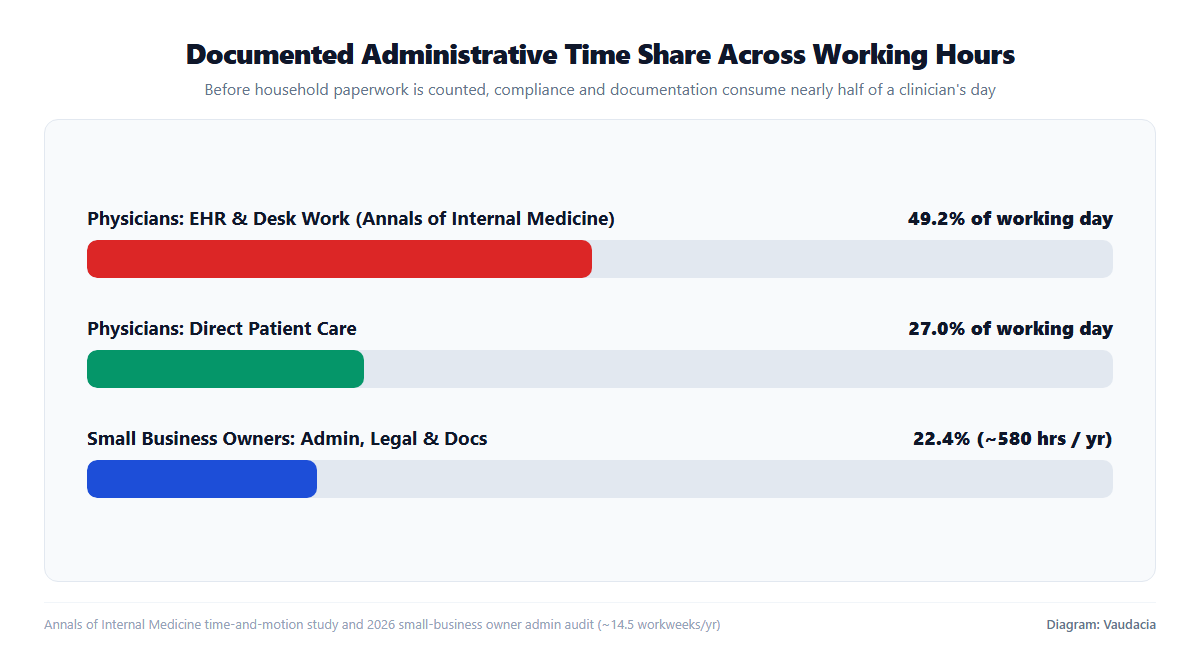
Medicine offers the cleanest measurement of the ratio. A 2016 time and motion study in the Annals of Internal Medicine found physicians spending 49.2 percent of the working day on electronic records and desk work against 27 percent with patients, close to two hours of documentation for every hour of care. No clinician chose that ratio. Billing and compliance requirements set it, and the clinician absorbs the difference.
What 22 Percent Actually Costs
Small business owners report spending 22.4 percent of their time on administrative, legal and documentation tasks. Take a 50-hour week, which is conservative for someone running their own operation, and that's 11.2 hours a week. Held across a year it reaches roughly 580 hours, or fourteen and a half forty-hour weeks. More than a quarter of the working year goes to work that isn't the work.
The pattern repeats upward. Teachers report 53-hour weeks with administrative work among the largest single sources of stress. Legal professionals describe admin as a primary driver of unhappiness in their jobs, which is striking given that documentation is supposed to be their craft. The more specialised the work, the more unpaid overhead attaches to it.
Burden flows toward whoever has least power to refuse it. That's why a national survey found nearly a quarter of insured American adults delaying or skipping care because of paperwork, and why household admin clusters around the days money moves rather than the days people have time, a timing problem that also explains why a salary runs out before month end.
The Burden Is Designed, Which Means It Can Be Built Down
Estonia is the useful comparison because it made an architectural choice rather than a technological one. Under the once-only principle, citizens and businesses supply data to the state once, and agencies reuse it through a shared exchange layer instead of asking again. Every state service went online by the end of 2024, and the government estimates the arrangement saves more than 1,400 years of working time annually. That estimate comes from the agency responsible, so read it as directional.
Luukas Ilves, who until 2024 was the Estonian government's chief information officer, described the practical result of that design to DW: "It takes 45 seconds to get to the point where it says submit the divorce application." The speed matters less than the fact that one agency's record settles what seven agencies would otherwise each ask you to prove.

The American version went the other way. Portals multiplied agency by agency, each with its own login, without a rule forcing them to share. OMB's tracking of active information collections stood at roughly 11.7 billion hours as of January 2026, above the fiscal 2023 accounting, though the two measures aren't identical. Digitising each queue separately moves the queue online and calls it transformation.
Auditing the Load by Counterparty
Most personal admin audits fail at the first step because people categorise by task: email, calls, bills, forms. That produces a to-do list, which is not a diagnosis. Categorise by counterparty instead, and the structure appears immediately.
For two weeks, keep one running note with three fields per interaction: the party that demanded something, the minutes it took, and whether a deadline was attached. No app, no tags, no colour coding. At the end, count distinct parties rather than total minutes, and sort the list by hours consumed.
The result usually surprises people in one specific way. A small number of parties generate most of the hours, and a large number of parties exist for a single annual event whose renewals, verification loops and password resets you carry for the other 364 days. Closing one of those accounts removes its entire annual tail instead of trimming it.
Two weeks of logging, then a fortnight of closing, consolidating and handing off the accounts of the worst offenders, is the whole intervention. The hours fall when fewer parties are entitled to send the paperwork, and speed is a rounding error next to that.
Comments (0)
No comments yet. Be the first to share your thoughts.