
Inside the Micro-SaaS Niches That Retain Subscribers
Five micro-SaaS categories that keep paying after month three, with the pricing, churn numbers and buyer each one needs.

Twenty-two thousand five hundred and forty-six apps were live on the Shopify App Store in June 2026, and 51 percent of them had never collected a single review. Another 47 percent carried no paid plan at all. Building software has become close to free, and getting paid for it month after month has not.
- 1Placement over features: The micro-SaaS products that keep paying sit inside a workflow that produces a recurring consequence, so removing them costs the customer money or time within days.
- 2Churn sets the ceiling: Identical products at the same $29 price can land at $6,200 or $21,700 in monthly revenue from the same sales effort, depending on whether monthly churn is 7 percent or 2 percent.
- 3Skip the one-time artifact: Audit reports, signature images and exported files get used once and cancelled. Sell the schedule, the alert, or the control layer over a team.
A merchant installs a distance-based delivery fee calculator in early November, runs it through the holiday rush, and uninstalls it when order volume drops back to a hundred a month. Nothing broke and the tool did its job. What it lacked was a second reason to exist, which is the difference between a product and a subscription.
The Churn Gap That Decides the Business
Benchmark data covering 939 B2B software companies from mid-2025 through early 2026 puts typical monthly logo churn at 3 to 5 percent for tools sold to small businesses, 1.5 to 3 percent at mid-market, and under 1 percent for the strongest performers. Five percent a month means replacing 46 percent of your base every year. Bain & Company's much-quoted finding, published in Harvard Business Review, is that a five point improvement in retention lifts profit by 25 to 95 percent. Most people building alone never model any of this before writing the first line of code.
Put two products side by side at $29 a month, both adding 15 customers monthly. At 7 percent churn the base levels off near 214 accounts, around $6,200 a month. At 2 percent the same sales effort settles around 750 accounts and $21,700. Identical category, identical price, a completely different business.
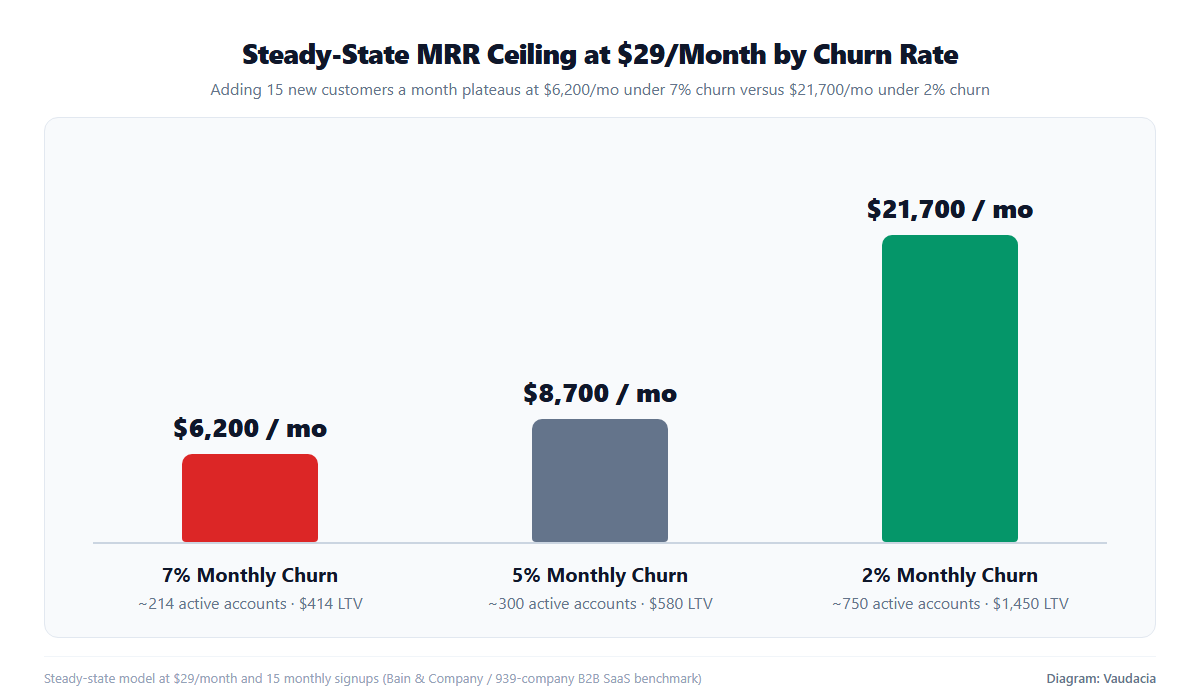
Average lifetime gross per customer at that price runs about $580 at 5 percent churn and about $1,450 at 2 percent. A $200 acquisition cost eats a third of lifetime value in the first case and funds paid growth in the second. That gap should decide which idea below you spend a year on, and the price ceiling of the niche matters as much as the churn rate inside it.
Utilities That Live Inside Checkout
A distance and radius fee calculator is the cleanest example of placement doing the retention work. A grocer or florist running its own drivers needs checkout to charge by zone, and once those zones are mapped and tested, removing the app sends every order back to a flat rate that loses money on the far suburbs. Pricing runs from about $7 to $49 a month, and support settles to almost nothing after the first week because the rules rarely change.
High-risk order screening with SMS verification sits in the same family and has a harsher reason to renew. Stores hit by card testing see chargebacks within days, so the merchant who switches it on has a live, expensive argument for keeping it on. That's the one I'd build first, because the value lands in the merchant's bank account rather than in a dashboard they have to remember to open.
Most rate-calculation apps depend on carrier-calculated shipping, which Shopify's Basic plan stores cannot add. That removes a large slice of small merchants from your addressable market, so check the plan mix before assuming the install base is bigger than it is.
Seasonality is the thing to underwrite rather than ignore. A utility sold to gift and food merchants spikes in November and bleeds through January and February, and a founder who reads the peak month as the run rate hires against revenue that vanishes. Charge annually with two months free, take the cash during the rush, and treat the February dip as scheduled.
Support hours are the quieter constraint for builders working from Lagos, Nairobi or Jakarta. The merchants buying these utilities cluster in North America, the UK and Australia, so the questions arrive while you're asleep and the app store reviews mention your response time. A $19 subscription can't fund overnight coverage, which means documentation and self-serve setup have to carry it.
Retention Software Sold to People Who Need Retention
Customer retention software is a $3.2 billion market, with small-business subscriptions typically landing between $29 and $79 a month. Selling it is awkward, since you're asking merchants to pay for emails and loyalty flows they rarely log in to inspect. The products that hold are the ones running on a schedule, so the merchant notices within a week when they stop.
Vertical specificity is what separates a renewal from a cancellation. A generic win-back tool competes with whatever the merchant's email platform already throws in, and it usually loses that comparison. A recall and reactivation tool built for dental clinics, or a subscription-save flow built for coffee roasters, faces fewer rivals and explains itself faster.
Watch the first fortnight and the pattern shows up early. A merchant who hasn't launched a single automation within 14 days is close to certain to be gone by month three, and onboarding emails won't change that. Ship the account with three working templates that fire on day one and the retention problem shrinks before it starts.
Two Team Tools Where the Switching Cost Is the Data
Email signature generators sell between free and $49 a month, and the self-serve version is the weakest retention story of the five. One marketing coordinator builds a tidy signature, rolls it out to 40 people, then changes jobs, and the subscription dies with their laptop. Every renewal in that model is a fresh decision made by someone who never bought the thing.
The version worth building is the administrative one. Sync the layout to the company directory, lock the formatting so nobody adds a rainbow font, and push campaign banners from a central console. Now the buyer is IT or marketing operations, and cancelling means 200 signatures drifting out of brand compliance by Friday, at a price that barely moved.
Code snippet managers at $5 to $15 per user per month follow the same shape. Individual developers will use free gists and editor built-ins indefinitely, so a solo plan leaks. The money sits in the shared library, where a team's snippets, environment notes and review checklist live in one searchable place with the plugin already installed on eight machines.
Where the Audit Model Breaks
SEO audit tools price at $19 to $59 a month or charge per audit, and the per-audit model is a trap dressed as simplicity. A report is a one-time artifact. It gets delivered, saved to a folder, forgotten, and the merchant has no reason to buy another until something visibly breaks.
Take 40 audits at $49 and you've booked $1,960 that has to be replaced next month through fresh prospecting. Monitoring at $29 across 120 accounts brings $3,480 whether or not you send a cold email. Matching it with audits means selling 68 of them every month at the same conversion rate you managed while you still had time to build.
The recurring version is a schedule and an alert. Crawl weekly, flag broken links, redirect chains and pages that lost their meta description, and send the warning the morning it happens. Agencies retain better than individual owners here, because the agency re-bills the work and keeps the seat open across dozens of client sites.
What This Leaves You Building
The merchant who uninstalls in February was never a bad customer. They bought a tool for a season, and the product had no way to become part of the year. All five ideas above can be built by one person with a laptop and a free weekend, which is exactly why the choice of which one to build carries more weight than the build.
Ranked honestly: the checkout utilities and the vertical retention tools deserve a year of attention, while the signature generator, snippet manager and audit tool deserve a quarter each and only when aimed at teams and agencies rather than individuals. The first pair gets removed at a cost to the customer. The other three get removed at a decision, and decisions are cheap. When the Black Friday dashboards spike next week, installs will be the least informative figure on the screen. The one that matters is how many of those merchants would lose money by uninstalling in April.
Comments (0)
No comments yet. Be the first to share your thoughts.