Castlevania, Toy Story and Jackbox Lead a Reissue Weekend
Three of this weekend's biggest game releases are old games in new boxes, and that's the whole point of fall 2026.

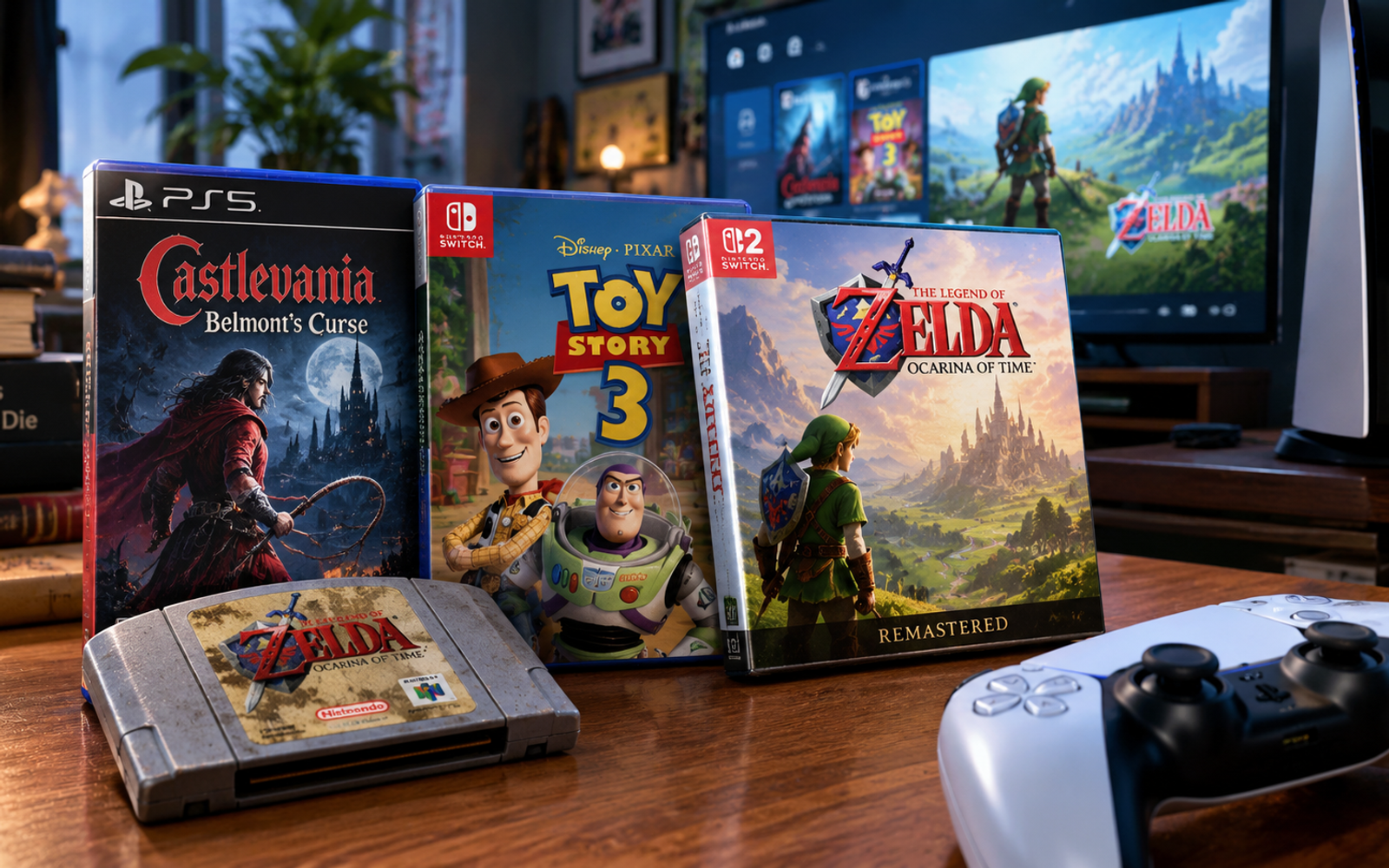
The demo went live on October 1. Two weeks later, on Thursday, Castlevania: Belmont's Curse shipped for Switch, PlayStation 5, Xbox Series and PC, which makes it the first new Castlevania since 2014. It's a 2D exploration game set in Paris in 1499, twenty-three years after the events of Castlevania III: Dracula's Curse. Rose Belmont, Trevor's daughter, spends most of the running time in catacombs, hitting things with the Vampire Killer.
That production credit stopped me. Konami built the game with Evil Empire and Motion Twin, the French studios behind Dead Cells. So a Japanese publisher handed its most gothic property, a series named after a Transylvanian castle, to a French team, and the French team set it in Paris. It's the right call, and it's also a small admission: whoever best understands how a 1989 side-scroller should feel in 2026 doesn't work in Tokyo.
A Sequel Built by the Studios That Studied the Original
The arithmetic in the timeline is the part worth sitting with. Castlevania III came out in 1989. Belmont's Curse picks up twenty-three years later in story time, so the fiction's gap is fourteen years shorter than the real one. Konami wrote a sequel that stands closer to its own predecessor than the release calendar ever managed.
That isn't a knock on the plotting. It's a measure of how carefully the thing was reconstructed. Evil Empire and Motion Twin made their names on a roguelite that quoted Symphony of the Night hard enough to double as a bibliography, and the reviews landing this week treat the new game as continuation rather than franchise rental. The whip, the map, the room-by-room chart that fills itself in as you explore: all of it is period-correct.
So the most traditional release of the week arrived with the strangest staffing story. A French studio reproduced the feel of a Japanese studio's 1990s output by treating it as technique rather than atmosphere, which is the harder trick. Whenever people argue about whether old games can come back without losing something, Belmont's Curse is the citation to reach for.
The Toy Story Reissue Is the Real Story
Toy Story landed the same day in a two-part package: Toy Story: Retro Roundup and Toy Story 3: Complete Edition. The 2010 Toy Story 3 game was licensed tie-in software, a category the medium spent two decades filing under disposable. It shipped to catch a film's opening weekend, it sold respectably, and then it did what licensed games always did, which is fall out of circulation once the paperwork moved.
Sixteen years on, it's back with "Complete Edition" printed on the box. This is the release that deserves the weekend slot, and it's the one with the least marketing behind it, which is roughly how preservation has always worked in games: quietly, commercially, and well after the people asking stopped asking.
The Calendar Is Doing the Work of the Archive
Run the three returning properties and the average gap comes out at roughly nineteen years between source material and this week's version. That average is the shape of the current release calendar. Rayman hasn't had a proper entry since 2013. The Star Wars Racer series went quiet more than twenty years ago. Grand Theft Auto VI arrives thirteen years after Grand Theft Auto V.
Jackbox is the odd one out, and it's instructive. There's no dormant franchise to revive and no 1990s artefact to restore. It ships a pack of party games every year, people play it once at a gathering and forget about it, and it keeps selling because the format is a room full of phones and a shared screen. It isn't marketed as heritage. It's the only thing on the weekend list that behaves like a normal product instead of an inheritance.
What the Ocarina Preview Is Doing to the Release Week
Game Informer's podcast on October 16 led with the Ocarina of Time remake, which doesn't arrive until November 5. The hosts spent the hour on a game you can't buy for another seventeen days, while the games that actually shipped on the fifteenth got a slot in the weekend roundup. The gap between what's being discussed and what's being sold has rarely looked wider.
The machinery behind that hype has its own schedule. Nintendo announced the remake at a Direct on June 9, showed it again during the Zelda 40th anniversary Direct on September 8, and will put themed Switch 2 hardware on shelves on October 29, a week before the game. By the time anyone can play it, the campaign will have been running for five months.
Attention and availability have come apart. A title three weeks from launch dominates coverage; three titles you can play tonight get a listicle. Music has the same drift, where streaming now throws up more than one No. 1 song at a time and the charts stop agreeing on what the top spot means. The only genuinely new idea in this week's releases came from Stranger Than Heaven, where Snoop Dogg teaches the protagonist how to rap, and that reads as an oddity rather than a direction.
None of this is a scandal. Belmont's Curse is a good game, the Toy Story package is better than a 2010 tie-in had any right to be, and the Ocarina remake will sell in numbers that justify every yen of the campaign. But a calendar assembled out of returns carries an expiry date. There are only so many 1998s left worth rebuilding, and the years after them belong to players who never stopped, who don't need anyone to remind them what a whip feels like. The quarter Rose Belmont stops selling is the quarter the industry has to ship something it can't hand back to you in a nicer box.
Comments (0)
No comments yet. Be the first to share your thoughts.