
Below ₦100M, Many Nigerian Firms Still Pay Tax
Nigeria raised the small-company tax exemption ceiling to ₦100 million, yet consulting and agency startups earning far less remain fully taxable under statutory exclusions.

Small business owners across Lagos and Abuja have spent the past year repeating a dangerous shorthand about Nigeria's rewritten tax rules: earn under ₦100 million and you pay nothing. On social media and inside founder WhatsApp chats, that headline gets repeated as blanket immunity. In practice, dozens of profitable boutique agencies, software consultancies, accounting firms, and medical clinics well under that threshold will still owe full corporate taxes, plus monthly late-filing penalties if they treat "tax-exempt" as permission to ignore the Nigeria Revenue Service portal.
- 1Three simultaneous tests decide the 0% CIT exemption: Under the Nigeria Tax Act, a company qualifies for 0% Companies Income Tax (CIT), 0% Capital Gains Tax (CGT), and exemption from the 4% Development Levy only if annual gross turnover is at or below ₦100 million, gross fixed assets do not exceed ₦250 million, and the firm does not provide excluded professional services.
- 2Consultancies and agencies below ₦100M still owe full corporate tax: Law firms, accounting practices, engineering consultancies, medical clinics, and advisory boutiques remain excluded from small-company relief even if annual revenue sits at ₦12 million.
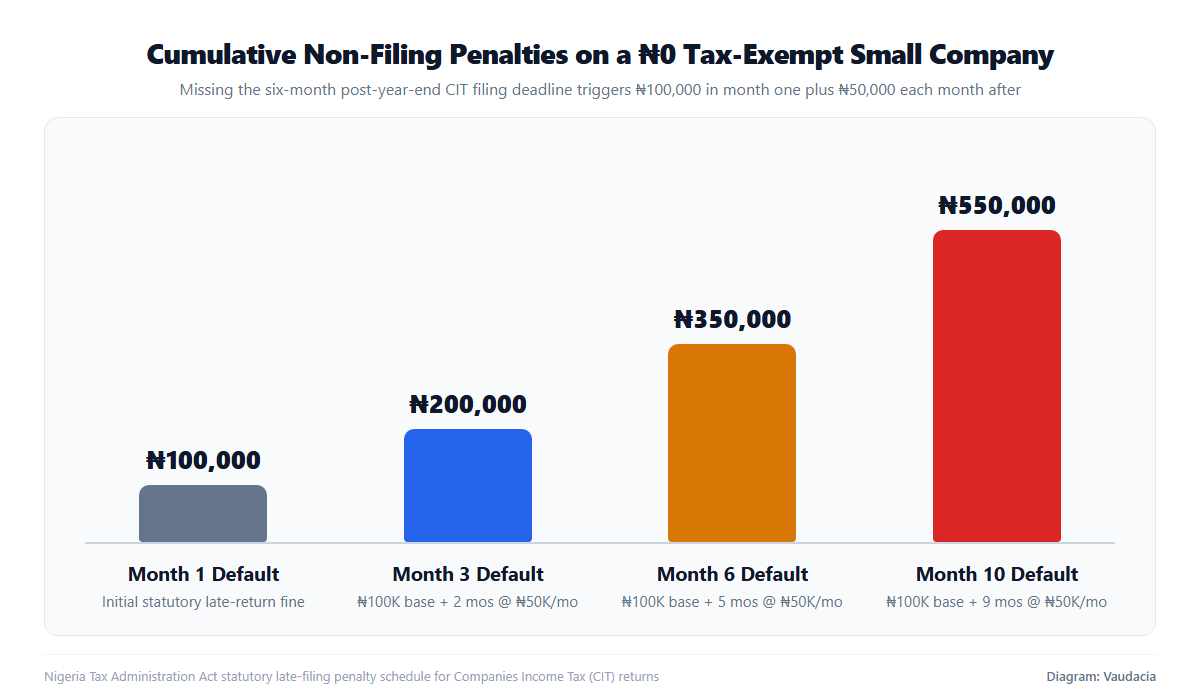
- 3Zero tax payable never means zero filing required: Every exempt small company must still file audited or simplified statutory returns within six months of accounting year-end or face a ₦100,000 penalty in the first month of default plus ₦50,000 for each subsequent month.
Under the codified Nigeria Tax Act statutory framework, qualifying small companies are exempt from Companies Income Tax (CIT), Capital Gains Tax (CGT), and the new 4% Development Levy (which replaces legacy fragmented charges such as the Tertiary Education Tax and Information Technology Levy across covered firms). Parliament lifted the old ₦25 million ceiling up to ₦100 million to relieve genuine micro-retailers, manufacturers, and early wholesalers fighting elevated financing and power expenses. Yet the statutory definition of a "small business" carries three strict gates that routinely disqualify large parts of Nigeria's urban services economy.
Where the ₦100M Small-Company Gate Closes
Qualifying for the 0% regime requires clearing three independent tests simultaneously during the relevant accounting year. Annual gross turnover must sit at or below ₦100 million. Total fixed assets, calculated before deducting depreciation, must not exceed ₦250 million. And third, the business must not fall under the statutory exclusion for entities providing professional services. Failing any single limb pushes the company straight back into the standard corporate tax net regardless of revenue size.
Because the three requirements apply together rather than as alternatives, founders cannot rely on a bank-statement revenue check alone. Auditors reviewing a small-company claim check the CAC incorporation objects, the gross fixed-asset schedule on the balance sheet, and the nature of client Withholding Tax (WHT) credit notes before confirming 0% liability.
How the ₦250M Gross Fixed-Asset Cap Traps Inflation-Hit Operators
Look closely at the middle gate on fixed assets. Many logistics operators, cold-chain distributors, printing workshops, and light agricultural processors generate well under ₦100 million in annual sales during their launch years while holding delivery trucks, diesel and solar power systems, cold rooms, or industrial machinery purchased after recent naira depreciation pushed imported equipment prices past ₦250 million.

Because the fixed-asset cap tests gross historical acquisition cost without subtracting accumulated accounting depreciation, an asset-heavy startup earning ₦65 million a year can silently lose exempt status strictly on balance-sheet hardware. Once cumulative gross cost on the fixed-asset register crosses ₦250 million, even five-year-old machinery sitting near zero net book value triggers loss of small-company eligibility.
Founders expanding workshop capacity often lease non-core heavy vehicles or structure warehouse property inside a separate holding entity rather than piling over ₦250 million of gross fixed assets onto the operating company's balance sheet. However, artificial fragmentation of related operations solely to duck the threshold invites anti-avoidance scrutiny during revenue audits.
Gross Turnover vs. Net Agency Commission for Thin-Margin Traders
The first gate trips up thin-margin traders and payment intermediaries in the opposite way. Statutory turnover measures gross sales invoiced on the company's own account, not gross profit or net margin retained.
A wholesale distribution company, building-materials supplier, or fulfillment intermediary clearing ₦115 million in annual customer invoicing on a slim 6% trading margin earns under ₦7 million before rent, fuel, and salaries, yet crosses the ₦100 million gross turnover boundary automatically. Once gross top-line receipts pass ₦100 million by even a single naira, the entire chargeable profit becomes subject to standard corporate income tax and the 4% Development Levy.
By contrast, software resellers, travel agencies, or logistics brokers who operate under properly drafted principal-agent agreements only recognize their earned agency commission as revenue rather than booking pass-through gross merchandise value belonging to the principal. Ensuring customer contracts, invoices, and accounting ledgers clearly distinguish pass-through client disbursements from earned commission fees prevents an intermediary earning ₦18 million in actual brokerage fees from being assessed as a ₦140 million principal trader.
The Professional Services Exclusion for Agencies and Consultancies
The single rule catching the most urban founders off guard is the professional services carve-out. As detailed in Legal500 on Nigeria's small-business professional services exclusion, firms engaged in providing professional services do not qualify for the small-company exemption even if they invoice ₦12 million a year with two laptops and zero real estate.
Classic regulated professions clearly fall inside this boundary: law practices, audit and tax consultancies, engineering firms, architects, and licensed medical practices. Yet the operational gray zone extends much further into modern digital work. Strategy agencies, IT architecture consultancies, outsourced HR practices, compliance advisors, and management advisory boutiques operating as limited liability companies face real classification risk if their Memorandum of Association, invoices, or client withholding deductions classify their output as advisory or consultancy services rather than standardized software licensing or commercial trade.
For lean service operators trying to build capital-light consultancies from scratch, incorporations written with broad "general consulting and advisory" object clauses now invite immediate tax reassessment. When corporate clients deduct 5% or 10% Withholding Tax on consultancy invoices and remit those credits under professional service codes, tax auditors possess an instant digital trail showing why the 0% exemption never applied. Separating distinct business lines, or checking before incorporation whether standardized product sales, software distribution, or retail logistics accurately reflect company revenue, matters before the first corporate client invoice goes out.
Why 0% Tax Liability Still Triggers ₦100,000+ Non-Filing Fines
Even companies that pass all three gates cleanly, earn ₦40 million selling physical goods, hold under ₦50 million in equipment, and owe zero naira in corporate tax, face expensive trouble if they skip statutory returns. Legal analysis in AO2Law's review of small-company compliance under the new tax regime stresses a distinction founders keep missing: an exemption from paying tax is never an exemption from filing tax returns.
Under Nigeria's updated tax administration penalty schedule, failing to submit an annual CIT return by the statutory six-month deadline after accounting year-end triggers an initial ₦100,000 penalty in the first month of default followed by ₦50,000 for every subsequent month the filing stays outstanding. Waiting ten months to "sort taxes out later" turns a legal ₦0 tax bill into ₦550,000 in statutory administrative fines before a company even pays an accountant to close the return.
Founders who confuse zero tax payable with zero paperwork required usually discover the difference when applying for a Tax Clearance Certificate (TCC) to bid on a corporate supply contract, clear customs, or renew a regulatory permit. At that point, every unfiled historical year must be regularized and every monthly late-filing penalty cleared before the portal issues a TCC.
Filing audited or simplified statutory financial statements within six months of your financial year-end locks in the 0% small-company status on record. Doing nothing on the portal hands tax officials the legal window to issue Best-of-Judgment assessments based on estimated bank inflows.
Reconciling Trapped Withholding Tax Credits and Tax Clearance
Exempt status also changes how founders manage Withholding Tax (WHT) credit notes deducted at source by enterprise buyers. Even when a small trading or manufacturing business qualifies for 0% CIT at year-end, large corporate customers frequently deduct WHT on supply contracts unless the vendor presents verified small-company exemption documentation ahead of payment runs.
When WHT is deducted from a company whose final CIT bill is ₦0, those tax credit notes become idle working capital trapped on the revenue portal unless the company files its annual return on time, reconciles its WHT schedule, and applies to offset or carry forward the credits against other eligible obligations.
Across Lagos and Abuja commercial districts, currency weakness compounds margin pressure for importers and local savers while rising energy bills force small businesses into private solar and power investments just to keep workshops open. With inflation pushing nominal naira sales closer to ₦100 million every quarter even when real unit volume stays flat, keeping clean gross revenue schedules, updated fixed-asset registers, commercial CAC object clauses, and on-time six-month tax filings determines whether a small business keeps its 0% exemption or absorbs avoidable back-assessments.
Comments (0)
No comments yet. Be the first to share your thoughts.