
Egypt's Haweya Lets Banks Open Accounts Without Paper Branches
Central Bank of Egypt rules for Haweya move remote bank onboarding beyond isolated selfie apps into a unified digital identity rail.

Opening a formal bank account anywhere across Upper Egypt or the Nile Delta used to mean burning half a workday inside a crowded branch waiting to have physical national ID cards photocopied, stamped, and signed in wet ink. Under rules cleared by the Central Bank of Egypt (CBE) in late August 2026, Haweya, Egypt's national digital financial identity platform, replaces that paper bottleneck with verified remote electronic Know Your Customer (eKYC) onboarding straight from a smartphone.
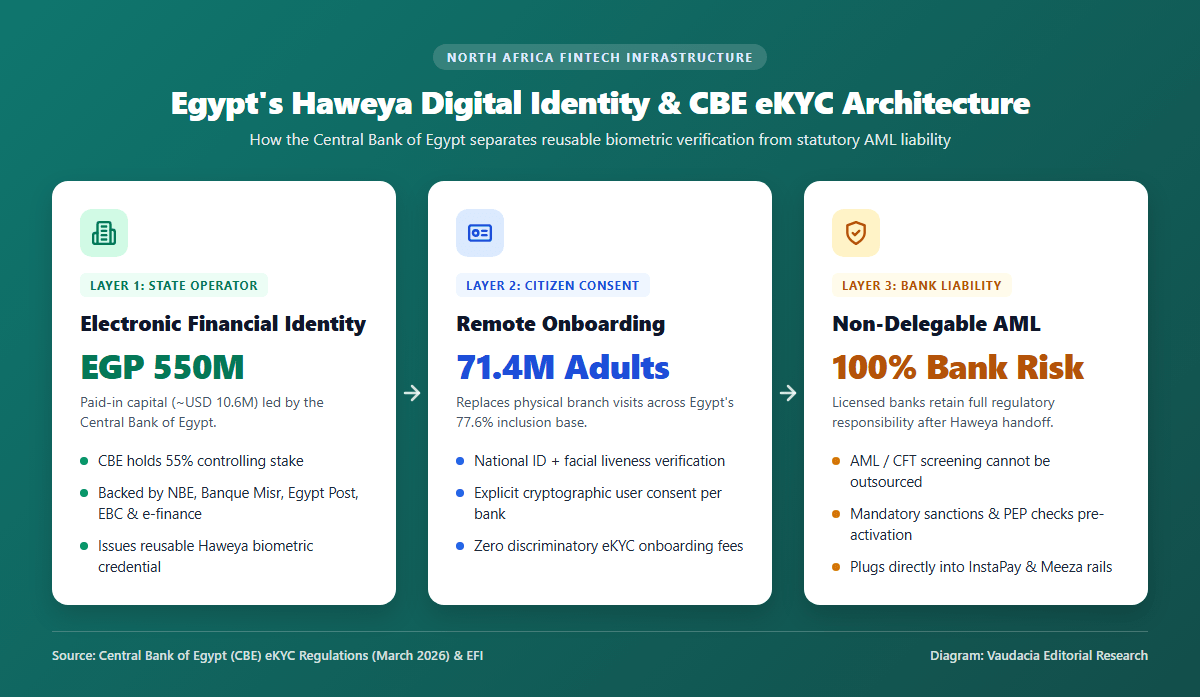
Rather than forcing every Egyptian lender to build its own isolated identity verification pipeline from scratch, the CBE's electronic KYC framework sets up a central verified identity credential owned and operated through Egyptian Financial Identity (EFI). Citizens verify their national ID and biometrics once through Haweya, then reuse that authenticated digital credential to open accounts, apply for credit cards, or activate brokerage and wallet services across licensed institutions without walking into a branch.
What Separates Haweya From an App Selfie
In dozens of emerging markets, "digital onboarding" has historically meant taking a slightly blurry phone photo of a plastic ID card inside an individual fintech app, waiting forty-eight hours for a human reviewer, and still hitting transaction caps until an in-person courier arrives with a signature pad. Haweya changes the architecture by separating identity proofing from bank product delivery.
As broken down in the CBE's Digital Financial Identity compliance blueprint, customers enroll on the Haweya application using multi-layered identity verification linked to official civil registry records, biometric liveness matching, and secure cryptographic token issuance. Once an individual holds an active Haweya credential, onboarding with a participating bank looks closer to an authenticated OAuth sign-in flow: the bank requests specific verified KYC fields, the user explicitly consents inside Haweya, and authenticated civil data populates the bank's compliance record electronically.
Read Also
Advertising a SaaS on a Tiny BudgetUnder legacy branch or isolated app KYC, every new bank relationship demanded a physical branch visit or courier signature, forced customers to re-upload ID scans and forms from scratch, and relied on unlinked third-party OCR tools at each lender. Under the CBE Haweya eKYC framework, licensed digital identity infrastructure operated by EFI replaces repeat document uploads with 100% remote digital enrollment and credential reuse across participating banks, applying uniform liveness, anti-spoofing, and civil ID checks while opening retail banking access across rural governorates.
Even so, Haweya does not turn commercial banks into passive bystanders. CBE rules draw a sharp legal line between identity verification and financial risk acceptance. Haweya authenticates who the customer is; the onboarding bank still remains legally accountable under Anti-Money Laundering and Counter-Terrorism Financing (AML/CFT) statutes for sanctions screening, ongoing transaction monitoring, income source verification, and enhanced due diligence on politically exposed persons.
Two-Stage Rollouts and Keeping Liability With Lenders
Central bank regulators rarely flip a single nationwide switch on remote biometric banking without a staged gate. Under the CBE rollout model, licensed banks pass technical integration audits, cybersecurity certification, and pilot limits before lifting remote onboarding ceilings across full retail portfolios. During initial onboarding tiers, accounts opened entirely via remote eKYC carry calibrated transaction and balance caps designed to catch synthetic identity attacks or compromised SIM swaps before higher credit or transfer limits unlock.
That risk-based posture reflects hard lessons learned globally as trillion-dollar mobile money systems became foundational retail banking rails. Whenever remote account creation drops from three days to three minutes, mule-account farms immediately test weak liveness checks and recycled phone numbers. Keeping final Customer Due Diligence liability pinned directly on each regulated bank ensures lenders do not blindly trust an API response when transaction velocity spikes unexpectedly on a brand-new account.
Why Remote eKYC Reaches Outside Cairo and Alexandria
Egypt has spent five years pushing financial inclusion sharply upward through Meeza cards, InstaPay real-time transfers, and telecom mobile wallets, yet full conventional bank accounts have lagged outside Cairo, Giza, and Alexandria simply because physical branches cost too much to plant in lower-income rural centers. Setting up and staffing a traditional suburban branch makes no economic sense for balances averaging a few thousand Egyptian pounds per household. When the nearest branch sits forty minutes away across crowded regional roads, unbanked households default to cash or informal rotating savings clubs even when they already send P2P wallet transfers weekly.
Remote eKYC flips that unit economics problem upside down. When a commercial bank or digital-first subsidiary can acquire and verify an agriculture trader in Asyut or a freelance designer in Mansoura at fractional marginal cost without paying for real estate, tellers, or paper couriers, full checking, savings, and micro-credit accounts become commercially viable downmarket. Customers already accustomed to InstaPay transfers can move directly into formal interest-bearing accounts, payroll products, Certificate of Deposit savings yields, and small business credit lines inside apps they already use. Just as helpful for Egypt's fast-growing digital banking licensees, banks building mobile-first subsidiaries no longer have to burn half their launch capital leasing street-level flagship premises just to legally sign up new retail depositors.
Technically, that trust layer depends on continuous anti-spoofing defenses. CBE technical supervision requires biometric presentation-attack detection capable of catching pre-recorded replay videos, printed high-resolution ID masks, and synthetic deepfake facial injection tools running on rooted handsets. Every approved authentication generates an auditable timestamped consent log tied back to the central registry, giving bank compliance teams clean regulatory evidence during central bank inspections without delaying legitimate applicants who hold valid cards.
Diaspora Remittances and Real Friction Points Ahead
Another clear winner sits outside Egypt altogether: millions of Egyptian expatriates working across Saudi Arabia, the UAE, Europe, and North America who regularly send remittances home or buy local property and Treasury bills. Historically, updating an expired national ID or opening a fresh local Egyptian pound account while living in Riyadh or Dubai meant waiting for summer holidays or executing notarized consular powers of attorney.
With remote digital identity authentication under CBE supervision, compliant diaspora citizens can verify identities electronically abroad, provided two practical hurdles hold up smoothly under real traffic. First, enrollment relies on up-to-date Egyptian national ID cards and active mobile numbers linked to the applicant, meaning overseas workers holding expired physical cards still hit civil registry bottlenecks first. Second, banks must handle multi-bank consent UX, account recovery when a user loses their smartphone, and rural low-end Android camera performance without locking legitimate customers out during liveness tests.
Digital identity rails thrive on trust and effortless recovery. If lost phones force citizens back into three-week physical branch queues to reset their Haweya credentials, adoption outside major cities will stall faster than any regulatory rule could help.
The telecom tie-in adds one more operational detail banks cannot skip. Because mobile numbers in Egypt are already bound against national ID cards under National Telecom Regulatory Authority SIM-registration rules, Haweya relies on continuous SIM-ownership verification to stop SIM-swap hijackers from taking over dormant banking credentials. If a rural customer changes prepaid SIM cards after a handset upgrade or loses a phone without updating carrier records, re-binding that cryptographic token smoothly becomes just as important as the initial sign-up flow. For Egyptian fintechs and legacy commercial banks alike, Haweya settles the hardest infrastructure argument: the state and central bank built the shared identity pipe so private lenders can compete on interest rates, lending speed, and customer experience instead of duplicating branch paperwork.
Comments (0)
No comments yet. Be the first to share your thoughts.