
South Africa E-Commerce Hits R159B: Now Comes the Margin Fight
With online retail reaching R159 billion and 10% of total South African retail spend in 2026, merchants face tougher fulfillment pressure alongside strict SARS customs and POPIA rules.

For years, skeptics insisted South African consumers would stick permanently to physical malls, blaming costly delivery miles, hesitant card habits, and inconsistent doorstep security. That argument just expired against hard sales totals. According to World Wide Worx's Online Retail in South Africa 2026 report, researched alongside Mastercard, Peach Payments, and Ask Afrika, South African online retail grows 22.5% to R159 billion across 2026 (up from R130 billion in 2025) and crosses 10% of total national retail turnover across a full calendar year earlier than older forecasts projected.
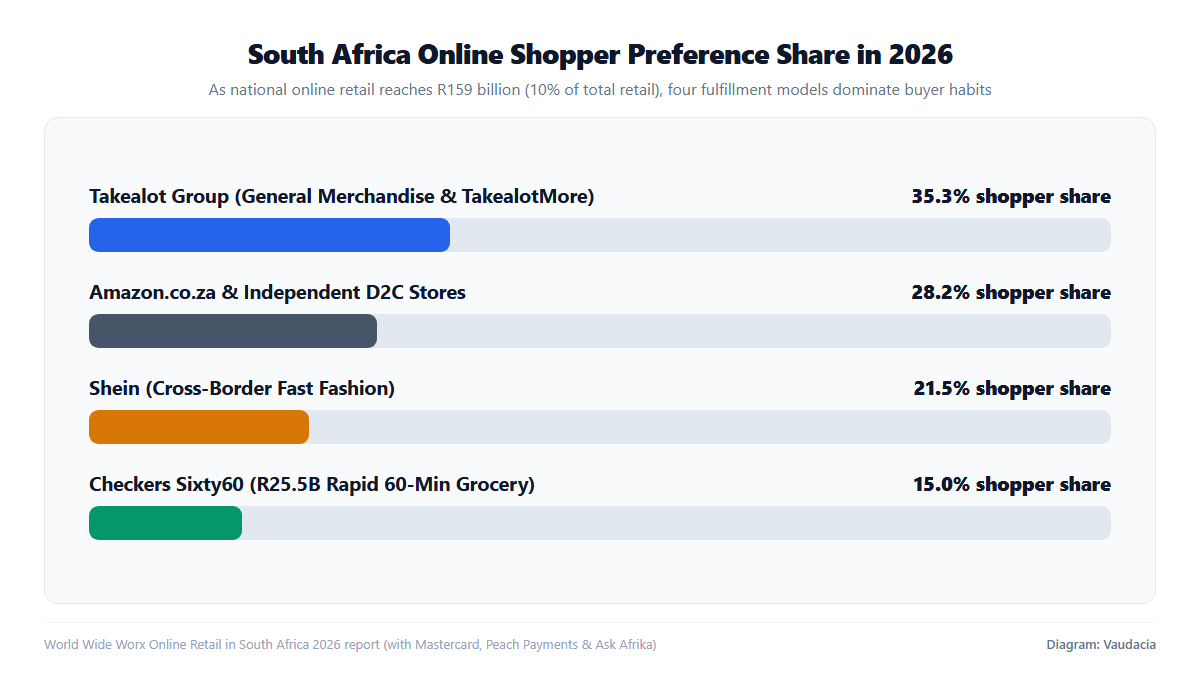
- 1Online retail reaches R159 billion (10% of total retail): According to World Wide Worx's 2026 study with Mastercard, Peach Payments, and Ask Afrika, South African e-commerce grew 22.5% from R130 billion in 2025 to R159 billion in 2026, led by Takealot (35.3%), Amazon.co.za and independent D2C stores (28.2%), Shein (21.5%), and Checkers Sixty60 (15.0%).
- 2Last-mile lockers and Instant EFT protect contribution margin: Shifting sub-R1,000 orders from R85 door-to-door couriers to R45 out-of-home parcel lockers and steering checkout volume from 3.5% to 5.5% BNPL fees onto 0.5% to 1.2% PayShap or Capitec Pay rails preserves merchant profitability.
- 3SARS customs parity and POPIA Form 4 tighten compliance: Enforcing the full 45% import duty plus 15% VAT on low-value offshore clothing parcels narrowed Shein's landed price edge, while POPIA Form 4 direct-marketing consent rules carry penalties up to R10 million.
Clearing that 10% threshold proves digital retail across Johannesburg, Cape Town, and Durban has permanently left experimental side-channel status behind. For independent D2C brands, Shopify store owners, and logistics operators mapping 2027 growth, however, rising total market volume arrives paired with sharper margin squeezes around Amazon Prime pricing, SARS cross-border tariff enforcement, and strict POPIA compliance.
Takealot, Amazon, Sixty60, and Shein Split the R159B Market
Even as overall consumer checkout volume rises strongly, buyer habits have concentrated around four competing fulfillment models fighting for repeat household spend. Takealot still anchors general merchandise with a 35.3% shopper share and its first full-year trading profit, leaning on deep regional warehouses and its TakealotMore delivery membership while tightening marketplace seller fee discipline and SLA metrics.
Amazon.co.za has lifted awareness rapidly alongside independent D2C stores (28.2% combined channel share) through its R59-per-month Amazon Prime shipping and Prime Video bundle, raising middle-class expectations for free rapid shipping. In grocery and everyday essentials, Checkers Sixty60 commands a 15.0% online buyer share around R25.5 billion in scale with its 60-minute scooter fleet, training urban buyers to expect same-hour convenience. Meanwhile, cross-border fast-fashion giant Shein holds a 21.5% shopper share under tighter SARS customs oversight. Independent stores caught between those giants cannot compete on generic free-shipping wars without eroding gross margin on every parcel dispatched.
Parcel Lockers and the R85-to-R45 Last-Mile Margin Gap
Looking past platform giants reveals a practical logistics shift reshaping courier unit economics nationwide. Fast-growing independent merchants scaling outside leafy suburbs increasingly combine traditional home couriers with out-of-home parcel lockers and pickup counters (such as Pargo points, Bob Box lockers, and Takealot Pickup hubs) inside neighborhood petrol stations, grocery convenience counters, and pharmacies.
Removing daytime residential security-gate failed drops trims costly second-delivery fees substantially while unlocking reliable fulfillment across high-density commuter corridors in Gauteng, KwaZulu-Natal, and the Western Cape. When a driver waits ten minutes outside a gated estate only to log an unsuccessful delivery attempt, the return trip back to the regional depot doubles fuel and labor cost on an order that only carried R180 in gross margin to begin with.
On typical sub-R1,000 baskets, dropping average last-mile courier expense from R85 door-to-door down to R45 locker collection frequently marks the thin boundary between losing money on acquisition marketing and netting profitable repeat cohorts. This maturity stage mirrors broader commercial patterns visible across top emerging African tech and commerce builders: flashy top-line gross merchandise totals stop turning heads once reverse logistics, warehouse rent, and return percentages decide actual net cash flow.
SARS Closes the 45% Customs Loophole on Offshore Fast Fashion
Meanwhile, the South African Revenue Service (SARS) crackdown on low-value cross-border fashion parcels altered the competitive terrain faster than any domestic marketing campaign could. Before regulators stepped in, overseas fast-fashion platforms moved millions of small apparel packages under legacy 20% flat customs concessions and sub-R500 de minimis exemptions that bypassed the full 45% import duties and 15% VAT absorbed by licensed domestic clothing retailers and local textile importers.

Enforcing parity customs duties plus standard 15% VAT clearance right at air-cargo and courier customs hubs stripped away a steep artificial price advantage overnight, while pushing offshore sellers to test regional warehousing inside South Africa just to stabilize delivery lead times. Once an imported R450 dress packet attracts formal clothing tariff assessment plus courier disbursement fees at OR Tambo International Airport, the landed checkout discount against a local retailer shrinks dramatically.
Agile Cape Town and Johannesburg apparel brands that keep core stock locally and offer transparent 48-hour size exchanges suddenly look far more competitive on total checkout price than unverified cross-border parcels hit by surprise courier customs bills at landing.
BNPL Installments vs. Pay-by-Bank Instant EFT Fees
Ask almost any WooCommerce or Shopify operator in Cape Town why expensive Instagram prospecting stalls on the payment screen, and two blockers surface repeatedly: narrow credit-card ownership and deep hesitation over entering 16-digit debit credentials online. Conventional credit lines cover only a modest percentage of salaried South Africans, while debit cards routinely stumble on messy 3D-Secure bank OTP timeouts mid-commute.
Over the past two years, modern local payment gateways (Peach Payments, PayFast, Ozow) alongside interest-free Buy Now, Pay Later (BNPL) installments from local providers like PayJustNow and Payflex bridged both cash-flow timing and card friction. Splitting a R1,600 jacket purchase or backup solar inverter accessory smoothly over three payday-aligned installments lifts average basket values noticeably when merchants keep pricing clean, echoing how frictionless mobile and instant payment networks accelerated retail trust across the continent.
Fast API bank rails such as Capitec Pay, PayShap, and modern Instant EFT integrations add another margin lever by letting shoppers authorize payments securely inside their native mobile banking app without typing screen-scraped banking passwords or paying 2.9% credit card interchange fees. On the supplier procurement side, cross-border importers also rely increasingly on Pay-by-Bank Instant EFT locally alongside faster treasury tools that shrink 4% to 6% offshore FX spreads as modern digital dollar rails reshape African merchant settlement. Smart operators model BNPL merchant discount rates honestly against raw Instant EFT fees and track order-cancellation rates on installment buyers so higher average order tickets genuinely expand contribution margin rather than masking fee bleed.
POPIA Form 4 Consent and the 65% Trust Barrier
Here rests the sobering reality tucked right alongside World Wide Worx's R159 billion headline: roughly 65% of internet-connected South Africans still avoid shopping online regularly. Research points directly past connectivity pricing toward an entrenched barrier: consumer skepticism surrounding spam blasts, card security, and sketchy data handling.
Under South Africa's Protection of Personal Information Act (POPIA), careless remarketing turns rapidly from an annoying growth habit into regulatory breach exposure and immediate checkout churn. The Information Regulator requires explicit Form 4 opt-in consent before brands send promotional SMS or WhatsApp broadcasts, backed by administrative fines reaching up to R10 million for serious contraventions. Scrubbing purchased contact spreadsheets or auto-enrolling one-time gift buyers into daily promotional WhatsApp blasts violates direct-marketing consent mandates cleanly and triggers instant user hostility.

Minimizing identity data footprint at checkout matters just as much. Requesting heavy ID scans or excessive personal histories to ship everyday retail goods multiplies Information Regulator breach liability unnecessarily if an app plugin gets compromised. When merchants store raw residential histories inside unpatched third-party loyalty apps or export unencrypted customer sheets across freelance marketing folders, one minor credential leak turns quickly into mandatory public breach reporting and expensive reputation repair.
How Independent D2C Stores Defend Margin in 2027
Small South African consumer stores cannot out-spend Takealot or R59 Amazon Prime on commoditized cables or detergent, yet they win fiercely loyal niche categories when buyers see transparent VAT-inclusive totals upfront, verifiable Johannesburg or Cape Town return addresses, prompt five-day EFT refunds, and respectful POPIA communication habits.
Keeping transactional delivery updates strictly operational on WhatsApp while leaving promotional opt-in checkboxes explicitly unchecked builds genuine credibility over repeat order cycles. Pairing a R45 parcel-locker checkout option with instant Capitec Pay or PayShap settlement gives hesitant buyers concrete reassurance that an online basket carries less friction and lower cost than fighting Saturday mall queues. Crossing R159 billion confirms the national logistics infrastructure is already working; capturing the next R50 billion goes straight to merchants who protect unit margins and earn repeat buyer trust long after delivery one arrives safely.
Comments (0)
No comments yet. Be the first to share your thoughts.