Why the Nasdaq Recovery Runs Through Memory Chip Supply
Apple's weak margin guide and the Nasdaq's three-month low share one cause: AI memory demand is eating DRAM wafer capacity.

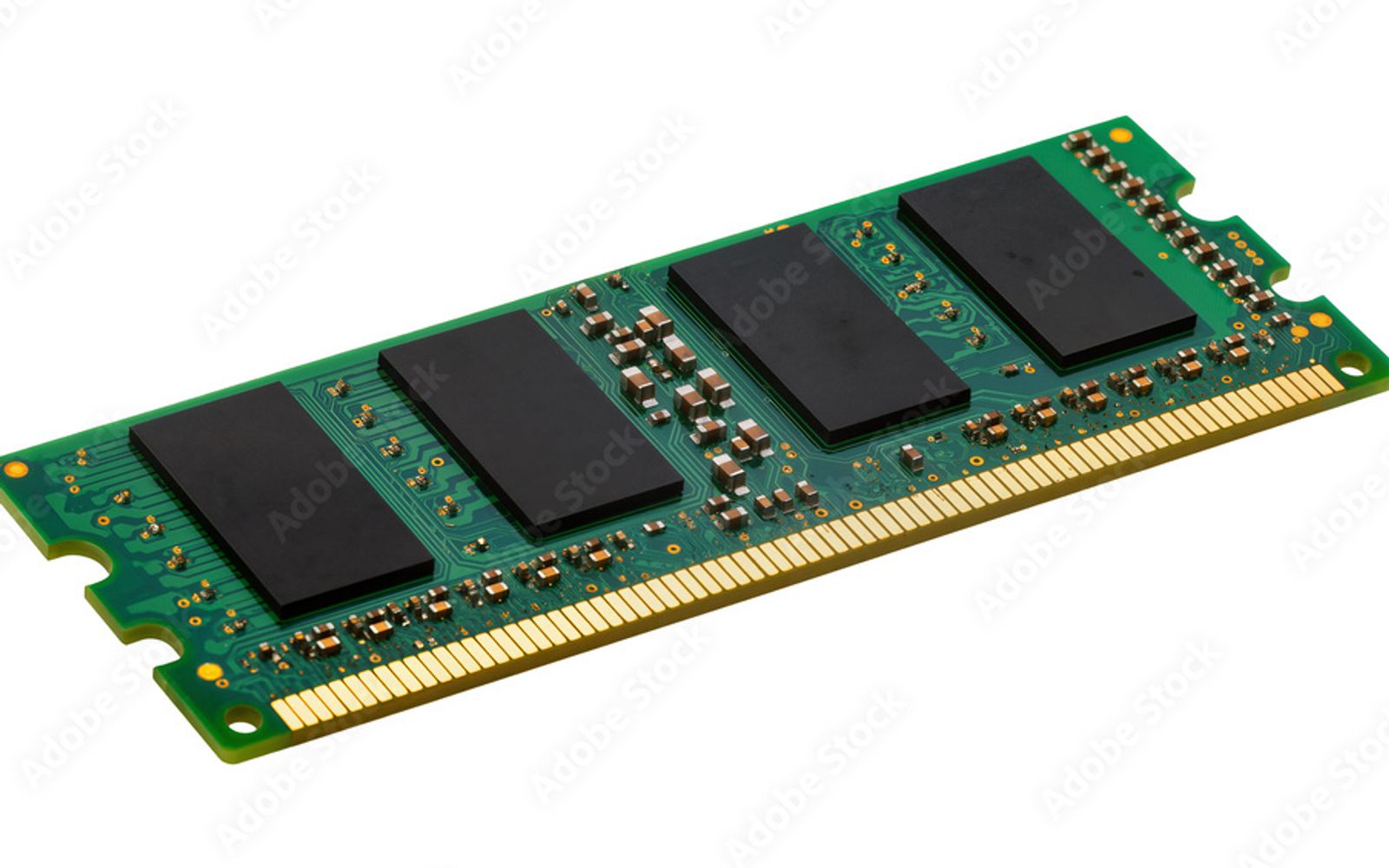
A single 300 mm DRAM wafer carries something close to 800 usable dies, and the fight on Wall Street this week is about where those dies go. One path puts them into LPDDR5X packages for handsets. The other stacks twelve of them vertically with through-silicon vias, mounts the stack on a silicon interposer beside a GPU, and sells the result to a data center at several times the price per bit. Memory makers have been choosing the second path for two years, and that choice has now reached the gross margin line of the largest company in the market.
- 1The shared cause: Apple's soft December margin guide and the Nasdaq's slide toward three-month lows come from one input, a global shortage of DRAM and high bandwidth memory that AI buildouts keep absorbing.
- 2The architectural reason: An HBM stack spends two to three times the silicon area per stored bit that a DDR5 die does, so every accelerator shipped takes wafer capacity away from phones, laptops and cars.
- 3What matters next: Memory contract pricing and Apple's gross margin line will move this index more than the midterm results or any single earnings beat.
Wednesday's premarket tape reflected the confusion rather than resolving it. Nasdaq 100 futures recovered to roughly 0.8% higher after an overnight session in which they had fallen as much as 2% on early midterm vote counts, Dow futures sat slightly lower, and the index at the center of the story had closed Tuesday at 25,372.01, up 0.83% but still near a three-month low. The Nasdaq-100 finished at 28,180.26, in correction territory and about 10% below its high, while the S&P 500 added 0.36% to 7,568.92 and the Dow lost 197.26 points to 51,786.72, according to CNBC's market wrap. Underneath all of it sat one company's guidance and one component.
Apple's December Quarter Is a Memory Bill
Apple's fiscal fourth quarter, the first under chief executive John Ternus, was not a demand problem. Revenue came in at $114.5 billion against estimates near $113.5 billion, iPhone revenue hit $57.58 billion against a $56.48 billion consensus, and gross margin landed at 47.9%. Kevan Parekh, Apple's chief financial officer, said: "Our record September quarter capped off a strong fiscal 2026, with all-time record revenue of $479 billion and double-digit EPS growth." Full year revenue of $478.8 billion was a record for the company, per Apple's results release.
The weakness was geographic and forward looking. Greater China revenue of $17.54 billion missed an $18.75 billion estimate, and iPad revenue of $6.23 billion missed as well. The number that moved the stock down 1.9% to $331.90, though, was the December quarter margin forecast, which the company tied to rising memory costs rather than to any pricing decision of its own. Apple can lift the price of an iPhone 18 Pro, as it did this cycle with a $100 increase, but it cannot set the price of DRAM, and it now buys that memory in a market where its order volume competes with hyperscaler capital budgets.
That is the mechanism the index-level coverage blurred. When a handset maker guides margins lower because of a component, the constraint has already traveled through procurement, contract pricing and inventory, which means it shows up in the next four quarterly reports regardless of what happens at the polls.
What an HBM Stack Costs in Silicon
High bandwidth memory is not a different kind of memory cell. It's the same DRAM cell, arranged badly for density and beautifully for bandwidth. Each die in the stack connects to the ones above and below through thousands of vertical copper vias drilled through the silicon, and the base of the stack carries a logic die that fans a 1024 bit interface out to the GPU. A DDR5 die talks to the rest of the system across 64 bits. The difference in wiring is the difference between a fire hose and a garden hose, and the silicon area required to build the fire hose is where the shortage lives.
The rule of thumb used across the industry is that an HBM bit costs two to three times the die area of a commodity DRAM bit. Part of that is the wide interface and the keep-out zones around the vias. Part of it is yield, because a twelve-high stack is only as good as its worst die, so stacking multiplies the odds of losing the whole unit. Part of it is packaging, since the base die runs on a foundry logic process rather than a memory process and queues behind every CPU and accelerator order.
Those multipliers are planning approximations rather than datasheet values, and they shift by vendor and process node. The direction is what matters. The same wafer, allocated to AI, delivers a fraction of the bits it would deliver to a phone. Memory makers aren't reducing output. They're reweighting it, because the margin per wafer is far better on HBM, and no board answers to a handset OEM when a hyperscaler is signing multi year supply agreements.
How One Margin Point Translates Into Billions
The sensitivity is easy to run. Apple booked $114.5 billion in revenue for the quarter, so one percentage point of gross margin is worth about $1.15 billion in a single quarter, or roughly $4.6 billion annualized. That's close to a fifth of the $6.23 billion the entire iPad line produced in the same three months, created or destroyed by a shift in component costs that most models treat as a rounding error.
Now run it from the demand side. If Apple ships on the order of 230 million phones a year, a figure that has held roughly steady for several cycles, and on device AI pushes average DRAM content up by 4 gigabytes per handset, that's about 920 million additional gigabytes of demand. At 2 gigabytes per 16 gigabit die and roughly 800 good dies per wafer, the math lands near 575,000 wafers. A single large DRAM fab running 100,000 wafer starts a month produces about 1.2 million a year, so one modest specification bump across the iPhone line absorbs close to half the annual output of an entire leading edge memory fab.
The memory market ran that calculation before Apple did. It's also why the mid range segment has been converging on flagship capability, as cheaper memory tiers and tighter software got squeezed into smaller budgets, a shift covered in why $400 phones caught up to $1,200 flagships. The open question for the next two quarters is whether handset makers respond by cutting memory content, which would blunt their own AI story, or by accepting lower margins.
Why Memory Makers Rally While the Index Falls
Tuesday's session made the split visible. Micron and Nvidia each gained more than 2%, Broadcom and AMD each rose about 3%, and Apple fell 1.9%, dragging the Dow lower while the Nasdaq Composite rose. Intel's 29% single-day collapse the previous week, after it guided down on client computing revenue of $8.1 billion, a 5% year-over-year decline, is the same trade seen from the other side. Whoever owns wafer capacity or sells the scarce part gets paid. Whoever buys it absorbs the cost.
Loading Diagram...(Hard refresh if it doesn't appear)
That relationship explains a set of moves that otherwise reads as a contradiction. The Nasdaq Composite can rise 0.83% in the same session that the Dow falls and the Nasdaq-100 stays 10% off its high, because the largest weights in the tech index are no longer uniformly on the buying side of the memory trade. A rotation inside an index isn't a recovery in the index. What happened Tuesday was a reshuffling of who pays the bill.
The Election Moves Timing, Not Physics
Early midterm vote counts pushed Nasdaq futures down 2% overnight, with Japan's Nikkei 225 off 3.5% and Korea's Kospi down 3% in sympathy, before US contracts recovered into Wednesday morning, as the WSJ's live coverage recorded. The market's stated reasoning is that a shift in Congress changes how quickly AI data centers get permitted, and state and local races can matter more than federal ones on that front. All of that is real, and all of it operates on a slower clock than a wafer allocation decision.
For a leading indicator on this index over the next quarter, watch DRAM contract prices and Apple's reported gross margin line. A political outcome can change how fast new fabs get permitted. It can't make an existing fab yield more bits per wafer this quarter.
A permitting delay in 2027 shows up as a supply response in 2030, which is roughly how long a greenfield memory fab takes from announcement to volume production. The wafers for the current quarter are already allocated. The margin guides have already been written into guidance.
The Yield Problem HBM4 Doesn't Solve Yet
HBM4 doubles the interface to 2048 bits and pushes the base die onto a more advanced foundry node, which raises the silicon cost per stack at the same moment demand for it is steepest. Anthropic has signaled a capital plan north of $895 billion, Meta has been raising tens of billions for AI infrastructure, and every one of those dollars eventually lands as an order for stacked memory. Memory makers can add HBM capacity, but each wafer converted removes commodity bits from the phone and PC market, and nobody has demonstrated a way to grow total bit output fast enough to feed both at current prices. The area penalty is physical, and fab construction is measured in years rather than quarters.
That unresolved constraint is why a record revenue quarter at Apple arrived with a lower margin forecast attached, and why a chip rally and a three-month index low can coexist on the same screen. Until a wafer yields more bits per square millimeter after the stack is built, the Nasdaq's advance will keep arriving as a rotation, and the bill will keep landing on whoever buys memory instead of selling it.
Comments (0)
No comments yet. Be the first to share your thoughts.