
Content Farms: How Websites Turn Empty Words Into Millions (And What Google Does About Them)
Why simple search questions lead to 2,000 words of filler, how traffic arbitrage makes assembly-line websites wildly profitable, and what Google is doing about it.
 By Vaudacia Staff
Every morning across the globe, an invisible assembly line boots up across millions of cloud servers. Long before human journalists pour their first cup of coffee or pitch an editor an original investigation, automated data scripts are already scanning billions of search engine queries, calculating commercial advertising yield per keyword, and manufacturing thousands of mechanical articles without a single human hand touching a keyboard.
- 1The definition: A content farm is an automated or low-cost publishing operation that produces massive volumes of articles designed solely to rank in search engines and harvest ad revenue, rather than satisfy human curiosity.
- 2The economic engine: Content mills operate on traffic arbitrage. By spending $0.001 to $5.00 to generate an article that earns $15 to $40 per thousand page views through display banners and affiliate links, they turn empty words into millions in pure profit.
- 3The evolution: From Demand Media's $1.5 billion freelance empire in 2011 to modern programmatic AI farms churning 10,000 scraped articles a day on expired domains, the packaging changes but the underlying machinery remains identical.
- 4The reader toll: Search results become clogged with artificial 2,000-word filler, buried answers, and circular sources. Recognizing the six signature red flags allows everyday readers to spot them in seconds and find authentic information.
On the consumer side of the screen, the result is an increasingly maddening digital obstacle course. A homeowner searching for instructions to reset a frozen digital thermostat or a cook checking whether homemade chicken broth can stay in the freezer rarely finds a straightforward two-sentence answer on the first page of Google anymore. Instead, the top search results lead to an identical template: three slow-loading display banners, an unmuted floating video player snapping to the corner of the screen, a patronizing introductory paragraph that restates the search query four different ways, and 1,500 words of irrelevant historical filler before the actual tip appears in a tiny bullet point at the bottom of the page.
This is not accidental bad writing, and it is not the work of careless bloggers. It is the calculated, industrial output of what digital media publishers call a content farm (or a content mill).
Understanding how these operations work, why Google repeatedly struggles to stop them, and how digital factories turn millions of empty words into pure ad arbitrage profit is the single most revealing lesson in how the modern commercial internet functions.

The Factory Floor of the Internet: What Is a Content Farm?
To understand a content farm, one first has to unlearn the romantic ideal of how publishing works.
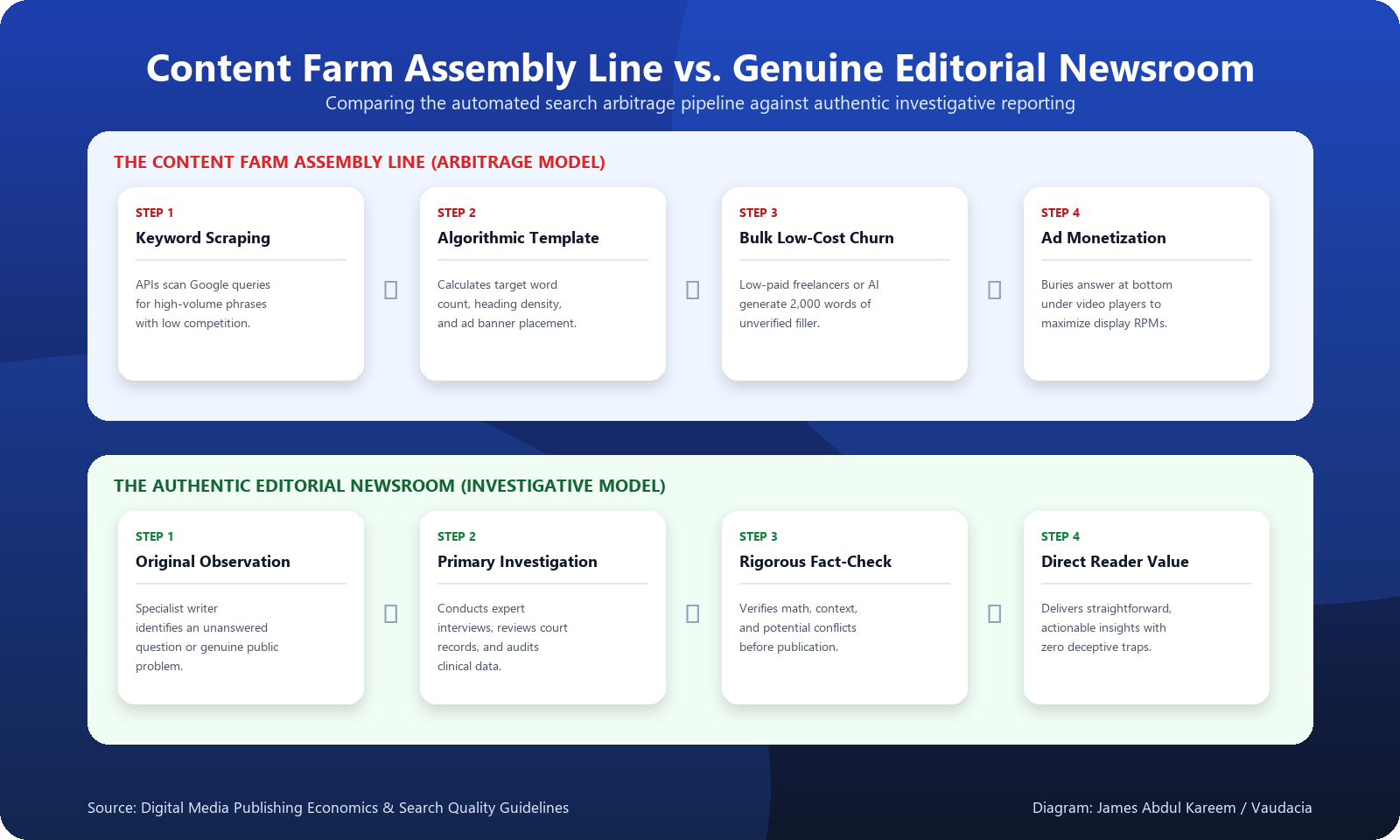
In traditional publishing, whether in a magazine, an investigative daily newspaper, or a genuine independent blog, an author starts with an idea, an observation, or an urgent piece of original reporting. The author writes because there is something meaningful or informative to communicate, and the publication distributes that insight to an audience that trusts its editorial judgment.
A content farm runs that entire process in reverse.
A content farm never begins with an idea, a writer, or a point of view. It begins with a database query.
The operators of a content mill run automated software that systematically queries search engine autocomplete feeds, commercial keyword intelligence platforms, and competitive traffic trackers. The software scans for search phrases that satisfy three strict economic requirements:
- High, predictable search volume: Thousands of people enter the exact question or phrase into Google every month.
- Weak editorial competition: Established mainstream outlets like The New York Times, BBC, or Wikipedia have not written a dedicated 2,000-word article targeting that precise keyword combination.
- High commercial advertiser rates: Advertisers are willing to pay competitive rates to show display ads next to that topic (home improvement, software error codes, personal loans, health symptoms, or consumer electronics).
Once the database generates a queue of 5,000 viable keywords, the operation treats article creation exactly like a widget assembly line. The primary goal is never to inform, delight, or challenge the reader. The only goal is to manufacture a page that contains just enough keyword density, heading tags, and word count to satisfy search engine indexing crawlers, at the absolute lowest cost possible.
The gap between what it costs to produce the text and what the page earns from automated display ads over three years is pure profit. That margin is the entire business model.
The Three Eras of the Content Mill
Content farms are not a modern invention born out of generative artificial intelligence. They have evolved through three distinct technological eras over the past twenty years, each getting cheaper, faster, and harder to regulate.
Era 1: The Human Sweatshop (2006 to 2011)
The undisputed pioneer of the modern content mill was a company named Demand Media. Founded in 2006 by former Myspace chairman Richard Rosenblatt, Demand Media built a publishing assembly line that stunned traditional media executives.
Demand Media operated flagship lifestyle and instructional portals like eHow, Livestrong, and Cracked. Instead of maintaining a conventional full-time newsroom, the company recruited an army of more than 10,000 freelance contractors across the globe.
The entire editorial assignment desk was algorithmic. Demand's proprietary software, named the "Content Algorithm," analyzed real-time search queries and estimated the commercial value of answering each one. The system automatically wrote article assignment titles and posted them to an internal freelance bulletin board.
Freelance writers logged into the portal, claimed an assignment, and had a few hours to write a 300 to 500-word article answering queries like "How to Cut a Watermelon" or "What Does a Transmission Fluid Leak Look Like?"
The compensation was famously minimal: typically between $3.00 and $5.00 per article, with copy editors earning roughly $1.00 to review each submission. At that pay rate, a writer could not conduct research, interview experts, or verify technical steps. To make minimum wage, contributors had to produce three to four articles an hour, relying on fast rewrites of whatever already appeared on Google's first page.
The financial model was wildly lucrative. By 2010, Demand Media was publishing more than 1,000 articles and videos every single day. In January 2011, Demand Media went public on the New York Stock Exchange under its official SEC registration with a valuation exceeding $1.5 billion, briefly making it worth more on paper than The New York Times Company.
Era 2: The Clickbait Network and Corporate Consolidation (2012 to 2022)
When Google overhauled its algorithms to penalize shallow 400-word articles in 2011, the content mill did not die. It simply expanded its word count and put on a corporate suit.
During this second era, digital media conglomerates recognized that search engines now favored long-form content (articles exceeding 1,500 words) and high domain authority. Companies began purchasing struggling print publications, popular entertainment blogs, and legacy lifestyle portals.
Publishing networks like Valnet (which acquired properties like ScreenRant, Collider, and CBR) and digital syndication hubs shifted their attention to entertainment listicles, video game walkthroughs, and streaming explainers. Instead of paying $5 for 400 words, they paid entry-level contributors $15 to $25 to write 1,800-word pieces with titles like "10 Things You Missed in Episode 4 of House of the Dragon".
To satisfy the length requirements dictated by search algorithms, writers were instructed to pad their submissions with extensive plot recaps, character histories, and repetitive introductions. The content was still produced on a mechanical assembly line, but it was disguised inside glossy responsive layouts and recognizable brand names.
Era 3: The Programmatic AI Pipeline (2023 to Present)
The arrival of advanced Large Language Models dismantled the last remaining financial bottleneck of the content farm: human labor.
Why pay a human freelancer $15 to write an 1,800-word explainer when an automated script connected to an AI API can generate that same article for less than two-tenths of a cent ($0.002) in thirty seconds?
Today's programmatic content farms represent the most extreme manifestation of the assembly line:
- Autonomous Web Scraping: Software monitors trending search terms, community forum discussions, and competitor sitemaps in real time.
- Automated Mass Generation: Scripts automatically generate structured outlines, draft 2,500-word articles, insert AI-generated stock graphics, and publish directly into content management systems without human editorial review.
- Expired Domain Hijacking: Operators purchase abandoned website domains that previously belonged to local newspapers, community colleges, or civic non-profit organizations. Because Google still assigns legacy authority to these domains, the new owners pump them full of 50,000 automated affiliate articles within weeks.
By mid-2024, search engine research firms identified hundreds of newly launched programmatic networks publishing between 2,000 and 10,000 articles every single day, a volume that dwarfs the output of any traditional journalism organization in human history.
The Hidden Math: How Turning Empty Words Into Pennies Makes Millions
To an ordinary reader, an assembly-line website looks like a complete failure. The prose is tedious, the ads are relentless, and the overall experience is frustrating. A natural question arises: who actually pays for this?
The answer is that nobody pays for the content directly. Content farms do not sell subscriptions or build reader loyalty. They sell attention arbitrage.
Here is the exact unit economics that makes content mills wildly profitable across the web:
The Production Cost Side
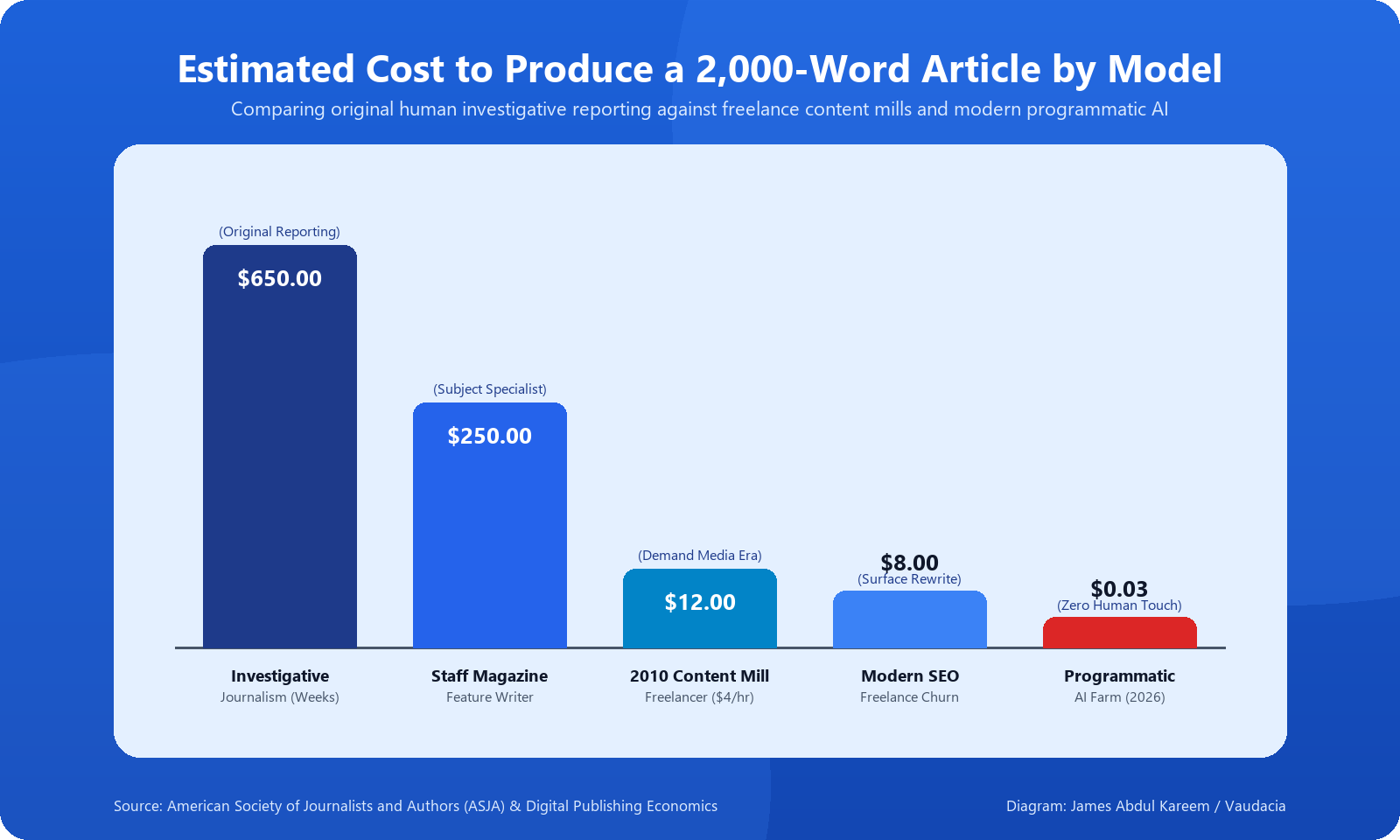
- Human Mill Era (2010): An article cost roughly $10 to produce ($8 to the freelance writer, $2 for basic editorial and CMS formatting).
- Modern SEO Freelance Churn: An offshore writer receives roughly $8 to produce a 2,000-word surface-level rewrite.
- Programmatic AI Mill Era (Today): An article costs roughly $0.02 to $0.05 in automated API compute and server hosting.
The Monetization Side (RPM Math)
Publishers measure ad revenue using RPM (Revenue Per Mille), which represents the total dollar amount a website earns for every 1,000 page views.
Through programmatic ad networks, including header-bidding exchanges, display banner slots, video units, and affiliate links generate an average RPM between $15.00 and $40.00, depending heavily on the target industry:
- General Entertainment and Celebrity Gossip: $8.00 to $14.00 RPM
- Cooking and Home Recipes: $18.00 to $28.00 RPM
- Tech Tutorials and Software Troubleshooting: $22.00 to $35.00 RPM
- Personal Finance and Insurance: $45.00 to $90.00+ RPM
The Profit Equation at Scale
Consider the conservative arithmetic for a mid-sized programmatic content farm managing 5,000 automated articles:
- Production Investment: 5,000 articles generated via automated pipelines at $0.05 each equals a $250 one-time setup cost.
- Traffic Performance: 80% of the articles fail to rank on search engines and receive zero traffic. However, the remaining 20% (1,000 articles) capture long-tail search traffic, averaging just 15 visitors per day each.
- Monthly Page Views: 1,000 winning articles multiplied by 15 visitors per day across 30 days generates 450,000 monthly page views.
- Monthly Gross Revenue: At a conservative average RPM of $25.00, 450,000 page views generates $11,250 per month in pure display ad revenue.
- Annual Net Return: That single $250 experiment yields $135,000 per year in largely passive cash flow, offset by only a few hundred dollars in annual server hosting costs.
When multiplied across forty or fifty niche domains, it becomes clear why private equity groups, opportunistic web publishers, and media holding networks continue investing in content mills.
Even if an article loses its search engine ranking after nine months, it has already returned several hundred times its initial production cost. It is pure financial arbitrage disguised as reading material.
The Anatomy of a Content Farm: 6 Red Flags You Can Spot in Seconds
Because content farms are designed around strict algorithmic formulas rather than individual author voice, they consistently display identical structural patterns.
Here are the six signature traits that reveal an assembly-line content farm within five seconds of clicking a link:
1. The Question Echo (The Intro Trap)
When an author possesses real expertise, they state the answer directly. A content farm cannot afford to do that. Providing the solution in the opening paragraph causes the visitor to leave immediately, collapsing ad impressions and viewability timers.
To keep visitors trapped on the page, the writer or AI prompt employs the Question Echo technique. The opening paragraph takes the user's exact search query and repeats it through several redundant sentences:
If someone is looking for how to change the battery in a car key fob, they are not alone. Many drivers wonder how to change their remote key battery when the buttons stop working. Changing a car key battery is an important task. In this article, we will show you how to change a car key battery step by step.
This passage offers zero practical information. Its sole purpose is to establish keyword relevance in the opening 100 words for search indexing bots while delaying the reader.
2. The Buried Answer
Notice how the actual instructions on manufactured websites consistently sit in Section 6 or 7, near the bottom of the page.
This is a direct response to advertiser viewability counters. Programmatic ad exchanges pay premium rates only when a display banner or video ad remains visible on an active screen for at least 15 to 30 continuous seconds.
By pushing the core answer past 1,500 words of background narrative, the site forces the reader to scroll through four screen heights of filler text, triggering multiple automated ad refresh cycles before delivering the necessary insight.
3. The Ghost Byline
A close look at the author box of a content mill rarely reveals a verifiable journalist with an established portfolio of published work.
Instead, content mills rely on three distinct byline tactics:
- The Anonymous Corporate Account: Articles credited to generic labels like Editorial Staff, Tech Team, or the website name itself.
- The Stock Avatar: A fabricated name paired with a purchased stock photo or an AI-generated portrait.
- The High-Volume Persona: A single named account that somehow publishes forty-two comprehensive guides in a single 24-hour window across unrelated topics like cardiovascular health, gardening, and video game mechanics.
4. The Ad Minefield
On a reputable publication, advertising supports the reading experience. On a content farm, the written text is merely the filler material separating high-density commercial real estate.
Common markers of an ad minefield include:
- Sticky video players that snap into the lower corner of the viewport when scrolling.
- Auto-refreshing banner ads that reload every 25 seconds, causing sudden layout shifts that jump the text around while reading.
- Prominent affiliate recommendation boxes highlighting products the author has never tested, held, or reviewed in person.
5. Circular Sourcing
When an investigative reporter or specialist writer explores a topic, they link directly to primary records: government databases, published scientific trials, patent filings, or direct interviews.
A content farm almost never conducts original reporting. Hyperlinks throughout the text lead to one of two places:
- Internal articles on the exact same website, placed to lower the domain's bounce rate.
- Sister websites owned by the same corporate holding company, creating a closed loop of self-referencing articles.
6. Programmatic Clones (Mad-Libs Publishing)
When searching for local service recommendations or software comparisons, users frequently encounter networks using programmatic templates.
The publisher writes a single 2,000-word template once:
Finding a reliable plumber in Chicago can be challenging. Whether someone is a longtime resident or just moved to the area, choosing the right service requires careful research...
The software then feeds a spreadsheet containing 400 municipal names into the database, instantly generating 400 separate URLs that read identically except for the swapped city name.
Inside the 6 Classic Models: How Content Mills Built Their Empires
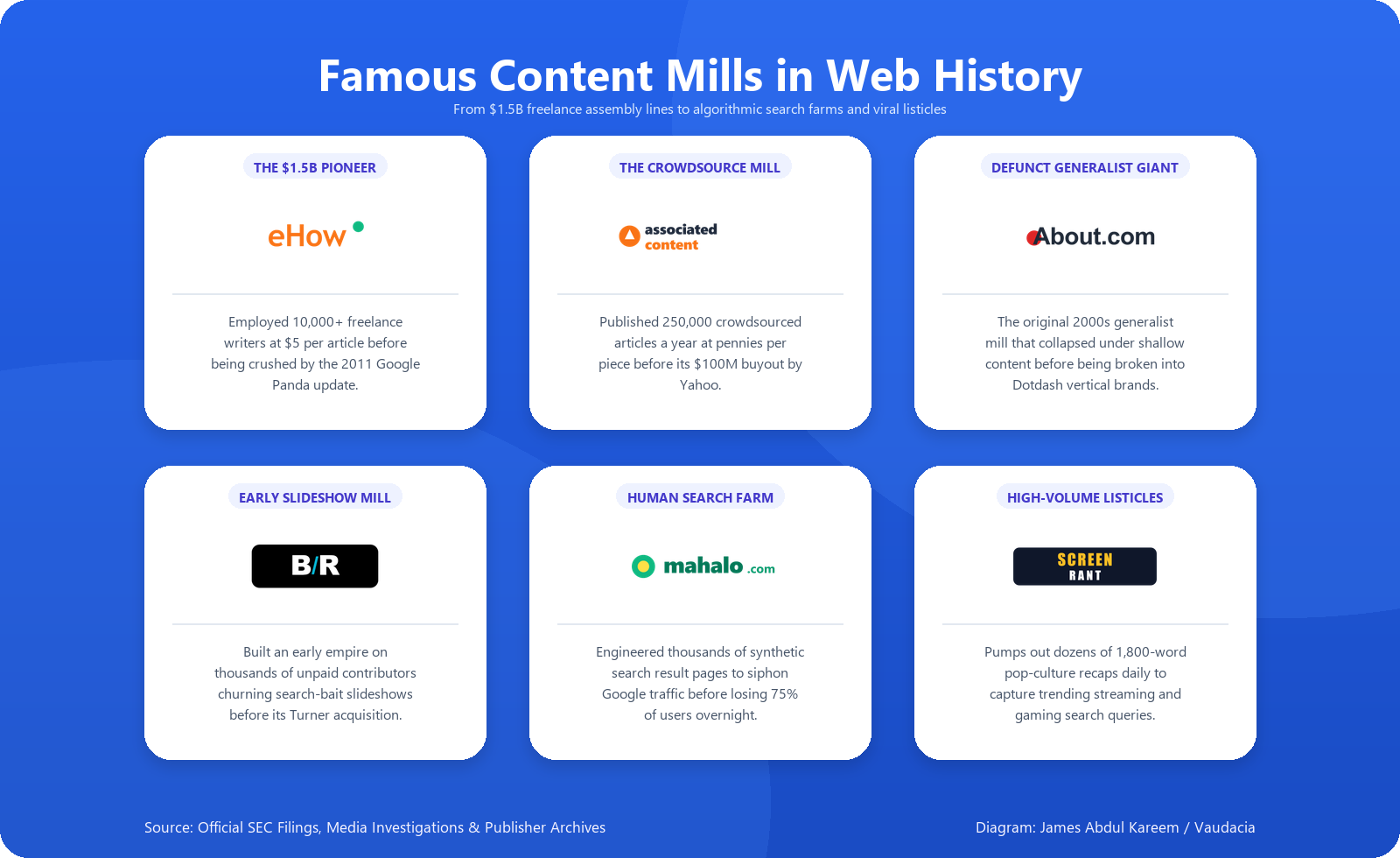
To understand how content farms came to dominate the open web, it is helpful to look at how the six most influential publishing factories operated at their commercial peak:
1. eHow (Demand Media): The Algorithmic Assembly Line
Demand Media was the pioneer of industrial-scale publishing. The company developed a proprietary algorithmic formula that scanned real-time search queries, calculated advertiser yields, and automatically generated article assignment titles. A remote workforce of more than 10,000 freelance contractors claimed these assignments on an internal dashboard, earning between $3.00 and $5.00 for each 400-word explainer. By publishing over 1,000 articles per day, Demand Media built a $1.5 billion public company on the New York Stock Exchange before Google's 2011 Panda update cut 40% of its search traffic within 48 hours.
2. Associated Content: The $100 Million Crowdsource Mill
Founded in 2005 under the slogan "The People's Media Company", Associated Content opened the floodgates to amateur writing at internet scale. Anyone could submit short articles, opinions, or local reviews and receive upfront payments ranging from $2.00 to $15.00 per piece, alongside micro-royalties based on page views. The site amassed hundreds of thousands of low-cost articles, leading internet giant Yahoo to acquire the network in 2010 for approximately $100 million to form the Yahoo Contributor Network. The model eventually shuttered in 2014 when search engines heavily penalized unverified crowdsourced text.
3. About.com: The 2000s Generalist Encyclopedia
During the early 2000s, About.com was an inescapable presence on Google search. The portal contracted specialized "Guides" who were assigned broad subject verticals (ranging from plumbing and auto repair to chronic medical conditions). Writers were required to produce steady quotas of evergreen articles and FAQs designed to rank for general queries. While useful in the early days of the web, the shallow breadth of the content led to declining authority. Parent company IAC retired the brand in the mid-2010s, breaking the domain apart into focused, higher-quality vertical publications under the Dotdash portfolio.
4. Bleacher Report (Early Era): The Crowdsourced Sports Farm
Before its $175 million acquisition by Turner Broadcasting in 2012, Bleacher Report built its massive digital sports footprint on the backs of thousands of unpaid or low-paid volunteer contributors. Writers were tasked with producing high-frequency search bait, famously packaging single rumors into 40-slide and 50-slide slideshows to multiply page impressions. The early operation was the definitive sports content mill before the company restructured, recruited established professional sports journalists, and modernized into a respected media brand.
5. Mahalo.com: The Human-Powered Search Result Farm
Created in 2007 by prominent tech entrepreneur Jason Calacanis, Mahalo attempted to build a "human search engine." Instead of producing original reporting, contractors were paid to hand-assemble search result landing pages for popular Google search queries, surrounding links with relevant summaries and heavy AdSense ad units. The platform grew rapidly until Google rolled out its 2011 Panda update, which decimated Mahalo's search visibility by roughly 75% overnight, forcing the site to abandon its search farm model and pivot to educational video tutorials.
6. Screen Rant (Valnet Media): The Modern High-Volume Listicle Factory
Screen Rant represents the modern, post-Panda evolution of the content mill, operating under digital publishing group Valnet. Rather than paying $5 for 400 words, the network commissions hundreds of entry-level contributors to churn out 1,500 to 2,000-word entertainment listicles, television episode recaps, and video game walkthroughs daily. Writers are instructed to pad simple answers with extensive plot background to maximize ad scroll depth and capture real-time Google Discover traffic feeds.
The Notable Scandals: When Legacy Brands Caught the Disease
The financial appeal of content farm economics has not stayed confined to obscure affiliate blogs. Over the past several years, respected mainstream media brands have adopted content farm tactics, leading to public editorial scandals.
Case 1: The CNET AI Finance Debacle (January 2023)
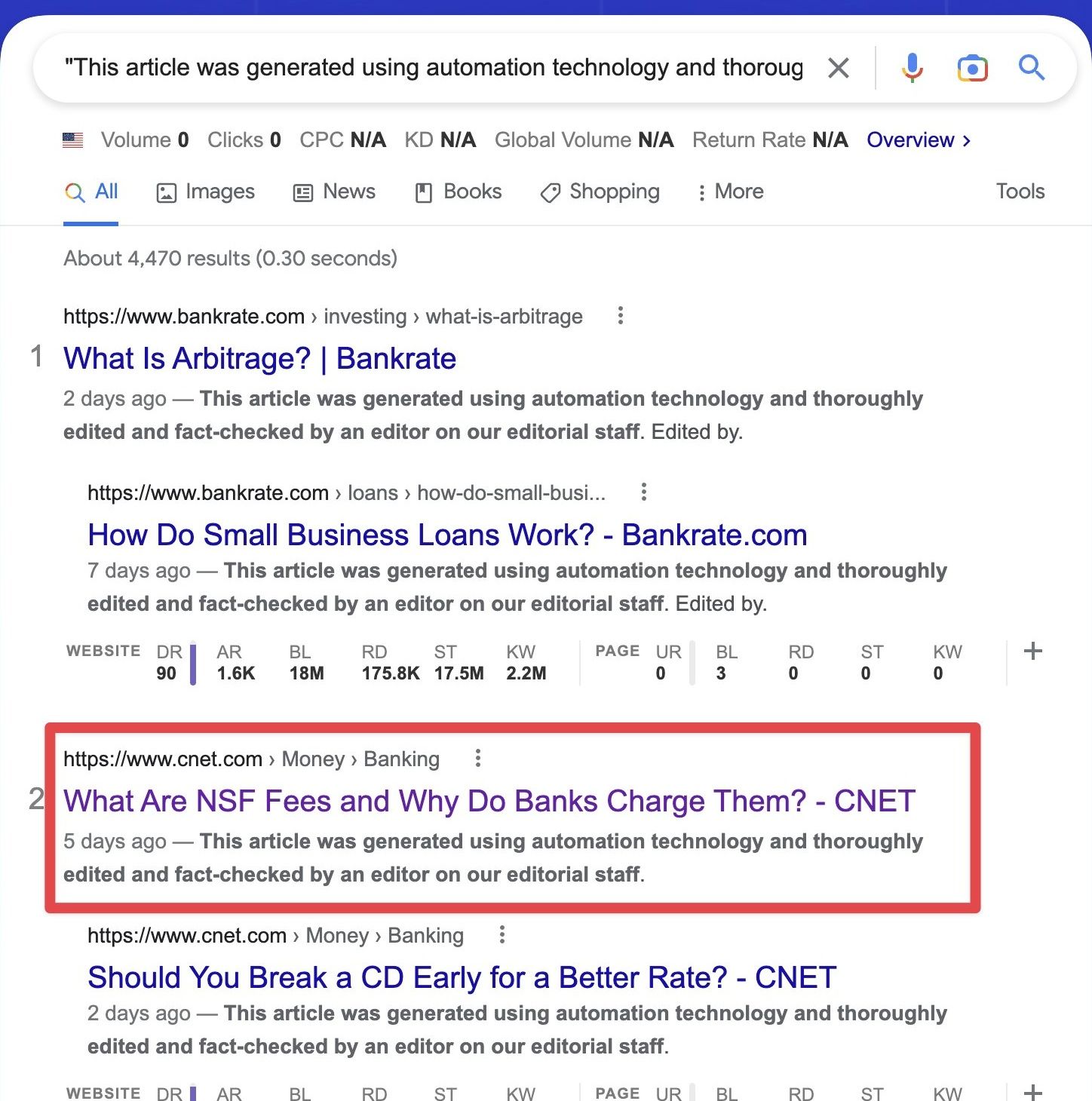
For nearly thirty years, CNET stood as one of the internet's most trusted technology news and consumer advice portals. In late 2022, following the acquisition of CNET's parent company by private equity firm Red Ventures, editors quietly began publishing dozens of automated financial explainer guides under the byline "CNET Money Staff".
The articles addressed sensitive personal finance topics like "What Is Compound Interest?" and "How to Cash a Check Without a Bank Account".
When independent tech publication Futurism investigated the byline in January 2023, they revealed that the articles were generated entirely by an automated AI engine.
Worse, the software was making basic arithmetic errors. In an article explaining compound interest, the AI claimed that a $10,000 deposit at a 3% interest rate would earn $10,300 in its first year, misunderstanding elementary financial calculations. Under intense union and reader criticism, CNET was forced to issue comprehensive corrections across more than half of its AI-generated articles and pause the automated initiative.
Case 2: Sports Illustrated and the Fake Authors (November 2023)
One of the most concerning examples of content farm methods invading a legacy brand occurred at Sports Illustrated.
In late 2023, Futurism's investigative reporting revealed that Sports Illustrated had been publishing product reviews and gear recommendations under fictitious author personas. Profiles like "Drew Ortiz", described as an outdoor gear specialist, featured headshots generated by artificial intelligence and biographical details fabricated out of thin air.
When reporters contacted The Arena Group, the management company licensing the brand, the author profiles were abruptly removed from the site. The incident severely damaged the credibility of a 70-year-old sports journalism institution, demonstrating how quickly legacy editorial standards can be compromised when automated affiliate revenue takes precedence over reporting.

Case 3: Expired Domain Parasite SEO (2023 to 2024)
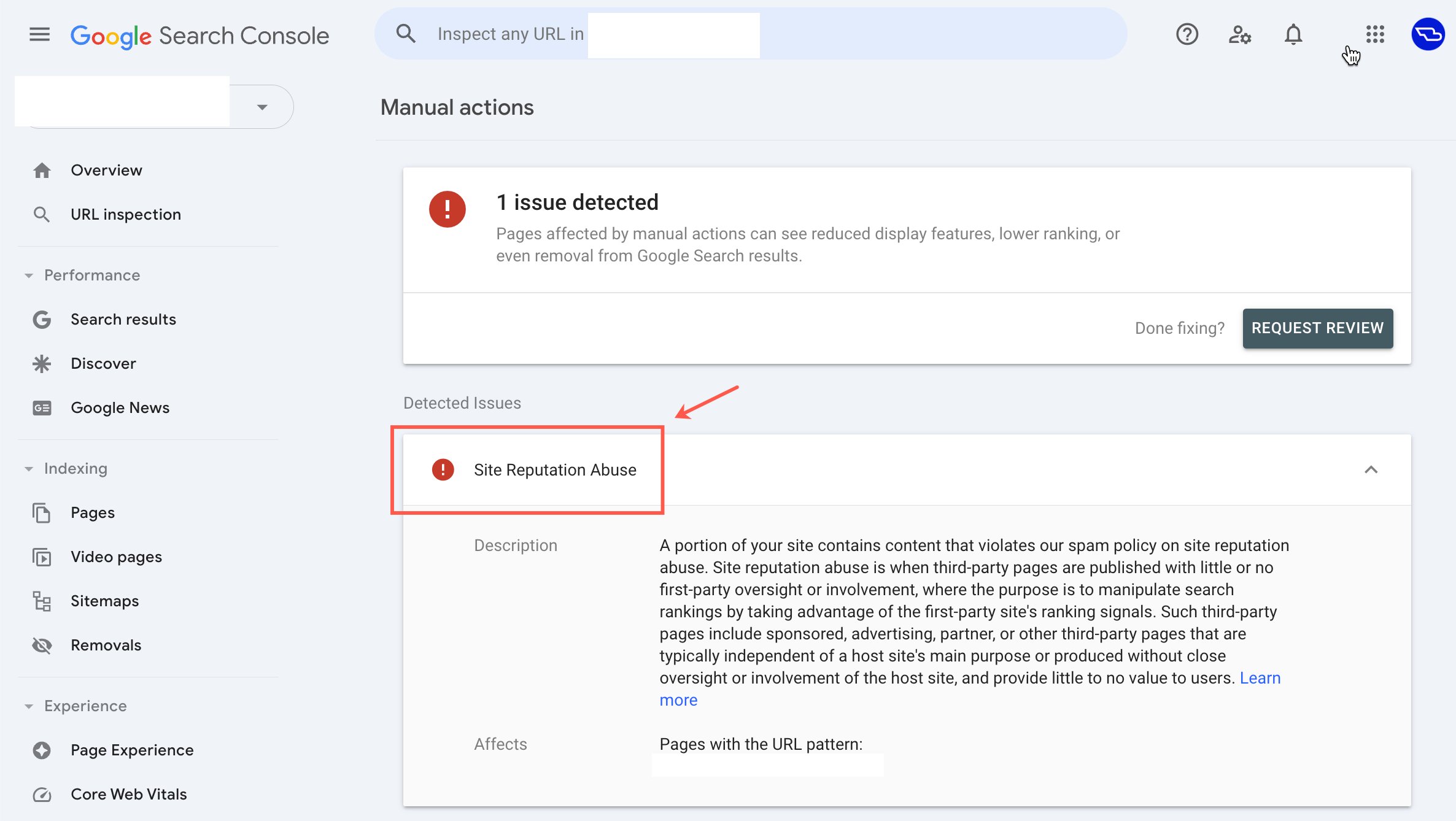
In recent years, commercial operators developed a technique known in search marketing as "Site Reputation Abuse" or "Parasite SEO".
Operators partner with major news organizations (or acquire the expired domains of shuttered newspapers) and host low-quality affiliate content farms within subdirectories of those authoritative domains.
Because search engines already trust the parent news brand, the low-quality affiliate pages immediately rank on the first page of Google, bypassing normal algorithmic quality assessments. Throughout 2023 and 2024, search results were inundated by legacy newspaper subdirectories ranking for commercial topics like offshore sportsbooks and private VPN reviews, with zero involvement from the newspaper's actual newsroom.
Google's Decade-Long War on Content Mills
Why do search engines allow this to continue?
The relationship between Google and content mills is a multi-decade contest that has shaped how information is indexed across the open web.
The Historic Google Panda Update (February 2011)
To understand modern search engine policies, one must look back to the Panda Update of February 2011.
By late 2010, the first generation of content mills, led by Demand Media and Associated Content, had degraded search result quality to a crisis point. For nearly every everyday query, the top three organic results were shallow 400-word eHow articles engineered by algorithms. Public frustration was widespread, and prominent technology columnists began describing Google search as broken.
In response, Google released an algorithmic overhaul named after engineer Navneet Panda, announcing official quality guidelines designed specifically to penalize pages with high ad-to-text ratios, thin analysis, and duplicate prose. The impact was catastrophic for content mills. Demand Media lost an estimated 40% of its search engine traffic within 48 hours. Competing mills like Associated Content and Mahalo saw their business models collapse almost immediately. Demand Media's stock price entered a sustained decline from which the company never fully recovered.
Why the Machinery Kept Returning
Panda demonstrated that Google could neutralize a specific generation of content mills. However, it also highlighted a fundamental algorithmic challenge:
Search engine bots do not read like human beings.
Search ranking algorithms assess quality using quantifiable mathematical proxies:
- How many external domains link to this webpage?
- Does the text incorporate related semantic subheadings?
- How many seconds does the visitor spend on the page before navigating away (Dwell Time)?
- Does the page render quickly on mobile devices?
Content mill operators are skilled reverse-engineers. Whenever Google adjusts its algorithms to reward specific signals, content farms adapt their production scripts to simulate those exact signals:
- When algorithms began rewarding comprehensive depth, content mills raised their word count targets from 400 words to 2,200 words.
- When algorithms rewarded user dwell time, content mills moved the primary answer to the bottom of the page to prolong session duration.
- When algorithms rewarded author authority (Experience, Expertise, Authoritativeness, and Trustworthiness), content mills created synthetic author personas with linked social profiles.
The Helpful Content System and the 2024 Reset
Between 2022 and 2024, Google introduced its Helpful Content System, subsequently incorporating it directly into its core ranking algorithms through the comprehensive March 2024 Core Update.
Google updated its official Search Essentials spam policies to target three specific content farm practices:
- Scaled Content Abuse: Producing massive quantities of unoriginal content across hundreds of pages, regardless of whether created by human writers, AI models, or a combination.
- Site Reputation Abuse: Third parties publishing low-value affiliate and content farm pages on authoritative third-party websites without proper oversight.
- Expired Domain Abuse: Purchasing high-authority expired domains solely to host low-quality commercial affiliate content.
During the March 2024 update, Google took algorithmic and manual action against hundreds of programmatic networks, de-indexing entire domains that relied on unedited automated text.
Yet, as everyday web users observe, the arms race continues. As search engines close existing loopholes, automated operations develop increasingly sophisticated writing styles, keeping search quality an ongoing engineering challenge.
Are Content Farms Strictly Harmful? The Nuance and the Gray Area
While it is easy to view all automated publishing as detrimental to the web, an objective examination requires separating commodity reference data from interpretive journalism.
Where Programmatic Publishing Serves a Purpose (The Utility Model)
Certain categories of practical information do not require narrative depth, unique author voice, or investigative reporting. They represent transactional lookups:
- Public Transit Timetables: A clean webpage displaying weekend departure times for a city commuter train.
- Athletic Box Scores and Results: A factual breakdown of player statistics following an evening basketball game.
- Postal Code Directories: Straightforward reference databases mapping neighborhoods to postal codes.
- Currency Exchange Rates: An accurate table displaying daily conversion rates between global currencies.
When an automated website compiles public data into an efficient, fast-loading, easily navigable reference tool without burying the answer, it provides a legitimate public service. Many of the internet's most useful reference tools operate as programmatic databases.
Where Content Mills Become Harmful (The High-Stakes Model)
The danger arises when content mills expand beyond transactional utilities into topics that demand firsthand experience, technical accuracy, and ethical responsibility:
- Medical and Health Guidance: When someone searches for symptoms of a child's illness or medication contraindications, an automated farm rewriting medical summaries without clinical training can spread outdated or dangerous guidance.
- Personal Finance and Life Decisions: Financial content mills promoting high-interest loan products or speculative investments under the guise of impartial consumer reviews take advantage of individuals during moments of financial vulnerability.
- The Siphoning of Journalism Resources: Every dollar of programmatic advertising revenue absorbed by an automated content farm is revenue diverted away from independent journalists, local newsrooms, and specialist writers who spend weeks conducting interviews and verifying complex stories.
A Comparative Breakdown: The Three Tiers of Web Publishing
To help readers evaluate online information, here is how the three main models of web publishing compare across production, economics, and reader value:
Tier 1: The Classic Content Mill (eHow and Demand Media Era)
- Primary Objective: Capture search volume using high-volume, low-cost freelance writing.
- Production Cost: $3.00 to $10.00 per article.
- Author Identity: Low-paid freelance contractors writing under anonymous or generic staff accounts.
- Content Depth: 400 to 800 words of surface-level rewrites with zero original reporting.
- Monetization: Dense banner ads, Google AdSense units, and low-tier affiliate links.
- Reader Experience: Shallow and repetitive, though occasionally answers basic everyday queries.
Tier 2: The Modern Programmatic AI Farm
- Primary Objective: Maximize ad arbitrage by publishing thousands of pages per day at near-zero marginal cost.
- Production Cost: $0.02 to $0.05 per article in API compute and hosting.
- Author Identity: Synthetic AI personas, stock photos, or borrowed legacy domain bylines.
- Content Depth: 1,500 to 3,000 words of formulaic text engineered to satisfy search ranking classifiers.
- Monetization: Auto-refreshing programmatic video units, sticky popups, and aggressive affiliate tables.
- Reader Experience: Frustrating; the necessary insight is buried beneath multiple screens of filler text.
Tier 3: The Authentic Independent Publication (Vaudacia Standard)
- Primary Objective: Build enduring reader trust through original reporting, independent analysis, and subject expertise.
- Production Cost: Substantial investment in original research, expert synthesis, and custom diagrams.
- Author Identity: Named, verifiable human authors with demonstrable experience in their coverage areas.
- Content Depth: Comprehensive masterclasses that respect reader time and explain complex systems from first principles.
- Monetization: Direct subscriptions, premium sponsorships, or transparent editorial partnerships.
- Reader Experience: Clear, informative, and focused on delivering immediate value to the reader.
Practical Steps to Bypass the Noise
Readers do not have to accept an internet dominated by assembly-line text. Everyday users can adopt practical habits to filter out content farms and find authentic, human-generated information:
1. The Community Forum Search
Over the past four years, one of the most prominent shifts in consumer search habits has been adding the word "reddit" or "forum" to search queries.
Users do this because they want insights from real individuals who have purchased the appliance, lived in the neighborhood, or resolved the technical bug firsthand. When searching for candid human experiences rather than commercial affiliate copy, community discussions remain an indispensable resource.
2. Search Operator Techniques
Basic search operators quickly remove commercial content farm networks from search results:
- Exclude terms: Include minus-best (-best) or minus-top (-top) in technical searches to filter out generic affiliate buying guides.
- Institutional searches: Use domain operators like site:gov or site:edu to prioritize primary public databases and research institutions.
- Exact phrase queries: Use quotation marks around specific technical error codes or model numbers to find specialized forum discussions rather than generic blog rewrites.
3. Check Author Profiles and Citations
When visiting an unfamiliar website for an important decision, take five seconds to review the article footer and author credentials:
- Does the author maintain an active, verifiable professional background in that specific subject area?
- Does the article link directly to primary government filings, academic research, or official documentation, rather than solely to its own internal pages?
- Does the website present a clean, stable reading layout without intrusive popups or disruptive layout shifts?
If a page fails these basic standards, navigate back. Denying content farms dwell time and ad impressions remains the most direct way to signal quality preferences to search algorithms.
4. Support Independent Human Journalism
The open web thrives when readers deliberately support publications committed to craftsmanship, accuracy, and depth. Bookmark trusted independent publications, subscribe to original newsletters, and share quality reporting directly with colleagues and friends.
When readers reward genuine editorial care, the assembly line loses its economic leverage.
Disclaimer: This deep dive is published for educational and analytical purposes to examine digital media publishing business models and search engine algorithmic history. Citations reflect publicly documented reporting from academic and industry sources.
Frequently Asked Questions
What is the simple difference between a content farm and a normal website?
A normal website or publication starts with a human idea, an observation, or original research, and creates content because they have something meaningful to share. A content farm starts with search engine data queries to identify high-volume search phrases with low competition, then mass-produces the cheapest possible text solely to capture search traffic and display ads.
How do content farms actually make money if nobody pays to read them?
Content farms operate on traffic arbitrage. They sell ad impressions (RPMs) and affiliate product links. Because automated scripts or cheap freelance rewrites cost pennies to create, an article that earns just $10 to $30 per month in display banner ads generates massive profit margins when multiplied across tens of thousands of URLs.
Why did Google not ban all content farms years ago?
Google has fought content mills for over fifteen years, most notably during the historic 2011 Panda update which crushed Demand Media. However, search engines evaluate pages using mathematical algorithms (word count, keyword presence, dwell time, backlinks) rather than human taste. Content farm operators continually adapt their code to mimic whatever quality signals Google rewards.
Why do content farm articles always bury the answer at the bottom?
To maximize ad revenue. Advertisers pay higher rates for display banners and video ads that remain in view on a screen for 15 to 30 continuous seconds. Pushing the two-sentence answer down past 1,500 words of fluff forces readers to scroll through multiple screen lengths and ad refreshes.
What is the easiest way for everyday readers to avoid content farms on Google?
You can append "reddit" or "forum" to your queries to find authentic human discussions, use search operators like "-best" to strip commercial affiliate listicles, and quickly check the author byline for verifiable human credentials and direct citations to primary sources.
Comments (0)
No comments yet. Be the first to share your thoughts.