
How Kenya's 5% YouTube Tax Differs From 3% SEP
With Google deducting a 5% withholding tax straight from Kenyan YouTube payouts, creators are separating local WHT credits from Kenya’s 3% SEP tax and 16% VAT rules.

Open any Nairobi creator WhatsApp chat since October 2026 and the exact same confusion shows up daily: did Kenya just stack a 5% cut, a 3% Significant Economic Presence (SEP) levy, and a 16% VAT surcharge onto every single YouTube AdSense check, leaving local filmmakers handing half their revenue to tax portals before camera rent gets paid?
Most of that alarm comes from folding three separate sections of Kenyan tax law into one imagined deduction. What changed directly in late 2026 was far more specific: rather than waiting for Kenyan YouTubers to self-declare AdSense monetization manually each June on iTax, Google began acting directly as an automated collection agent for the Kenya Revenue Authority (KRA), deducting 5% withholding tax at source starting with finalized September 2026 YouTube earnings distributed in October 2026 while freezing payouts altogether for AdSense profiles missing a verified 11-character KRA PIN.
Separating that 5% resident withholding tax from Kenya's 3% Significant Economic Presence (SEP) tax and 16% digital VAT clears up most of the anxiety in minutes, and explains why Kenya's Digital Content Creators Association (DCCAK) criticized the sudden enforcement calendar as an unexpected cash-flow shock.
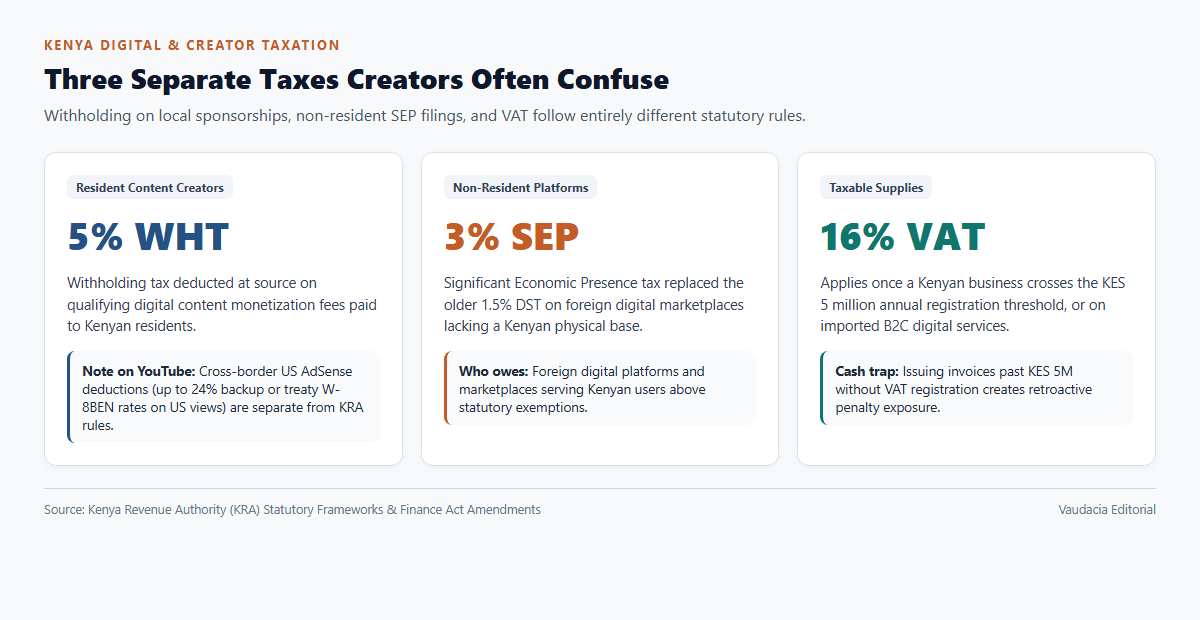
Mapping Where Each Kenyan Digital Tax Hits
Looking at the flow from global ad auctions to a Kenyan creator's M-Pesa or bank account immediately highlights one critical boundary: the 3% Significant Economic Presence (SEP) tax never sits inside a resident Kenyan YouTuber's payout path.
Despite viral clips claiming local vloggers owe another 3% SEP cut, Kenya's 3% SEP levy (which succeeded the earlier 1.5% Digital Service Tax under Tax Laws Amendment legislation with no minimum turnover exemption) applies strictly to non-resident foreign digital enterprises generating revenue from Kenyan users without maintaining a permanent physical office in Kenya, such as offshore software subscriptions, foreign streaming bundles, and overseas marketplaces. Resident individual filmmakers, musicians, and podcasters based in Nairobi, Mombasa, or Kisumu answer to standard resident income tax and the 5% withholding framework, not non-resident SEP. Similarly, Kenya's Finance Act also distinguishes between purely digital creator monetization settled by global ad networks and domestic corporate consultancy gigs, where local corporate clients have long deducted standard 5% resident withholding tax under Management or Professional fees headings.
Reviewing KRA's official withholding tax guidance alongside Google's dedicated YouTube tax update for Kenyan creators nails down how the 5% line operates mechanically. Google deducts 5% directly off finalized YouTube monetization settled through Kenyan AdSense profiles, spanning ad-share earnings, channel memberships, Super Chat receipts, and AdSense-routed brand funds. For resident Kenyan creators, that 5% source cut works as a withholding advance tax credit rather than a separate punitive surcharge stacked on top of normal brackets: when filing annual iTax income tax returns, you log verified KRA withholding certificates to reduce final tax owed on net taxable profit after subtracting camera equipment, studio leases, sound mixing, and editor wages. Meanwhile, Value Added Tax at 16% operates along a separate path as a consumption levy on qualifying domestic B2B supplies or cross-border electronic consumer services above statutory VAT registration criteria; Google Ireland or Google LLC distributing creator AdSense shares does not charge viewers 16% checkout VAT at playback, whereas VAT-registered Kenyan creative agencies invoicing corporate banks or telcos above the KSh 5 million annual registration floor invoice 16% VAT cleanly on corporate tax invoices and file monthly VAT returns through TIMS/eTIMS. Keeping those three tax codes distinct on monthly ledgers prevents bookkeepers from treating an advance income-tax credit like an unrecoverable sales tax.
Incorporating vs Staying Sole Proprietor and How Deductions Work
Beyond immediate payout pain, automated platform reporting alters how mid-tier Kenyan media channels think about business structure once annual gross billings climb past KSh 3 million or KSh 5 million. Operating as an unregistered solo freelancer mixes personal living expenses with studio bills, making it awkward to prove allowable deductions when KRA iTax queries arrive. Under graduated individual income tax rates climbing up to 35% on top income brackets, high-earning solo creators without clean itemized cost schedules risk paying steep marginal personal bills, whereas a formally registered Kenyan limited company pays a flat 30% resident corporate tax rate on documented net profits after verified commercial expenses.
Brand-deal procurement pushes in the same direction: major Kenyan telecommunications companies, banks, and NGOs rarely onboard six-figure influencer retainers today without demanding an active KRA Tax Compliance Certificate (TCC) and electronic eTIMS-compliant invoices. Channels that log genuine production invoices, wear-and-tear allowances on cameras and workstations, studio electricity, Adobe or editing software licenses, and mobile broadband contracts inside monthly bookkeeping files turn that dreaded 5% deduction into a documented tax asset rather than an uncredited cash leak. And if a production team invests in higher capital equipment or rents regional studio space alongside part-time sound engineers, keeping formal payroll PAYE and supplier receipts separated neatly from AdSense remittances prevents mixed-account guesswork during June iTax filing rushes.
Why DCCAK Slammed Automated Deductions as an Ambush
Seeing how neatly those distinctions sit inside statutes helps explain why creators pushed back fiercely once October settlement notifications hit phones. According to The Standard's reporting on Kenyan YouTubers' 5% deductions and digital policy commentary from KICTANet on Kenya's creator tax rollout, DCCAK challenged automated platform collection on three practical operational grounds.
First comes gross-margin compression. YouTube already keeps roughly 45% of gross ad auction spend before calculating creator shares, and Kenyan creators attracting US diaspora or international tech viewers suffer up to 30% American Chapter 3 withholding on that US audience slice because Kenya lacks an active bilateral US double-taxation treaty. Slicing another 5% off the remaining gross pool before subtracting camera rentals, mobile data bundles, transport, lighting rigs, and sound editors drains working cash right away, highlighting why initiatives like continental creator tooling grants across Africa focus heavily on lowering production overhead.
Second is sudden execution timing after years of dormancy. Although Kenya introduced the 5% digital monetization rate back in the Finance Act 2023 (revised downward from a harsher 15% proposal), sporadic self-filing meant thousands of independent freelancers never expected instant payout holds tied to AdSense iTax PIN verification deadlines. Third is cash-refund friction on thin-margin shoots: if a crew spends KSh 450,000 producing a documentary series yielding KSh 380,000 in ad payouts, Google's script still strips 5% from gross proceeds because automated billing tools cannot inspect local receipts, leaving small operators struggling to recover excess credits quickly through KRA audits.
Confirm your US Form W-8BEN residency paperwork stays valid inside AdSense alongside your 11-character KRA PIN. Without verified W-8BEN filing on record, backup US withholding can clip up to 24% across global views rather than limiting deductions strictly to US-based traffic.
Rather than mixing studio payouts inside personal household accounts, disciplined Kenyan creators treat source withholding as the deadline to clean up accounting permanently. Keeping commercial M-Pesa tills separate from personal expenses, saving vendor receipts for lenses, editing seats, and contractor wages, and separating Google's 5% WHT certificates from local agency sponsorship contracts gives KRA audits clear net-profit documentation and moves growing channels onto the structural path where independent creators operate like proper holding companies. One clean afternoon organizing quarterly expense folders protects far more operating cash than chasing automated tax bots after payouts freeze.
Comments (0)
No comments yet. Be the first to share your thoughts.