
Europe's 2027 Nomad Rules: Higher Floors, Shorter Runways
Three separate European residency and remote-work shifts take effect between late 2026 and January 2027 across Malta, Montenegro, and Estonia.

Remote founders looking at European tax residencies for 2027 are walking into a much narrower map than the one marketed aggressively three years ago. Between late December 2026 and January 1, 2027, three popular European footholds change pricing, renewal visibility, or eligibility gates at the same time: Malta replaces legacy low-floor special tax statuses with a consolidated €35,000 minimum annual tax bill; Montenegro approaches a legislative December 31, 2026 horizon around its foreign-income tax exemption for remote workers; and Estonia raises e-Residency state fees from €150 to €165 while leaving a frequent point of confusion wide open.
Each change targets a different tier of mobile capital, proving that Europe and global digital nomad doorways are narrowing fast even where headline marketing banners still sound welcoming. Comparing the statutory dates side by side makes it easy to separate costly legal surprises from routine administrative fee bumps.
Side-by-Side Across Malta, Montenegro, and Estonia
The sharpest mistake remote workers make when evaluating European base camps is treating digital-company registration, tax residency, and temporary physical stay permits as interchangeable products. Only Malta's program grants a structured remittance-based tax regime alongside EU long-term lifestyle mobility, while Estonia's €165 card changes nothing about your physical right to live inside Schengen borders.
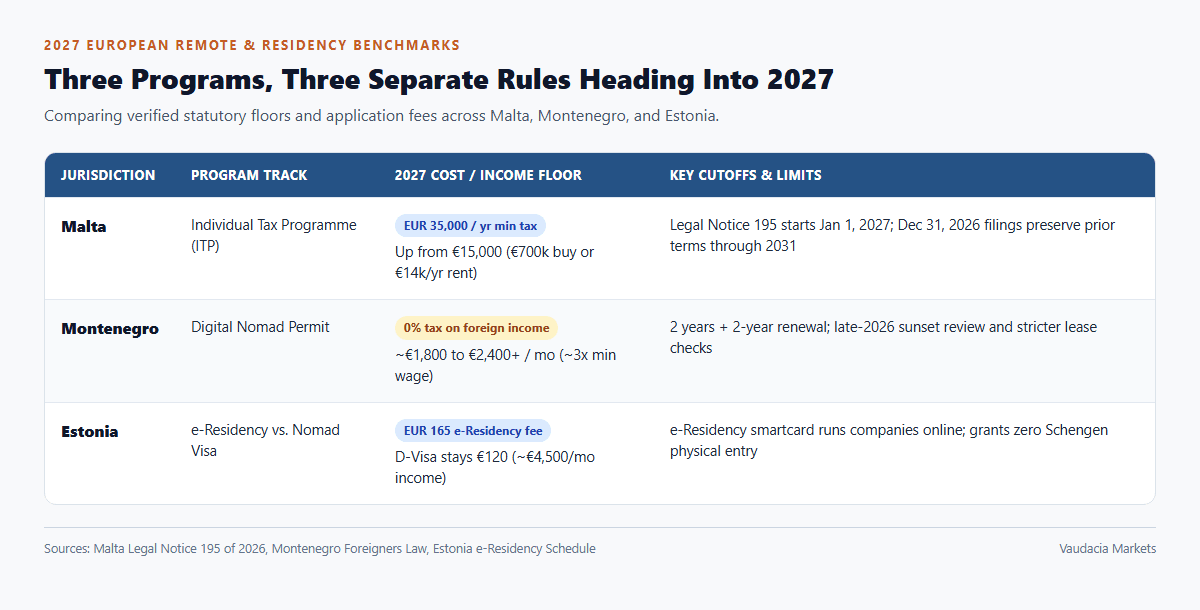
Comparing the three jurisdictions side by side shows that the steepest financial cliff sits in Valletta rather than Tallinn: Malta's Individual Tax Programme under Legal Notice 195 of 2026 hikes the minimum annual tax floor from €15,000 under the old Global Residence Programme up to €35,000 on January 1, 2027 alongside strict property purchase or lease thresholds; Montenegro's non-EU Digital Nomad Permit pairs a two-year stay (plus two-year renewal) with 0% local personal income tax that faces a December 31, 2026 statutory horizon; and Estonia's January 1, 2027 fee adjustment lifts the digital e-Residency company-management card to €165 while keeping physical Schengen stay rights governed separately by its €120 Type D Digital Nomad Visa. Because all three changes cluster around the exact same year-end window, remote operators who set up corporate and personal residency structures between 2022 and 2025 need to review both personal tax floors and company renewal dates before Q1 2027 filings lock in.
Malta Ends the €15,000 Floor Under the Individual Tax Programme
For more than a decade, wealthy non-Maltese entrepreneurs used Malta's Global Residence Programme (GRP) and sister schemes to secure EU residency status while capping annual Maltese tax liability on remitted foreign income at a €15,000 minimum floor. Under Legal Notice 195 of 2026, Malta retires that patchwork model and rolls applicants into a single Individual Tax Programme (ITP) taking effect January 1, 2027.
As confirmed in Inari Law's detailed breakdown of Legal Notice 195, the headline concession remains intact: qualifying beneficiaries pay a flat 15% tax strictly on foreign-source income remitted into Malta, with unremitted offshore gains left outside the Maltese charge (other than local Maltese-source income taxed at 35%). What jumps dramatically is the price of entry. The annual minimum tax doubles and then some, resetting at €35,000 per year across the unified framework alongside non-negotiable property obligations requiring beneficiaries to maintain a qualifying residential purchase or high-tier annual lease in Malta or Gozo, plus comprehensive health insurance and clean regulatory due diligence through an authorised registered mandatory.
For founders netting €300,000 to €600,000+ who intentionally remit around €235,000+ annually into local European accounts, €35,000 aligns cleanly with the 15% remitted effective rate and still clears high-tax Western Europe comfortably. Conversely, mid-tier remote agency owners previously paying €15,000 on minimal remittances face an instant €20,000 annual surcharge on top of rising Maltese coastal rental costs just to keep the certificate active, forcing genuine 2027 budget comparisons against Cyprus Non-Dom dividend rules, Greek non-dom flat-tax tiers, or Italian inbound tax regimes.

Montenegro's Adriatic Value Meets a Year-End Sunset Question
Across the Adriatic, Montenegro remains one of Europe's clearest value footholds for remote workers who want lower tax friction without putting €700,000 into Mediterranean apartments. Its Digital Nomad Temporary Residence Permit opens two years of legal stay renewable once for two additional years (four years total), charging 0% Montenegrin personal income tax on qualifying offshore remote revenue while indexing monthly income proof near three times Montenegro's minimum wage, typically landing roughly €1,800 to €2,400+ per month depending on qualification criteria tracked in Montenegro digital nomad program guides.
Here is the timing issue catching careful planners off guard heading into late 2026: key foreign-income tax exemption provisions written into Montenegro's digital nomad statutory package carry a December 31, 2026 sunset window unless parliamentary amendments formally extend or permanently codify the exemption past year-end. Applicants signing twelve-month coastal leases in Tivat, Kotor, or Budva on the assumption of multi-year 0% tax certainty should watch official Montenegrin Ministry of Interior and tax gazettes directly rather than trusting outdated 2024 nomad blog posts.
At the same time, Montenegro sits outside the Schengen Area, making it useful as a long-stay reset base for UK, US, Canadian, and Commonwealth passport holders managing strict Schengen 90/180-day limits, yet pointless for anyone specifically chasing EU passport clocks or border-free European travel inside five years. Moving between Podgorica, Athens, and Lisbon still counts your Schengen nights strictly under automated border entry logs, meaning remote workers splitting quarters across Southeastern Europe need written entry stamps and day trackers before assuming a residency card elsewhere grants carte-blanche Mediterranean travel.
Meanwhile, Malta's shift puts pressure on international private banks servicing ITP holders. Because the flat 15% regime taxes foreign capital only when remitted onto the island, European banks and tax advisers scrutinize exact separation between segregated capital accounts and foreign income streams before January remittances hit Maltese IBANs. One mislabeled wire mixing pre-residency capital with current dividend income creates avoidable tax disputes at audit time.
Clearing Up Estonia's €165 Fee Hike Without Buying the Wrong Permit
Unlike Malta's €20,000 tax floor surge, Estonia's administrative update is modest on paper and massive in misunderstanding. Under official e-Residency programme administrative updates, state application fees stepped upward toward €165 (up from €150 for smart ID cards collected at foreign missions) alongside €120 fee revisions covering Type D national visa filings. Nobody walks away from incorporation in Tallinn because an authentication card costs €15 extra.
Where applicants routinely burn months of wasted planning is confusing Estonian e-Residency with physical Estonian residency or a Digital Nomad Visa. An e-Residency card gives an entrepreneur a cryptographic government smart ID to register an Estonian private limited company (OÜ), sign digital contracts across EU counterparties, and manage corporate banking online from anywhere on earth. It carries zero border entry rights, zero Schengen stay days, and zero personal tax residency privileges inside Estonia.
Founders wanting to physically live in Tallinn must still qualify separately under Estonia's Digital Nomad Visa (with its €4,500 gross monthly income requirement), startup founder permit, or work-based TRP channels, and verify whether their overseas tax office treats a solo remote OÜ as locally managed and controlled in their home jurisdiction. Understanding the practical tax and compliance fine print behind digital nomad visas protects remote earners far more than chasing headline fees.
Before booking relocation flights or non-refundable annual leases for Q1 2027, confirm two things in writing from local counsel: whether your home country triggers Controlled Foreign Company (CFC) rules on your operating company, and whether your chosen European permit issues personal tax residency certificates recognized by bilateral double-taxation treaties.
Comments (0)
No comments yet. Be the first to share your thoughts.