Maruti Suzuki's 5 Startup Bet: Your Playbook for 2026
How five Indian startups landed deals with an auto giant and what it means for where you should spend your time this year.

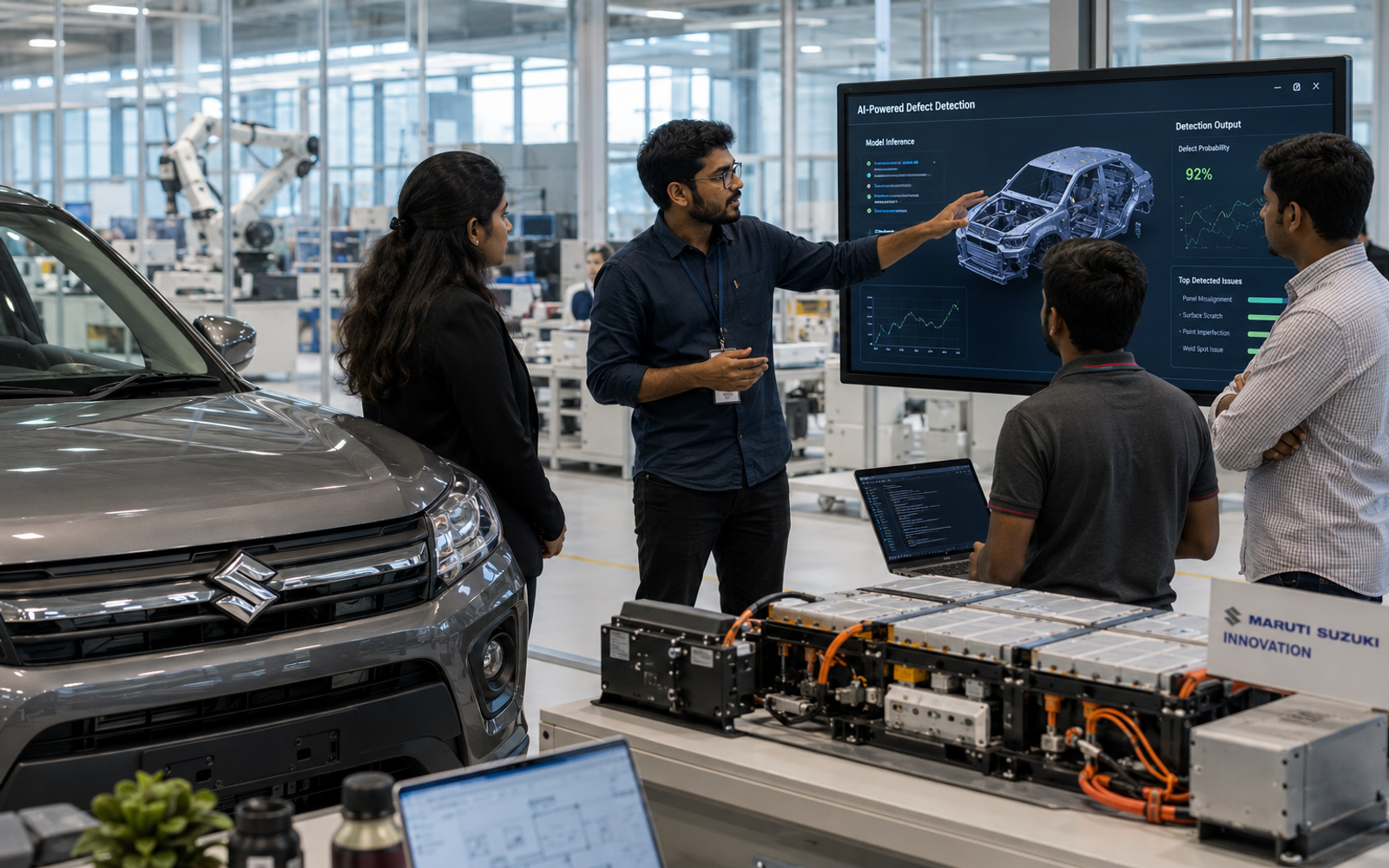
On June 29, 2026, Maruti Suzuki, India's largest automotive manufacturer by volume, officially onboarded the fifth cohort of its corporate incubation accelerator. The initiative, run in partnership with the Nadathur S. Raghavan Centre for Entrepreneurial Learning (NSRCEL) at IIM Bangalore, selected five early-stage technology companies: MiniMines, Easework AI, Sarvam AI, Siftly, and CodeMate AI.
For founders, enterprise software operators, and venture investors, this program provides a rare, transparent case study in corporate venture mechanics. While corporate innovation labs have historically earned a reputation as bureaucratic dead-ends, Maruti Suzuki's structured model reveals how industrial conglomerates are using early-stage software pilots to modernize sprawling, legacy supply chains.
Inside the Cohort: The Five Problems Industrial Giants Need Solved
Examining the five selected startups demonstrates where enterprise industrial spending is prioritizing automation over incremental factory floor modifications:
- MiniMines (CleanTech & Circular Economy): Focuses on the recycling and extraction of critical minerals from end-of-life lithium-ion battery packs. As global electric vehicle production expands, automotive original equipment manufacturers (OEMs) face mounting regulatory pressure and raw material shortages. Developing closed-loop battery reclamation capabilities directly shields automakers from volatile global commodity markets.
- Sarvam AI (Vernacular Customer Intelligence): Develops foundational language models and speech synthesis tools tuned for regional Indian dialects. With over three thousand authorized dealership networks across urban and rural markets, customer acquisition and warranty servicing require conversational AI that communicates naturally in vernacular languages without high human call-center overhead.
- Easework AI (Computer Vision & Process Automation): Automates high-friction back-office documentation, warranty claim verification, and inventory tracking through multimodal computer vision, dramatically accelerating invoice reconciliation across thousands of tiered automotive component suppliers.
- Siftly (Fleet Logistics & Telematics Optimization): Applies machine learning to commercial fleet dispatching and carrier logistics, reducing idle transit time and optimizing fuel economy for vehicle haulers transporting thousands of finished automobiles from factories to distribution hubs.
- CodeMate AI (Embedded Automotive Software Quality): Provides automated code review and security auditing for internal engineering teams, helping software developers catch critical vulnerabilities early as connected vehicle architectures incorporate millions of lines of proprietary code.
Escaping Proof-of-Concept Purgatory
For early-stage B2B startups, partnering with an industrial behemoth that manufactures over two million vehicles annually offers tremendous commercial leverage, but it also carries acute systemic risks. In the venture ecosystem, the most common startup killer is "Proof-of-Concept (PoC) Purgatory": a protracted nine-month pilot where a corporate innovation team requests endless product modifications, pays zero pilot fees, and burns through the startup's remaining cash reserves before legal procurement ever issues a contract.
What distinguishes the Maruti Suzuki cohort is its partnership with an academic and institutional buffer (IIM Bangalore's NSRCEL) alongside upfront, funded proofs of concept. This structure ensures that early-stage builders receive financial compensation to cover cloud computing and engineering hours while testing deployment feasibility within live production facilities.
The Shift From Generalized AI to Vertical Integration
Notice the technological composition of the cohort: three of the five startups are AI-centric, yet none of them are selling generic productivity wrappers or general-purpose chatbots. Each startup is deeply embedded in a specialized operational bottleneck: battery supply chains, multi-dialect customer service, supply-chain document parsing, or automotive code verification.
In 2026, enterprise buyers are no longer interested in novelty AI demos. Industrial giants operate on razor-thin unit economics and strict assembly-line cadence; they buy software exclusively when it directly compresses operational expense, mitigates regulatory compliance fines, or removes friction from existing workflows.
The Bottom Line
Maruti Suzuki's cohort proves that the most lucrative opportunities for B2B founders do not require inventing entirely new consumer categories. Immense value is being created by building specialized, domain-specific software that solves urgent, expensive bottlenecks for legacy industrial giants.
For entrepreneurs navigating the enterprise landscape, the mandate is clear: avoid generic horizontal features, anchor your technology to verifiable operational pain points, and treat corporate pilots not as vanity milestones, but as rigorous commercial contracts with clear economic returns.
Comments (0)
No comments yet. Be the first to share your thoughts.