Steady Bedtimes Beat Long Weekend Catch-Up Sleep, Study Shows
Going to bed at 10:30 p.m. on Tuesday and 2:00 a.m. on Friday hurts mood far more than one short night. Multi-month wearable data from UCSF and UCSD explains why timing matters.

You can hit eight full hours on your nightstand clock and still drag yourself into Monday feeling emotionally flattened, irritable, and foggy behind the eyes. Most popular sleep advice still treats sleep like a simple checking account: borrow two hours on Wednesday night, deposit three extra hours Sunday morning, balance restored.
Biometric data published on November 12, 2026 in Scientific Reports indicates your brain treats erratic sleep timing far worse than mild sleep shortfalls. Led by researchers at UC San Francisco (UCSF) and UC San Diego (UCSD), including senior author Dr. Ashley Mason of UCSF's Department of Psychiatry and Behavioral Sciences, the research team analyzed 22,894 adults (nearly half women, average age 46) who wore commercial smart rings continuously through the long-running TemPredict Study.
Unlike cramped university sleep labs that monitor twenty undergraduates inside sterile rooms for two nights, this paper captured real adult schedules over an average of 154 consecutive days per participant. Tracking nearly five full months of daily biometric curves alongside monthly psychological questionnaires revealed a sharp gradient: people whose sleep-wake window drifted sharply from day to day carried noticeably greater odds of severe depression, anxiety, and loneliness, even before factoring in total average sleep duration.
How the Sleep Regularity Index Works
Scientists measured participant schedule consistency using the Sleep Regularity Index (SRI), a 0-to-100 score quantifying how likely a person is to be asleep or awake across identical timestamps over consecutive 24-hour cycles. Going lights-out around 11:00 p.m. and waking at 7:00 a.m. every morning pushes SRI high. Falling asleep at 10:15 p.m. Monday, pulling a 1:45 a.m. phone scroll Thursday, and sleeping past 10:30 a.m. Sunday drags the score down steeply even if weekly averages sit around seven hours and thirty minutes.
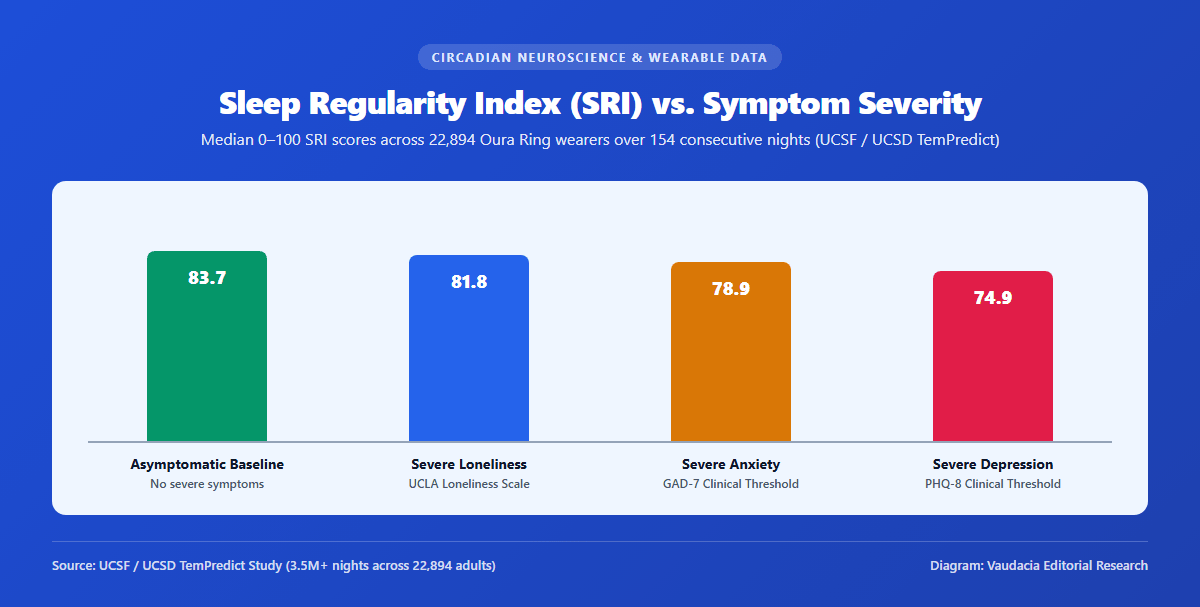
Across the TemPredict cohort, participants reporting normal mental-health baselines averaged an SRI near 83.7 to 83.8, whereas participants experiencing severe depression symptoms averaged 74.9 (an 8.8-point regularity drop), those with severe anxiety averaged 78.9 (a 4.8-point drop), and those reporting severe loneliness averaged 81.8 (a 2.0-point drop). Those gaps held steady across age brackets and gender splits even when participants logged comparable total hours in bed over a full week.
As summarized in News-Medical's overview of the study, across nearly twenty-three thousand participants, every 5-point decline in Sleep Regularity Index aligned with measurably higher likelihood of worse mental health scores. Even more instructive for biometric researchers: when investigators artificially clipped the dataset down to mimic a brief seven-day study window, those relationships blurred sharply. As detailed in Bioengineer.org's summary of the multi-month paper, brief one-week snapshots erase slow circadian drift that only months of continuous observation catch cleanly.
Why Weekend Catch-Up Throws Off More Than Grogginess
Chronobiologists call environmental timing anchors circadian cues: light exposure, meals, physical movement, and daytime conversation that tell peripheral tissues and brain clocks what hour of day has arrived. Shifting wake-up time two or three hours later every Saturday and Sunday flies your autonomic nervous system across two time zones every Friday night and forces it backward Monday at 6:30 a.m. without boarding an aircraft.
Dr. Mason and co-authors noted that inconsistent sleep hours rarely operate in isolation. Drifting morning alarms delay bright outdoor light hits, push breakfast hormones off rhythm, shrink afternoon exercise energy, and separate people from steady daytime household routines. Over several months, misaligned cortisol peaks and melatonin onset gradually flatten mood resilience alongside daytime concentration.
That biological timing echoes earlier daylight performance work: as we explored when breaking down why morning alertness depends less on militant 5:00 a.m. clubs than stable light cues, predictability beats extremes. An ordinary 7:15 a.m. alarm held steady seven days running outperforms heroic 5:00 a.m. Tuesday workouts followed by Sunday noon collapses.
Bidirectional Causation Without Blaming Tired Workers
No serious clinical researcher argues setting a strict morning alarm cures clinical depression by itself. Both UCSF and UCSD authors highlighted an honest two-way link across their data: fragmented circadian cycles worsen emotional regulation, while active anxiety, rumination, and depressed mood make keeping steady lights-out boundaries far harder at night.
Hospital shift nurses, new parents waking every three hours, and hourly service staff covering rotating weekend rosters also deal with clock chaos built straight into mortgages and rent checks rather than weak willpower. Naming timing stability as a clinical signal helps physicians look past generic "get eight hours" handouts without scolding exhausted patients whose work rotas rotate weekly.
For remote knowledge workers who accidentally manufacture social jetlag through late-night laptop sprints and weekend sleeping-in marathons, locking the wake hour first offers a clear, free adjustment before reaching for pricey mattress coolers or melatonin gummies. Trying to force sleep at 10:00 p.m. while wide awake breeds clock-watching stress; keeping Saturday morning wake times within roughly 45 minutes of Wednesday weekday alarms builds clean biological sleep pressure so drowsiness returns smoothly within ten days. Stepping outside for ten minutes of natural morning skylight shortly after waking, eating meals at roughly predictable hours, and absorbing an occasional late Friday dinner cleanly without dragging Saturday breakfast past noon lets the central clock stabilize naturally.
Sleep clinicians also warn against falling into orthosomnia, the habit of staring obsessively at morning wearable sleep scores until mild performance anxiety itself fragments rest. Commercial smart rings excel at capturing broad multi-month behavioral drift, such as spotting whether nocturnal resting heart-rate drops happen an hour earlier after steady wake windows, or whether nighttime temperature curves align smoothly, yet day-to-day sleep stage estimates still swing noisily on wrist or finger sensors. Looking at thirty-day bedtime and wake-time spreads gives far more actionable guidance than panicking over a single Tuesday readiness gauge showing "68."
Employer culture and evening household boundaries determine how easily workers hold those lines steady. Responding to chat pings until midnight twice weekly while dialing into 7:30 a.m. standups on alternate mornings splits internal physiology even when average weekly hours look adequate on paper. Families raising young children or sharing cramped apartments often find anchoring shared morning blinds, kitchen breakfast light, and predictable afternoon wind-down periods works far more reliably than policing strict lights-out curfews nobody enjoys keeping. If you already wear an Apple Watch, Garmin, or smart ring, focusing on narrowing your weekday-to-weekend wake spread over three consecutive weeks offers one of the highest-return, zero-cost physiological upgrades modern sleep science supports.
What Makes Five-Month Biometric Datasets Harder to Dismiss
Traditional consumer sleep headlines routinely rest on tiny thirty-person college dormitory studies or one-off surveys asking stressed adults to guess how many hours they slept last Tuesday. Self-reported memory misses drifting bedtimes consistently because tired minds blur how long they truly spent staring at phones under duvet covers versus sleeping deeply. Capturing continuous nocturnal ring telemetry across nearly twenty-three thousand real participants living normal family schedules across changing daylight seasons strips out both laboratory artificiality and retrospective guessing. When large longitudinal biometric datasets and monthly mental-health questionnaires move together across five months, holding your morning clock steady earns serious clinical respect alongside nutrition and movement.
That practical shift changes how frequent flyers, hybrid office workers, and university students approach ordinary Sundays too. Instead of treating weekend mornings as free recovery vouchers to sleep until midday after chaotic Friday screens, stepping outside for fifteen minutes of daylight within a consistent hour keeps Monday morning alertness sharp without chasing afternoon espresso shots or expensive sleep supplements. Consistently protecting circadian regularity across seasons costs zero dollars and steadily stabilizes daytime emotional footing week after week.
Comments (0)
No comments yet. Be the first to share your thoughts.