The $2 Trillion Rocket: What SpaceX's IPO Actually Unlocked
SpaceX's record-breaking IPO made Elon Musk the world's first trillionaire. The mechanics behind a $2.1 trillion valuation.

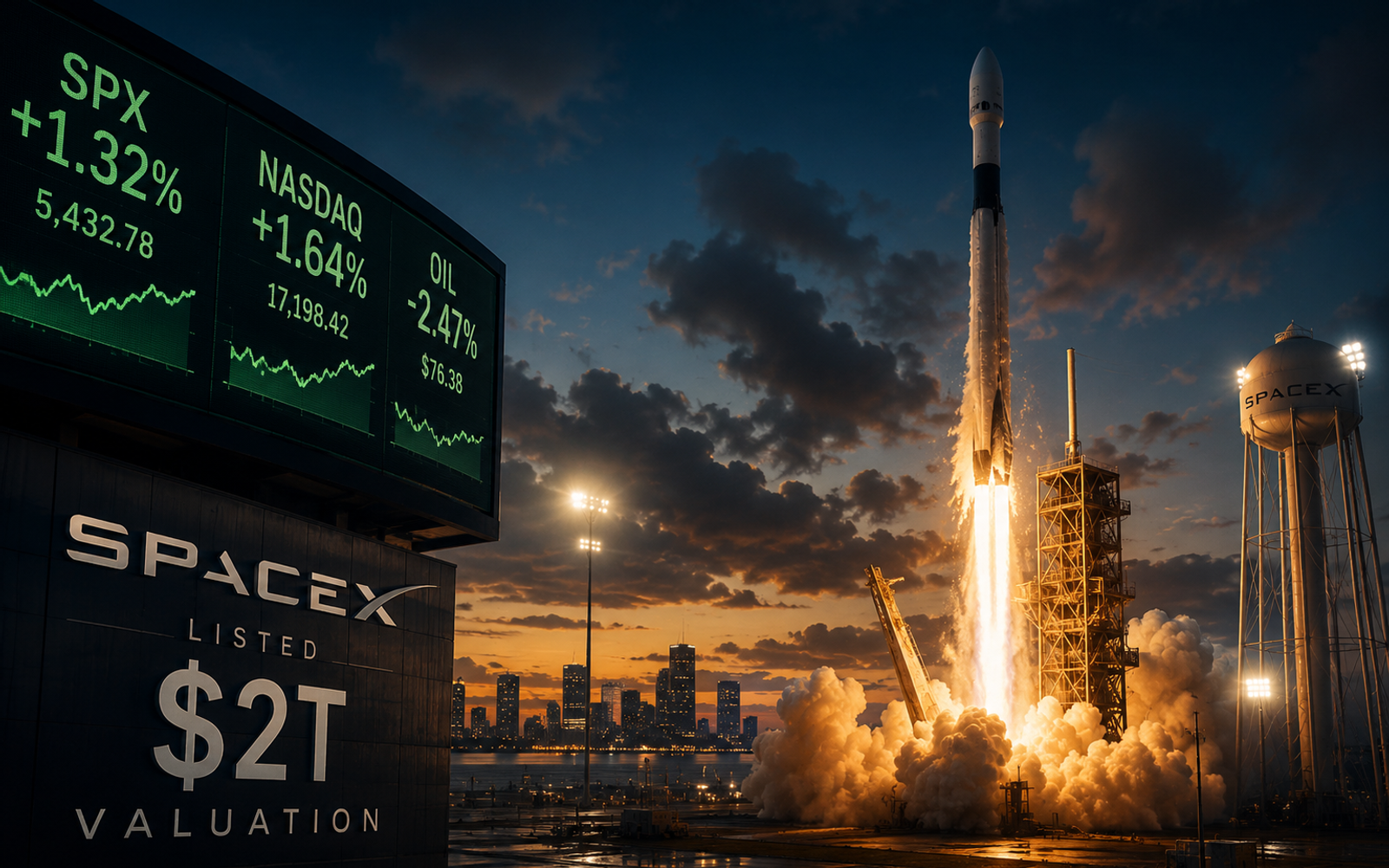
The numbers arrived first, then the crowd. On June 12, 2026, SpaceX shares began trading on the Nasdaq at $145 apiece. By the afternoon, the company's market cap sat north of $2.1 trillion, according to CNBC. Elon Musk's personal stake pushed his net worth past $1 trillion for the first time in history. The IPO raised $75 billion, making it the largest public offering ever recorded. These are not normal numbers. They describe something that existing financial language struggles to contain.
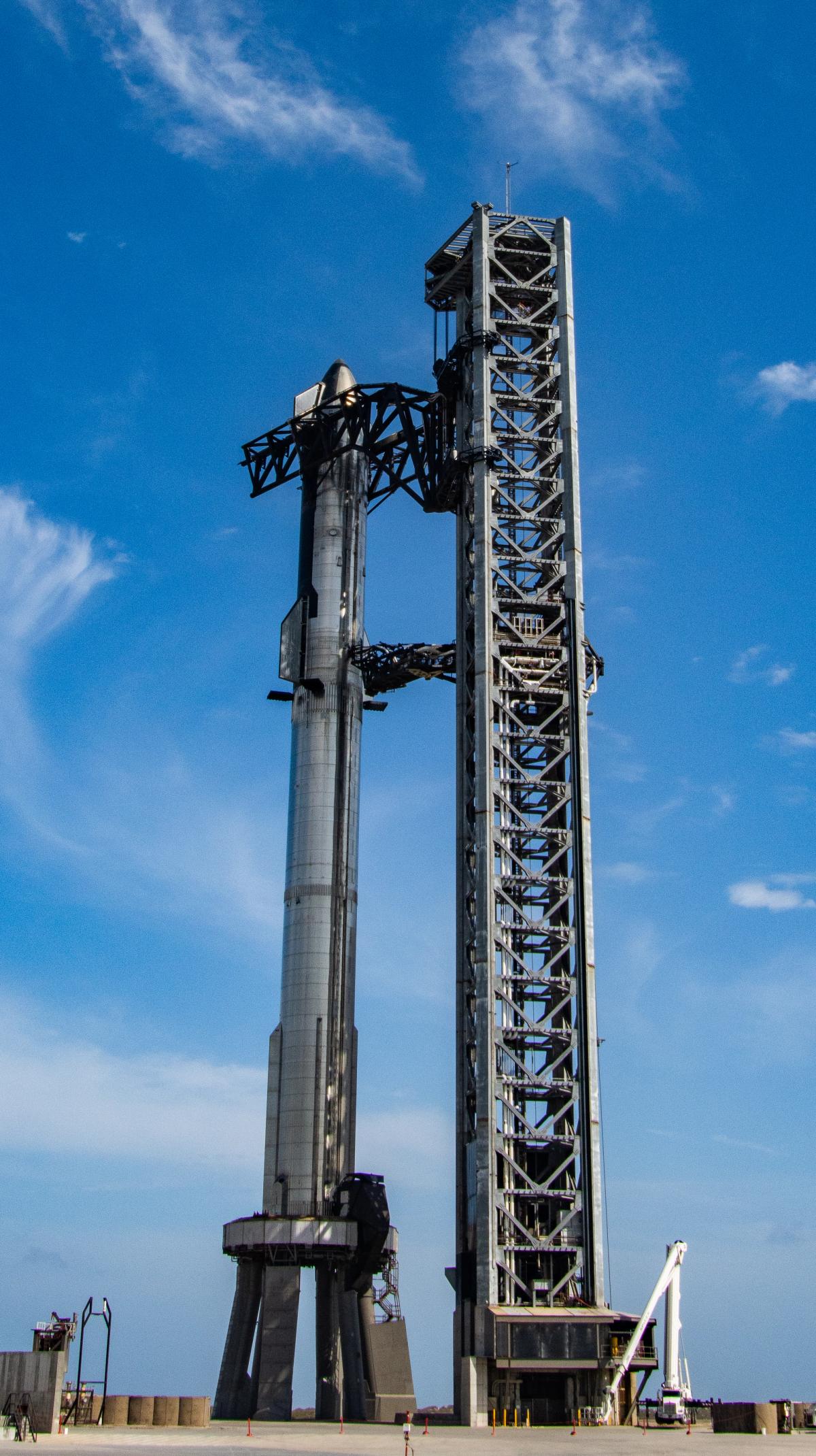
Consider the physics. SpaceX builds rockets that throw metal tubes through the upper atmosphere at 17,500 miles per hour. The Falcon 9 stands 70 meters tall. The Starship, still in testing, is taller than the Saturn V. These are industrial objects, built in factories south of Los Angeles and launched from pads in Texas and Florida. The gap between what the company physically produces and what the market says it's worth is the actual story. That gap is where the tension lives.
A $2.1 Trillion Bet on Leaving Earth
The valuation makes SpaceX more valuable than Broadcom, the chip giant whose market cap had been climbing for years. It puts SpaceX in the same weight class as Meta and just behind Amazon, which sits at $2.6 trillion according to Stock Analysis. A company that has yet to turn a consistent profit from its core operations is now worth more than most of the world's largest corporations. That inversion is the defining feature of this moment.
But even at scale, the operational numbers don't explain $2.1 trillion. The gap is filled by something Reuters described as the "Elon premium," a valuation boost driven as much by faith in Musk's vision as by traditional financial metrics. Investors aren't buying rockets. They're buying the idea that SpaceX will be the company that puts people on Mars, builds a permanent off-world economy, and owns the infrastructure for interplanetary travel. That vision is priced in. The question is whether the hardware can deliver.
What $75 Billion in New Money Buys
The IPO raised $75 billion. That is more liquid capital than the annual operating budgets of multiple mid-sized sovereign nations combined. It is enough money to build roughly 1,100 Falcon 9 rockets from scratch. SpaceX says it will use the funds to accelerate Starship development, expand the next-generation Starlink constellation, and build out its deep-space human spaceflight architecture. Each of those priorities comes with its own capital and technical hurdles.
A concrete example of where that money goes: Starlink global subscribers passed 10 million in early 2026, generating tens of billions in high-margin recurring cash flow. Direct-to-cell satellite agreements with major global telecommunications carriers allow standard, unmodified 4G and 5G smartphones to connect directly to low Earth orbit satellites whenever cellular towers are out of reach. That is a technical breakthrough with immediate commercial utility across maritime corridors, aviation routes, and remote rural territories worldwide. It is also a massive recurring revenue stream that grows regardless of whether anyone ever sets foot on Mars.
The unit economics of Starlink explain why Wall Street embraced the offering. Each satellite costs roughly $250,000 to manufacture and deploy, with a single Falcon 9 flight carrying up to 60 units. With over 6,000 operational satellites in low Earth orbit, subscriber growth continues to accelerate across enterprise, maritime, defense, and residential tiers. At an average revenue per user between $80 and $120 per month, global subscription revenue provides the stable, recurring cash flow required to subsidize Starship development. That is the commercial engine that finances deep space hardware without relying exclusively on taxpayer subsidies.
The Liquidity Event That Reshuffled the Board
SpaceX's public debut did not happen in a vacuum. The company had long resisted going public. Musk himself said for years that he wanted to keep SpaceX private to avoid short-term earnings pressure. That changed for partly regulatory and partly structural reasons. As SpaceX grew to dominate the launch market and Starlink began generating material revenue, the pressure from employees holding private shares became impossible to ignore. Secondary markets had already been trading SpaceX stock at high valuations. The IPO simply formalized what the gray market already knew.
The ripple effects were immediate. Broadcom lost its spot as the most valuable hardware company by market cap. Amazon, sitting at $2.6 trillion, became the next company in line behind SpaceX and the tech giants. The space economy, once a niche corner of aerospace, is now a mainstream asset class. Funds that never looked at launch vehicles are now building positions. Pension funds. Sovereign wealth funds. University endowments. They're all buying the story.
The Sovereign Hegemony Dilemma
Here is where the financial story turns into a geopolitical challenge. SpaceX's ascent is often framed as a triumph of Silicon Valley capital and commercial aerospace efficiency. But the company's sheer scale now poses a structural dilemma for sovereign governments and legacy aerospace primes worldwide.
By operating over 60% of all active satellites in orbit and flying more orbital payload mass than every nation state combined, SpaceX has become an unavoidable global utility. While global carriers have embraced direct-to-cell satellite roaming, several international telecommunications regulators have pushed back, citing data sovereignty concerns and national security vulnerabilities. Relying on an American commercial provider for primary communications infrastructure during natural disasters and civil crises creates unprecedented strategic dependencies.
Meanwhile, traditional national space agencies and defense ministries are being forced to recalibrate. In Europe, the delayed debut of Ariane 6 highlighted how dependent Western allies had become on Falcon 9 launches to put scientific and military payloads into orbit. In Asia and the Middle East, sovereign space programs are debating whether to attempt competing with reusable rocketry or accept perpetual customer status on SpaceX manifests.
The strategic tension is undeniable. SpaceX offers the world the cheapest launch capacity and lowest-latency global orbital connectivity ever engineered. Yet it concentrates planetary communications and space logistics inside a single publicly traded entity answerable to public shareholders and a famously volatile founder. For foreign nations seeking sovereign space access, dependence on a private American contractor is an uncomfortable reality that no public market valuation can resolve.
The Engine That Can't Stop
The engineering challenges haven't gone away. SpaceX's Starship has flown multiple test flights but hasn't yet achieved reliable orbital refueling, a requirement for deep space missions. The Raptor engine, which runs on liquid methane and liquid oxygen, has experienced combustion instability issues at high chamber pressures. These are not marketing problems. They are physics problems. And physics doesn't care about valuations.
Orbital refueling is the next threshold. Starship needs to transfer propellant between vehicles in orbit to reach the Moon or Mars. That has never been done at scale. The tanks are enormous. The boil-off rates are punishing. The margins for error are thin. If SpaceX solves this, the architecture for deep space becomes real. If it doesn't, Starship remains a very large rocket that can't leave Earth orbit. The market has priced in the first outcome. It has not priced in the second.
What Comes Next
Amazon's Project Kuiper, a direct competitor to Starlink, has yet to launch its full constellation. The company sits at $2.6 trillion in market value, meaning it has the financial resources to compete but not the head start. SpaceX has been launching Starlink satellites for years. Kuiper is still building out its production line.
The real long-term competition, though, will come from outside the United States. China has accelerated deployment of its state-backed Guowang and Qianfan broadband megaconstellations, while the European Union continues funding its IRIS² sovereign secure satellite network. At the International Telecommunication Union (ITU), the race for low Earth orbit spectrum and orbital inclinations has intensified. Starlink's aggressive filings for tens of thousands of orbital slots have effectively locked up the most desirable orbital real estate, forcing late entrants to navigate increasingly crowded collision corridors.
Elon Musk became the world's first trillionaire not because SpaceX sells tickets to space today, but because the market believes it will sell tickets to space tomorrow. That belief is priced in. The rockets have to catch up.
Comments (0)
No comments yet. Be the first to share your thoughts.