The Fox-Roku $22B Deal Broke Streaming. Here's Your Playbook.
Fox just paid $22 billion for Roku. For creators and founders, the real story is about who controls distribution and what happens when neutrality ends.

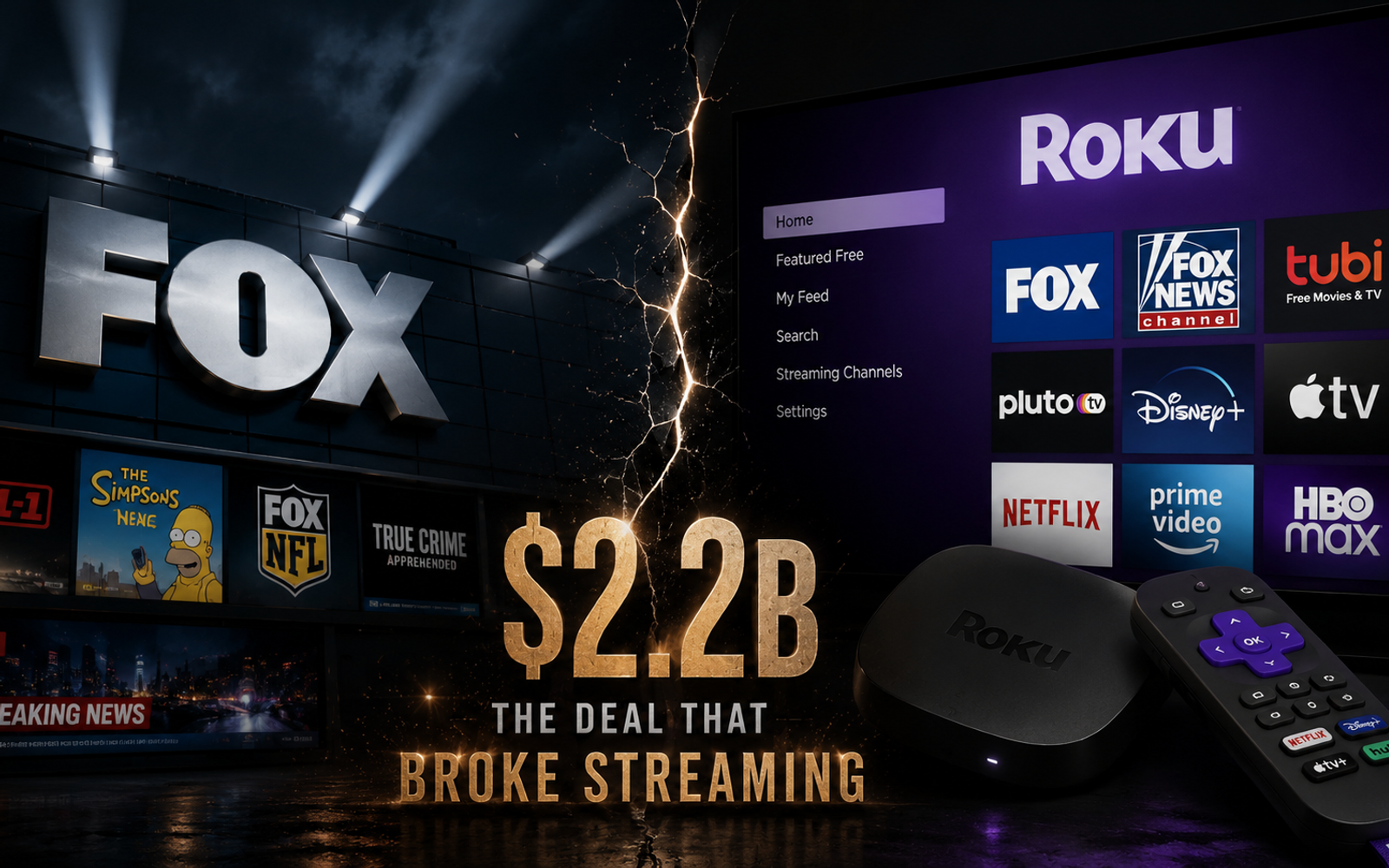
Fox Corporation announced on June 15, 2026, that it reached a definitive agreement to acquire Roku for $22 billion in enterprise value, paying $160 a share in a mix of cash and stock. The initial reports broke before dawn, and by mid-morning, the transaction had monopolized executive conversations across television, streaming, and venture-backed media.
The surface-level narrative is straightforward: an old-line broadcast titan is buying a hardware and connected-TV operating system. But the deeper reality for digital entrepreneurs and media operators is far more consequential. This transaction signals the end of neutral distribution on the living room screen, and it redraws the map for anyone relying on programmatic video or third-party apps for audience reach.
What Fox Actually Bought
When Rupert Murdoch orchestrated the $71 billion sale of 21st Century Fox entertainment assets to Disney in 2019, many Wall Street analysts assumed the slimmed-down Fox Corporation would eventually wither as a legacy relic of linear broadcast and cable news. Instead, Fox pursued an entirely different operational path. It avoided the money-losing prestige subscription streaming wars that plagued Disney+, Paramount+, and Peacock, and instead bought free ad-supported streaming service Tubi in 2020 for just $440 million.
That bet paid off handsomely. Tubi steadily expanded into one of the most profitable and high-volume FAST (Free Ad-Supported Streaming TV) networks in the market. By adding Roku, including its proprietary Roku Channel and direct software relationships with more than 100 million active connected-TV households worldwide, Fox instantaneously transforms itself into the third-largest player in American television by total viewing share, trailing only YouTube and Netflix.
The financial scale of the bet is immense. Fox is financing roughly $12 billion of the acquisition through new debt facilities, a leverage commitment that caused Fox shares to slide nearly 10 percent in initial trading as credit rating agencies evaluated the balance sheet pressure. Yet Fox CEO Lachlan Murdoch framed the move as essential infrastructure, declaring it the definitive bridge connecting Fox's live sports rights and news broadcasts with the largest independent operating system in television. While Roku founder and CEO Anthony Wood emphasized that the platform would remain open and partner-friendly, the commercial incentives governing the hardware have permanently shifted.
Roku's True Business: The Gatekeeper's Toll
Outside the tech sector, Roku is still widely perceived as a consumer hardware company that manufactures inexpensive HDMI dongles and budget streaming sticks. In reality, hardware has long served as a loss-leader to subsidize Roku's actual economic engine: digital advertising and software gatekeeping.
In the first quarter of 2026, Roku generated $613 million in advertising and platform revenue, up 27 percent year over year, while device revenue remained essentially flat. The Roku Channel alone captures roughly 3 percent of all domestic streaming viewership according to Nielsen. But the real asset Fox acquired is not the channel; it is the default operating system that controls the HDMI inputs of millions of smart televisions built by manufacturers like TCL, Hisense, and Sharp.
Every time a consumer turns on their television, Roku dictates what tile appears in the primary carousel, which sponsored screen-saver takes over the display, and which voice-search query routes to which content library. That is not merely distribution. It is the toll booth at the entrance of the living room.

The Illusion of the "Neutral" Operating System

For over a decade, Roku's market appeal rested entirely on its perceived neutrality. Unlike Amazon (which uses Fire TV to steer viewers into Prime Video and Amazon Channels) or Apple (which prioritizes its own hardware and ecosystem), Roku did not own a sprawling legacy production studio. It treated third-party streaming channels, whether Netflix or an independent niche culinary network, with equal programmatic detachment.
That neutrality was the foundation that allowed Roku to assemble its 100-million-household moat. Yet in digital platform economics, open gateways rarely remain neutral once an owner possesses vertically integrated content to favor.
History offers clear parallels. When legacy cable operators like Comcast and Time Warner consolidated regional cable distribution in the 1990s and early 2000s, they routinely engaged in carriage disputes, burying competitor channels in the high triple-digits of the electronic program guide while giving their own regional sports networks prime, low-numbered placement. In mobile software, Apple built the App Store as an open developer ecosystem before instituting strict in-app purchasing requirements and competing directly against popular third-party utilities. Amazon similarly used internal merchant data on its marketplace to identify high-margin product categories for its private-label brands.
Fox's pledge to maintain an "open, partner-friendly platform" must be evaluated against this economic reality. Vertical integration does not require heavy-handed bans or public de-platforming. It happens quietly in the background: small algorithmic weighting adjustments in the recommendation feed, micro-second latency differences in programmatic ad auctions, and preferential pricing on home-screen promotional real estate.
The FAST Channel Squeeze and the Ad Inventory Tax
For digital publishers, video networks, and media startups, the most immediate friction lies in the mechanics of connected-TV advertising. Under standard distribution agreements, Roku has traditionally retained up to 30 percent of the advertising inventory on third-party channels operating within its ecosystem, monetizing those impressions through its proprietary OneView ad exchange.
With Fox at the helm, Tubi and Fox Sports will operate with zero inventory friction and preferential auction routing. Independent FAST channels and media brands will find themselves competing for programmatic advertiser budgets against an in-house competitor that incurs no platform tax.
When the entity that runs the auction also bids in the auction, the margin structure for independent participants inevitably deteriorates. Advertisers seeking connected-TV reach will naturally be steered toward packaged buys across Tubi, Fox Sports, and The Roku Channel, squeezing independent operators who lack direct corporate sponsorship sales teams.
The Strategic Playbook for Independent Media Operators
None of this means independent video networks or digital content entrepreneurs should abandon connected TV. What it does mean is that treating any single platform as a permanent partner is a strategic liability. Navigating this new landscape requires three distinct operating adjustments:
- Aggressive Multi-OS Diversification: Never allow Roku, or any single platform, to represent more than a third of your connected-TV viewership. The global smart TV market is fragmented across Samsung Tizen, LG webOS, Google TV, and Amazon Fire TV. Independent operators must build containerized cross-platform applications and distribute across every major TV manufacturer rather than optimizing exclusively for Roku OS.
- Direct Ad-Tech Stack Control (Bring Your Own Ad Server): Avoid relying entirely on the platform's default programmatic revenue share. Leading digital publishers increasingly negotiate custom app agreements that permit them to plug in direct supply-side platforms (SSPs) and demand-side platforms (DSPs), ensuring they retain direct buyer relationships and first-party pricing data rather than accepting whatever remnant yield the platform allocates.
- Building Off-Platform Audience Moats: The ultimate defense against living room gatekeepers is audience intent. Viewers who search specifically for your brand name or app title by voice or text are substantially harder for an operating system to divert than passive channel surfers. Media companies must cultivate direct relationships via dedicated newsletters, web hubs, and community touchpoints, driving deliberate viewer intent rather than relying on algorithmic home-screen placement.
The Bottom Line
Fox's acquisition of Roku proves that the streaming war has shifted from content creation to distribution control. Producing compelling video is no longer enough when a handful of corporate conglomerates own the digital doorway through which audiences find it.
For digital media founders and business leaders, the message is unmistakable: ownership of the underlying customer relationship is the only durable asset in modern media. Everything else is operating on borrowed land.
Comments (0)
No comments yet. Be the first to share your thoughts.