Pomellato's Revolution Is Everything You Think It Isn't
Pomellato's Palais de Tokyo exhibition is gorgeous. But the real story is what it says about luxury in 2026.

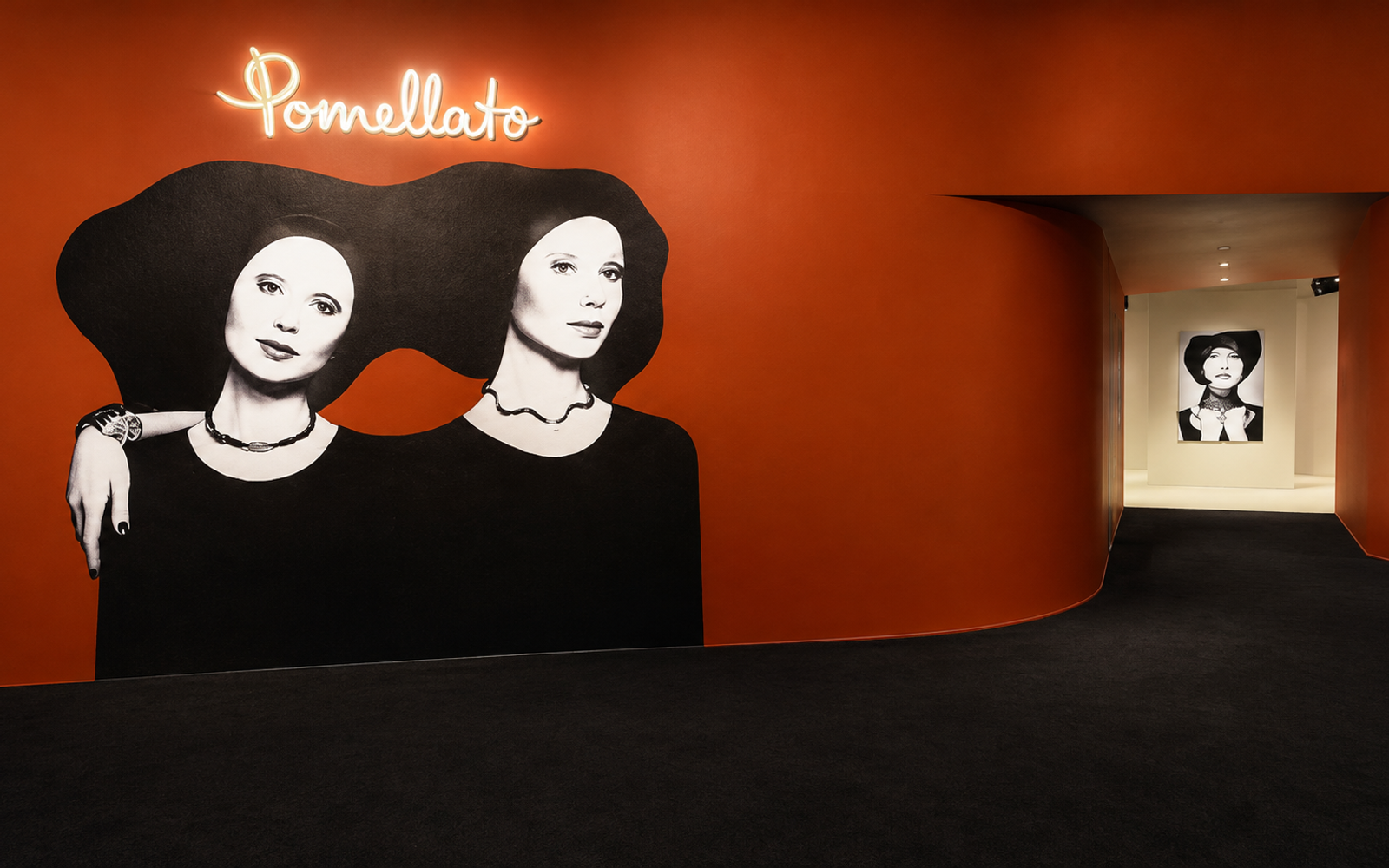
You walk into the Palais de Tokyo and the first thing you see is a chain. Not a necklace, not a bracelet, just the chain itself. A thick, almost architectural thing in rose gold, laid out like an artifact. Which it is, in a way. Pomellato built its reputation on that chain, on the idea that a necklace could be something you throw on with a t-shirt, not something you save for a gala.
The exhibition, "Le Joaillier Révolutionnaire," opens June 24 and runs through July 20, and it is gorgeous. It is also exactly the kind of thing that makes me uneasy.
That unease has nothing to do with the jewelry itself. Look closely at the pieces on display, many pulled from the maison's archives and shown to the public for the first time. You can see the radicalism. In the 1960s, when every respectable jeweler was still doing floral brooches and diamond tennis bracelets, Pino Rabolini decided to make fine jewelry that felt like fashion. He used colored gemstones the way a painter uses pigment. He built necklaces that moved like fabric. He trusted women to buy their own diamond rings, which in 1967 was practically a political statement.
The curatorial hand of Alba Cappellieri, a professor at Politecnico di Milano and a genuine scholar of jewelry design, gives the show real intellectual weight. The exhibition dedicates a section to each of the maison's revolutions: Image, Craftsmanship, Color, and Women. Each gets its own room. Each tells a tidy story.
And that is the problem: the tidiness of it.
Real Revolutions Are Messy
The word "revolutionary" gets thrown around a lot in fashion. It has become a kind of verbal tic, a way of saying "this is important" without being too specific about why. Pomellato's exhibition leans hard on that word; it is right there in the title. But the structure of the show, the museumified format that separates each revolution into its own cleanly labeled chamber, suggests something more controlled than revolutionary.
Revolutions are chaotic. They leave scars. They produce things that don't fit neatly into categories. This exhibition, for all its beauty, feels like a revolution that has been curated, packaged, and priced.
I wrote about this trend earlier this year, looking at how luxury brands have seized on the museum exhibition as the ultimate marketing vehicle. It is not just Pomellato. Van Cleef does it. Dior does it. Even Hermès, whose Resort collection this season was notable for its restraint, has been staging increasingly elaborate brand retrospectives.
The format has become so standardized that you could almost write a template: find a prestigious cultural institution, hire a respected academic curator, pull archival pieces, organize them by theme, add some immersive elements, call it a revolution. The Vogue analysis of the jewelry market in 2026, titled "Age of Asset," noted that once rare, museum-grade brand shows have become a central part of the luxury marketing playbook. Some maisons now stage up to two major exhibitions a year, often simultaneously across continents.
The contradiction is baked in. A revolution cannot be scheduled. It cannot be free with advance reservation, which this exhibition is. Admission is complimentary; you just need to book a slot. That is generous. It is also an effective lead generation funnel. The show is designed to make you fall in love with Pomellato, and if you fall in love, you know where to find the boutique.
Color as Currency
The most compelling room in the exhibition is the one dedicated to color. Pomellato has always understood something that many jewelry houses forget: gemstones do not just sparkle, they communicate. A tsavorite garnet is green in a way that says something entirely different from an emerald. An amethyst can be dark and brooding or pale and ethereal depending on how you cut it.
The maison's use of colored stones in the 1970s and 1980s was genuinely disruptive because it treated color as the main event, not a supporting player. Most jewelers of that era used colored stones as minor accents, little pops of contrast in a field of diamonds. Pomellato flipped that: they made the colored stone the whole point.
Walking through this section, you can see the lineage clearly: the chain necklaces from the 1980s set with irregular cabochons, the massive rings that look like candy on the finger, the way the gold is worked, hammered, brushed, and polished in ways that catch light differently. It is precise and accomplished.
Craftsmanship and the Problem of Skill
The craftsmanship section is immaculate. You can watch videos of the goldsmiths in Milan working on chains that take weeks to assemble. You can see the tools, the molds, and the wax models that preceded the final piece. It is the kind of transparency that luxury brands have embraced as a response to a culture that increasingly demands to know how things are made.
And I will admit: I stood there longer than I expected. There is something hypnotic about watching a skilled artisan set a stone: the tiny adjustments of the prongs, the precise tap of the hammer that either secures the gem or cracks it. The skill is real, and the dedication is real.
But craftsmanship has become a kind of rhetorical shield for the luxury industry. When you say "this took 800 hours to make," you are also saying "this justifies the five-figure price tag." Which it might. But the heavy emphasis on craft can also obscure harder questions. Where do the stones come from? How are the miners treated? What is the environmental cost of extracting a tsavorite garnet from the depths of the earth and shipping it to Milan to be set in gold?
Pomellato, like most luxury houses under the Kering Group, has substantial sustainability initiatives and leads in environmental reporting. But the exhibition does not really grapple with any of this. It is a celebration, not an interrogation.
The Women's Room and Financial Independence
The final section of the exhibition focuses on women. Pomellato has made female empowerment a central pillar of its identity. The brand's campaigns have long featured women who are older, more powerful, and more interesting than the typical jewelry model: women in tailored suits and silk, laughing, holding champagne, wearing a Pomellato ring on their index finger like a signet.
The message is clear: this is not a romantic gift bestowed by a partner. This is a purchase you make for yourself. The exhibition traces this approach back to the 1990s, when the maison began explicitly marketing to women as self-purchasers, long before the rest of the industry caught on.
It is a good story, but it is also a story that has been told many times before by luxury marketing departments. The empowered woman who buys her own diamonds has become a staple of contemporary advertising. Pomellato was genuinely early to this narrative, and the exhibition makes that case convincingly.
Yet I kept thinking about what empowerment actually means in the context of an object that costs more than most people's annual rent. There is an inherent strangeness to celebrating female financial liberation through an object that is itself an artifact of extreme wealth concentration. The exhibition does not grapple with that tension.
On the Question of Audience
The Palais de Tokyo is a smart choice for this show. It is a contemporary art institution, not a traditional decorative arts museum. The building itself, with its soaring concrete walls and raw industrial architecture, creates a productive friction with the glittering objects on display. You can walk from an installation of radical feminist sculpture to a room of gold necklaces, and the contrast forces you to contemplate where art ends and commerce begins. The line has been blurring for decades, and Pomellato is deliberate about positioning itself across both sides.
Who is this exhibition for? The free admission lowers the barrier, but the location in central Paris still selects for a specific visitor: wealthy travelers, contemporary art collectors, and journalists covering the luxury sector. The exhibition will not change the mind of someone who considers fine jewelry an unnecessary indulgence. It doesn't need to; it speaks directly to an audience that already values the aesthetic.
What would a real revolution look like in jewelry in 2026? It might be a brand that refuses to use newly mined stones entirely, working solely with recycled gold and repurposed vintage gems. It might be a house that prices its pieces transparently, laying out exact material costs, labor hours, and profit margins. It might be a label that abandons the seasonal jewelry calendar altogether in favor of permanent, circular collections.
Pomellato does not do those things, but that is not an indictment. It is a luxury maison operating within a global luxury conglomerate, and the system follows predictable commercial rules. The exhibition is honest about what it is: a lavish retrospective for a house that made bold, creative choices over six decades.
The Real Innovation Nobody Discusses
What the exhibition gets right, quietly and consistently, is the emphasis on wearability. Pomellato's jewelry is designed to be worn, not merely locked in a vault. That sounds obvious, but it is surprisingly rare in the world of high jewelry.
Much of fine jewelry is essentially sculptural: too heavy, too fragile, or too ostentatious to actually put on and live in. Pomellato's pieces, even the most elaborate archival creations, invite physical touch. The chains move fluidly. The stones sit flush against the skin. You can imagine someone wearing one of these necklaces to an evening dinner, a board meeting, or a casual lunch.
That tactile accessibility, that refusal to separate fine jewelry from everyday life, is the true inheritance of Pino Rabolini's vision. And in the end, that might be the only revolution that matters: not the institutional exhibition, not the polished marketing narrative, but the fact that someone in Milan decided that a woman should be able to buy herself a gold chain and wear it on a Tuesday morning.
Comments (0)
No comments yet. Be the first to share your thoughts.