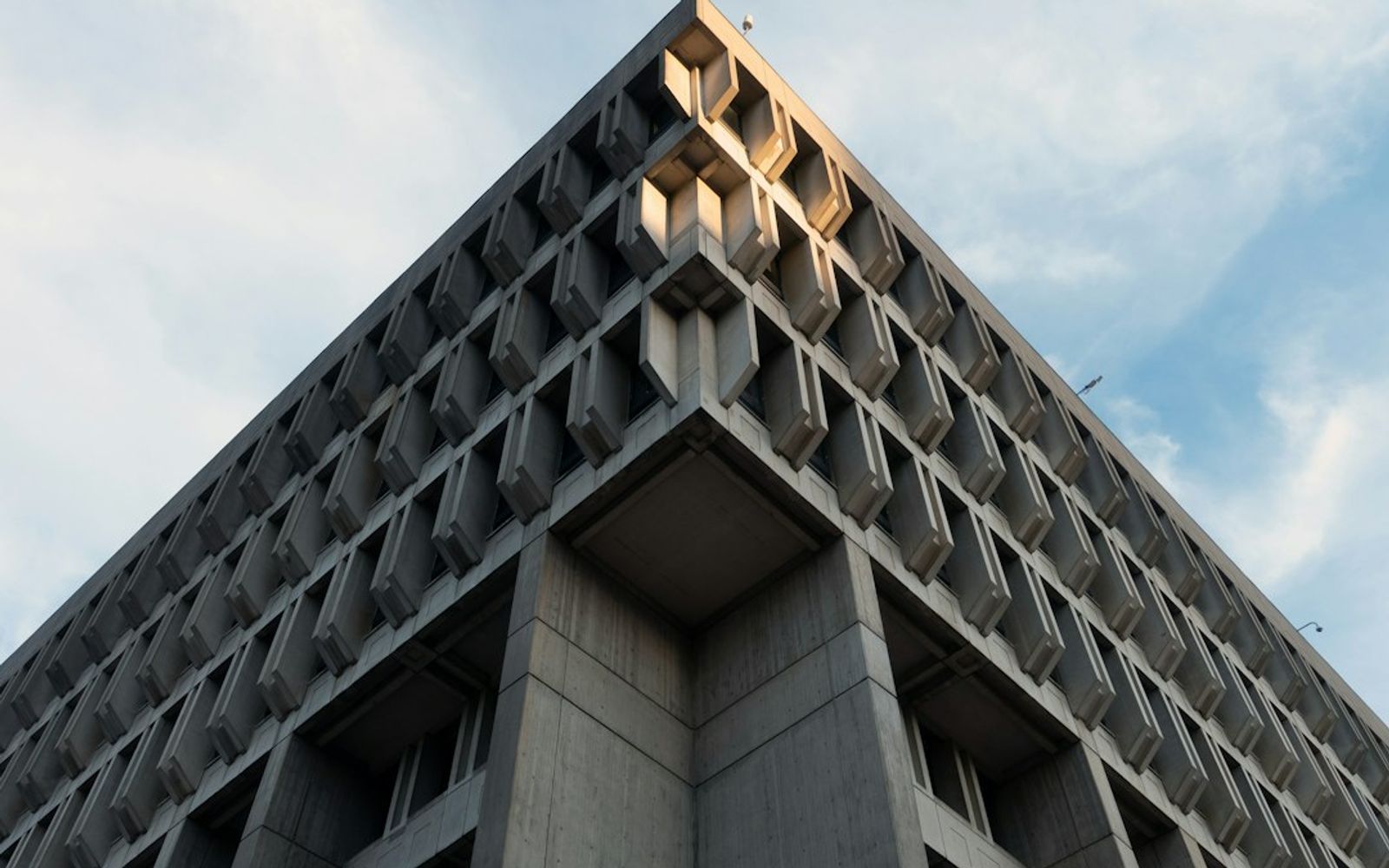
Brutalist Concrete: Why Demolition Stopped Making Sense
Concrete landmarks are being kept instead of knocked down, and the reasons are economic more than sentimental.

The Morton Salt Girl is still up there, umbrella and all, painted on the roof of a building that stopped packing salt in 2015. Below her, a 3,600-capacity room sells out on weeknights. The Salt Shed opened in 2022 on a 4.2-acre stretch of Chicago's North Branch industrial corridor, and the conversion kept the shed, the roof, the logo and the awkward loading geometry that made it a factory in the first place. Nobody argues about it now. A decade ago the same structure was a line item somebody wanted gone.
In London, the argument got settled on a spreadsheet. The Acre, finished last year in Covent Garden, keeps 80% of the concrete frame of a Richard Seifert Brutalist block and threads 65,000 square feet of new space through it. The retained structure saved roughly 4,250 tonnes of embodied carbon, according to Gensler, the firm behind the retrofit, and the project took the Institution of Structural Engineers' 2025 award for large-scale city-centre retrofit. The 65,000 square feet is the detail that stops me. You can add premium floor area to a building without pouring a new frame, and the carbon saving arrives attached to the cost saving.
Put the 4,250 tonnes in terms a planning committee can use. A typical petrol car emits somewhere near 1.6 tonnes of CO2 a year from its tailpipe, so the frame of one Covent Garden office block is worth about 2,600 cars parked permanently. That number travels. It's why the fight over Brutalism has quietly stopped being a fight about taste.
The Carbon Case Now Pays for Itself
In September 2025, Gensler and Opportunity London published a retrofit guide setting out five pillars for making reuse investible, and the blockers they named were policy inertia and financing gaps. Engineering wasn't on the list. The structural work has been solvable for years. The problem sits in the pro forma, where demolition and rebuild still beats retrofit unless somebody prices the carbon that gets thrown away with the slab.
Where a city does price it, the concrete survives. London has spent the past few years pushing retrofit as a route to its climate targets, and the results now include buildings that would once have been knocked down without a second meeting. The Acre's tenants moved into a structure designed for a different economy and a different workforce, and it worked because Seifert built the floorplates deep and almost column-free. That was an accident of 1970s office planning. It reads now as foresight.
The instinct is the same one behind the right to repair argument about hardware, scaled up by a factor of ten thousand. A structure is worth more than the cost of replacing it, and the sums only look close because nobody counts what gets destroyed.
Concrete Was Always Built to Be Repurposed
Brutalism gets credit for being ugly and very little for being useful. Load-bearing concrete frames, wide spans, few internal columns, enormous mass. The mass is what you want in a music room, because it stops sound leaking into the neighbours, and the spans are what you want in a gallery, because they let you hang a wall anywhere. The raw, unfaced surfaces that offended a generation of critics are also the surfaces that take a knock without needing a specialist.
Then there's the touring logic of the thing. A 3,600-capacity room is the rung where an artist can play two nights instead of one and delay the arena for another year. The Salt Shed added a 5,500-capacity outdoor yard next door on the same 4.2 acres, so a promoter can scale a show up or down without leaving the site. That flexibility is the business case, and an old salt works happened to have the footprint for it.
None of that explains why the buildings were available in the first place. They were hated in the 1980s, and demolition became a way of enforcing taste. The ones that survived the wrecking ball often did so because they had no preservation constituency, which kept them cheap, which kept them available. Cheap and available is the precondition for everything the Salt Shed and the Midway garage pulled off.
The Small Version Is the Harder Test
Midway Contemporary Art sits in a former limousine garage in northeast Minneapolis, a few minutes from the Mississippi. The gallery worked with b+ and Snow Kreilich on a conversion that arrived in phases: the existing building became galleries and offices between 2021 and 2024, and a library and learning centre on the adjacent car park is due in 2026 and 2027. The budget was small enough that the nonprofit did some of the work itself. Demolition was never on the table.
That phasing is the part worth studying. A capital-markets retrofit like The Acre can be underwritten by an investor who wants a building full of tenants by the fourth quarter. A nonprofit can't finance a decade of design in one go, so the building is allowed to stay visibly unfinished and open anyway. It reopened with a K.R.M. Mooney exhibition titled reserves, and the gallery still reads as a work in progress, which is honest rather than sloppy.
Read Also
Advertising a SaaS on a Tiny BudgetWhen Reuse Becomes a Backdrop
In Sharjah, the Sharjah Art Foundation has spent years converting 1970s and 1980s modernist buildings, the Flying Saucer among them, into working cultural space. The danger in that model is museumification, where a building gets preserved as an object and stops being a place where anything unplanned happens. The good conversions keep some friction. The bad ones turn the loading bay into a bar and charge eighteen pounds for a cocktail in it.
China runs the same play at a different scale. Beijing's 798 Art District and Shougang Park turned factory grounds into cultural landmarks, and this month the Beizhong Tech and Culture Park in Shijingshan opened an exhibition of young artists' science fiction work at its A Peak Museum. When the state owns the land, conversion is urban policy with a cultural face, and the question of who gets to use the ground floor never quite gets asked.
Most of what gets called adaptive reuse is a landlord discovering that heritage is cheaper than a new facade. The design award tells you what the architect did. The price at the door tells you who the building is actually for, and whether it's open on a wet Tuesday in February.
Brutalist concrete was poured to outlast the politics that produced it, and it has outlasted several. The buildings that survive the next decade will be the ones where somebody counted the tonnes before the wrecking ball arrived. That argument is happening in planning offices and investor decks rather than in studios, which is less romantic than a preservation campaign and considerably more effective. For once, the cheapest option is the thing already standing.
Comments (0)
No comments yet. Be the first to share your thoughts.