Android's Zero-Click SMS Bug Leaves Older Phones Exposed
CVE-2026-58882 lets a silent 8-byte binary WAP Push packet crash Android cellular telephony and drop active emergency calls. Phones stuck on Android 12 or 13 remain vulnerable.

Most mobile security threats still ask the victim for one careless tap: open a sketchy WhatsApp link, sideload a sports stream APK, or grant accessibility controls to a fake cleaner app. CVE-2026-58882, widely nicknamed the modern Android "SMS of Death," skips user interaction completely. A malformed binary message just 8 bytes long rides across cellular signaling, never chimes, never shows up in Google Messages, and crashes the privileged system process running cellular calls and mobile data.
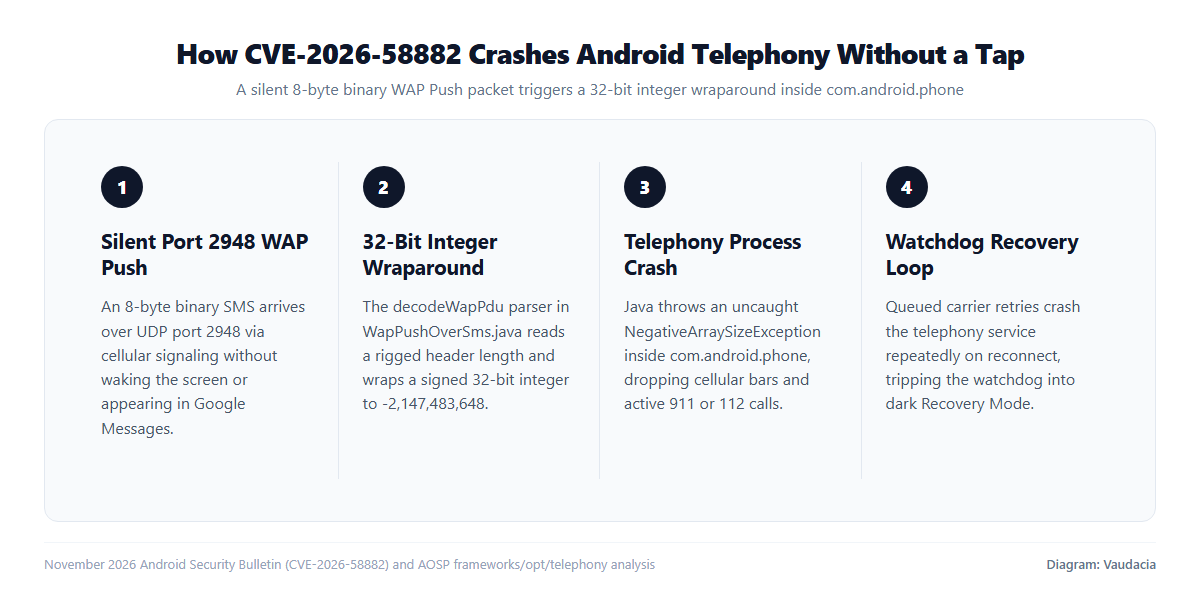
- 1An 8-byte silent binary SMS crashes Android telephony: CVE-2026-58882 exploits a 32-bit signed integer wraparound (-2,147,483,648) inside decodeWapPdu in WapPushOverSms.java over UDP port 2948, throwing an uncaught NegativeArraySizeException that kills com.android.phone and drops active 911 or 112 calls without user interaction.
- 2Queued carrier retries trigger Recovery Mode loops: Because mobile networks re-send unacknowledged binary SMS packets automatically when a handset reconnects to a tower, repeated crashes trip Android's system watchdog and strand unpatched phones on the Recovery Mode screen.
- 3Android 14 to 17 are patched while Android 12 and 13 remain exposed: Google merged the fix in the November 2026 Android Security Bulletin for Android 14, 15, 16, and 17, leaving end-of-life Android 12 and 13 consumer phones and older enterprise LTE scanners dependent on rare OEM backports or custom AOSP builds.
Active voice conversations disconnect on the spot, including emergency calls dialed to 911 or 112. Disclosed in late October 2026 by security researcher Mark Blaszczyk with a working proof-of-concept, the flaw sits inside legacy telephony code shared across years of Android builds. Google patched actively maintained branches in the November 2026 Android Security Bulletin, leaving a familiar gulf between recent flagships and millions of perfectly working phones frozen on older software.
Inside the 8-Byte WAP Push Packet
Understanding why an invisible message knocks a modern phone off its cell tower requires revisiting a leftover slice of early 2000s telecom design: WAP Push. Before fast mobile web standards matured, carriers created a silent binary SMS channel on UDP port 2948 so networks could push MMS pointers, voicemail counts, and provisioning updates straight to the OS. Even on 5G networks, Android keeps that parser active so carrier alerts never break.
Inside Android's frameworks/opt/telephony module, WapPushOverSms.java contains a parser called decodeWapPdu. Its job is simple: inspect incoming binary WAP Push headers, read the declared header byte count, and allocate a matching Java byte array in memory.
As technical analyses of CVE-2026-58882 documented, Blaszczyk spotted a classic bounds-checking mistake in that allocation calculation. Crafting an 8-byte payload with a rigged header-length field pushes a 32-bit signed integer calculation into wraparound at -2,147,483,648. Java rejects negative array lengths outright, throwing an uncaught NegativeArraySizeException inside com.android.phone.
Because com.android.phone is the core telephony service managing modem communications, that single exception kills cellular connectivity immediately. Signal bars drop to zero, active calls snap shut, and Android restarts the telephony process a few seconds later while most users blame a dead zone.
When One Crash Becomes a Recovery Mode Loop
One dropped call is bad enough; interrupting an emergency dispatch is worse. Worse still, carrier networks treat an unacknowledged binary SMS as temporarily undelivered, or a targeted attacker can transmit a small burst over several seconds.
When queued poisoned packets hit an unpatched handset repeatedly, the device falls into a tight loop: com.android.phone wakes up, pulls the waiting binary payload off the tower, throws NegativeArraySizeException, crashes again, and trips Android's system crash watchdog. After enough consecutive restarts, Android aborts normal boot and strands the phone on the dark Recovery Mode screen, where non-technical owners typically lose local photos to a factory reset unless USB Debugging was already enabled to flush queued messages over ADB.
Open Settings > About phone and look closely at your Android version and Security patch level. Google merged the decodeWapPdu fix for Android 14, Android 15, Android 16, and Android 17 inside the November 2026 bulletin cycle, while Android 12 and Android 13 sit outside active upstream maintenance unless a vendor backports the patch on its own.
Which Android Versions Received the November 2026 Patch
Flagship handsets from Samsung, Google, OnePlus, Xiaomi, and Motorola sold over the last three years either already carry the November 2026 fix or sit directly inside carrier rollout schedules. The uncomfortable exposure sits one rung down: budget devices and reliable 2021 or 2022 mid-range phones that still run smoothly every morning yet never received an update past Android 12 or Android 13.
That maintenance cliff stings more in 2026 precisely because mid-range phones caught up to $1,200 flagships in everyday speed and display quality, giving buyers little practical reason to replace working hardware every two years. Yet Android OEM update commitments still abandon cheaper SKUs early, and as antitrust rulings against Google repeatedly demonstrate, courtroom pressure rarely fixes slow downstream security pipelines.
Why Carrier SMSC Filters and Chat Apps Cannot Block Port 2948
Because WAP Push packets arrive over legacy cellular signaling channels rather than standard internet sockets, airplane mode breaks delivery only while the cellular radio stays off. Even devices connected exclusively to home Wi-Fi remain reachable whenever the baseband modem stays registered to a nearby cell tower for voice calls and emergency calling.
Note too that because WapPushOverSms handles incoming cellular transport beneath regular userland messaging apps, moving daily texting to Signal, WhatsApp, or Telegram, or disabling RCS inside Google Messages, has zero effect on port-2948 vulnerability. The malformed 8-byte header triggers its exception inside the privileged telephony service before any user-installed messaging app ever receives an intent.
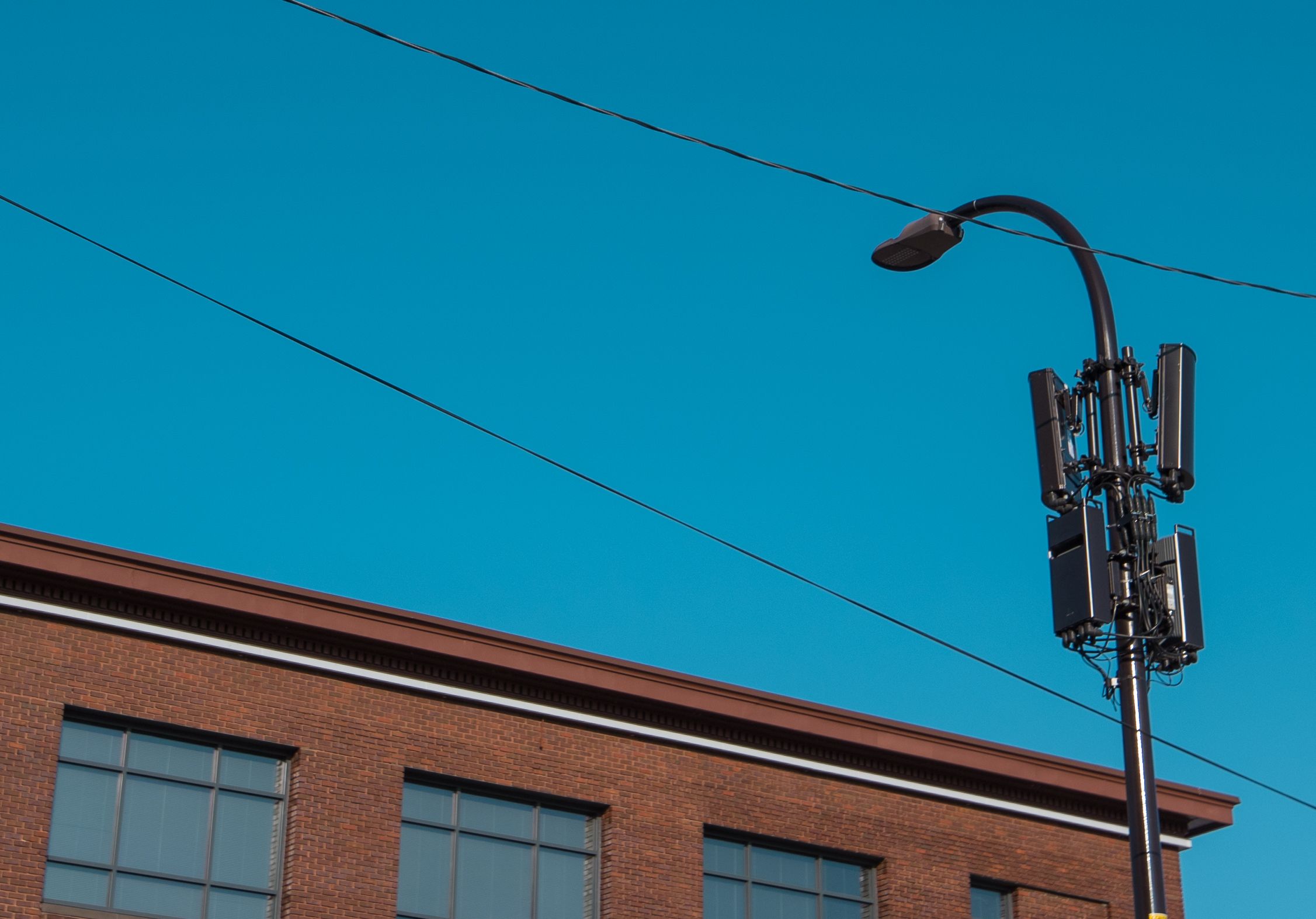
Carrier edge filtering varies just as sharply. Some tier-one mobile networks already scrub malformed binary SMS packets on port 2948 at their Short Message Service Center (SMSC) gateways before frames reach radio towers, stripping anomalous header lengths upstream regardless of what handset software a customer runs. Smaller MVNOs, cross-border roaming interconnects, and bulk enterprise SMS aggregators vary widely, however, and an attacker operating a portable software-defined radio (SDR) fake base station within physical cellular range bypasses upstream carrier scrubbing altogether to deliver those 8 bytes straight into WapPushOverSms. That uneven network perimeter explains why device-level patching inside frameworks/opt/telephony remains the only reliable guarantee across carriers and countries.
Enterprise Scanners, Dual-SIM Phones, and the LineageOS Lifeline
Enterprise fleet managers running older rugged barcode scanners, delivery tablets with active LTE SIMs, or point-of-sale payment terminals locked on Android 12 or Android 13 face a particular operational headache. Specialized commercial board support packages (BSPs) routinely trail consumer security patches by a year or more and cannot easily swap to alternative operating systems without breaking mobile device management (MDM) or payment-card certifications. Where those terminals operate inside warehouses or retail stores with reliable wireless coverage, pulling physical cellular SIMs and running strictly over WPA3 Enterprise Wi-Fi eliminates the cellular signaling attack surface until the hardware vendor ships a patched firmware image.
Owners who rely on dual-SIM smartphones with an international travel eSIM or secondary data line should also bear in mind that both active SIM slots feed incoming binary PDUs into the same com.android.phone process. Even if a primary domestic carrier filters malformed port-2948 traffic at its SMSC gateway, a secondary roaming eSIM registered to a less restrictive partner network can still deliver the crash payload to an unpatched handset.
For older consumer phones permanently abandoned on Android 12 or Android 13 without vendor backports, community ROMs such as actively maintained LineageOS branches that merge upstream November 2026 AOSP security tags close the decodeWapPdu parser bug on models with unlockable bootloaders. Carrier-locked consumer handsets past vendor end-of-life have no such escape hatch.
How to Check Your Security Patch Level and Protect Older Devices
Checking where a phone sits takes less than two minutes under Settings > About phone (or Software information on Samsung Galaxy models). Look specifically for the "Android security update" or "Security patch level" date rather than the marketing UI version number:
- Patch level dated November 1, 2026 or newer: The bounds check inside decodeWapPdu is active and malformed WAP Push headers are discarded safely without crashing com.android.phone.
- Android 14, 15, 16, or 17 on an October 2026 or older patch: Connect to Wi-Fi, open Settings > System > Software update (or Security & privacy > Updates), and install all pending monthly security rollups immediately.
- End-of-life Android 12 or Android 13 devices: If your phone no longer receives monthly patches and you store unbacked-up photos or two-factor authenticators locally, enable automatic cloud or local backups now and turn on USB Debugging under Developer Options from a trusted home PC so queued SMS frames can be cleared via ADB if a crash loop ever strikes.
When people keep a capable mid-range device for four or five years because cameras, batteries, and OLED screens hold up comfortably, carrier-facing telephony parsers become silent liabilities long after retail warranties expire. Until all Android manufacturers treat five-year minimum AOSP security maintenance as baseline infrastructure across entry-level lines rather than a flagship perk, a single integer wraparound in two-decade-old SMS code will keep exposing millions of working handsets years after they leave the box.
Comments (0)
No comments yet. Be the first to share your thoughts.